2)How is the equilibrium exchange rate determined? Provide an example of the import effects on the...
2)How is the equilibrium exchange rate determined? Provide an
example of the import effects on
the demand for Canadian dollars. (Detail Answer)
Homework Answers
There are two techniques to determine the foreign exchange rate. One technique falls under the old-style highest quality level instrument and another strategy falls under the traditional paper cash framework. Today, the highest quality level system doesn't work since no standard financial unit is presently traded for gold.
All nations presently have paper monetary standards not convertible to gold. Under the inconvertible paper money framework, there are two techniques for swapping scale assurance. Presently, the conversion scale between the Canadian dollar and any outside money is dictated by the powers of market interest, that is, similar to the estimation of some other straightforwardly exchanged great or administration.
Factors that impact the estimation of the Canadian dollar are:
Loan fees: Relatively higher financing costs in Canada increment remote speculators' interest for Canadian dollar-named protections. Be that as it may, the pace of return of outside speculators is subject to the normal future presentation of the Canadian dollar. On the off chance that remote financial specialists foresee a decrease in the estimation of the Canadian dollar, they request a higher loan cost on Canadian dollar protections.
Interest rates: The estimation of the Canadian dollar is connected to the quality of world ware costs. Items speak to a bigger portion of fares in Canada contrasted with the United States and numerous different nations. At the point when item costs rise, Canada's terms of exchange improve in light of the fact that its products have gotten generally increasingly important. Since Canada's compelling acquiring power is higher, this development is typically reflected in a higher conversion scale. The inverse additionally holds: more fragile product costs can convert into a flimsier Canadian dollar.
Expansion rates: Inflation is the rate at which general value levels ascend after some time. On the off chance that swelling in Canada were to surpass remote expansion rates, this would lessen the buying intensity of the Canadian dollar comparative with outside monetary standards. That decrease would be reflected in a relative decrease in the estimation of the Canadian dollar. The inverse is likewise valid. Supported, moderately low expansion in Canada affects the swapping scale.
Global exchange of products and ventures: When a nation has an exchange excess, trades surpass imports, putting upward pressure on the conversion standard (the interest for the cash surpasses the stockpile). At the point when a nation has an exchange shortfall, imports surpass sends out, putting descending weight on the conversion standard (the stock for the money surpasses the interest).
Remote speculation and obligation installments: Inflows of outside interest in Canada increment the remote interest for Canadian dollars, pushing the conversion standard up. Direct speculation made by Canadians abroad has the contrary impact. Obligation installments made to outsiders push the conversion scale down.
Profitability: A nation's efficiency – the measure of yield that can be delivered with a given degree of sources of info – can be a factor in the assurance of the conversion scale through its impact on relative costs and worldwide aggressiveness. For instance, if efficiency in Canada were to become quicker than in the United States, the costs of Canadian products would turn out to be progressively aggressive and, after some time, Canadian yield and fares would expand, prompting more noteworthy interest for Canadian dollars.
Add Answer to:
2)How is the equilibrium exchange rate determined? Provide an
example of the import effects on
the...
Questions 3. Exchange Rate Effects on Investing. Explain how the appreciation of the Australian dollar against...
 Questions 3. Exchange Rate Effects on Investing. Explain how the appreciation of the Australian dollar against the U.S. dollar would affect the return to a U.S. firm that invested in an Australian money market security 4. Exchange Rate Effects on Borrowing. Explain how the appreciation of the Japanese yen against the U.S. dollar would affect the return to a U.S. firm that borrowed Japanese yen and used the proceeds for a U.S. project. 6. Bid/ask Spread. Utah Bank's s bid...
Exchange rate (U.S. cents per Canadian dollar) 120 Draw a demand for dollars curve. Label it...
 Exchange rate (U.S. cents per Canadian dollar) 120 Draw a demand for dollars curve. Label it D. Draw a supply of dollars curve. Label it S. Draw a point at the equilibrium quantity and equilibrium exchange rate. Draw an arrow between the D and S curves that indicates a price at which there is a surplus of dollars. Label it. O O O 1104 When there is a surplus of dollars in the foreign exchange market, _ 1007 O A....
Consider the market for Canadian dollars. If the exchange rate rises from 2 Mexican pesos per...
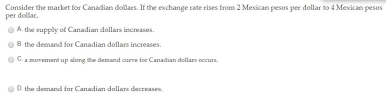 Consider the market for Canadian dollars. If the exchange rate rises from 2 Mexican pesos per dollar to 4 Mexican pesos per dollar, A. the supply of Canadian dollars increases. B. the demand for Canadian dollars increases. OC.a movement up along the demand curve for Canadian dollars occurs. OD. the demand for Canadian dollars decreases.
Question 2 (a) Explain the difference between nominal exchange rate and real exchange rate (6) As mentioned in clas...
 Question 2 (a) Explain the difference between nominal exchange rate and real exchange rate (6) As mentioned in class, the Big Mac Index is a numerical tool for assessing disparities in consumer purchasing power between countries. Suppose that the Big Mac costs 7.50 Canadian dollars in Canada and 5.50 US dollars in the US. Suppose that the nominal exchange rate is 1.2 Canadian dollars to 1 US dollar. (i) Calculate the real exchange rate. (ii) Is the Canadian dollar undervalued...
The exchange rate for a foreign currency that is determined by supply and demand is Group...
The exchange rate for a foreign currency that is determined by supply and demand is Group of answer choices a constrained exchange rate. a floating exchange rate. a fixed exchange rate. a controlled exchange rate.
Explain using a diagram the partial equilibrium effects of an import quota when the consumer's income...
 Explain using a diagram the partial equilibrium effects of an import quota when the consumer's income decreases. Also, analyse (using a separate diagram) the partial equilibrium effects of an import quota if the technology rate increases.
Figure 13-2 Real Interest Rate Supply of Loarable Funds World interest rate, o Derrand for Loanable...
 Figure 13-2 Real Interest Rate Supply of Loarable Funds World interest rate, o Derrand for Loanable Funds Quantity of Loanable Funds Real Exchange Rate Supply of Canadian Dollars (5-1) Quantity of Dollars Refer to the Figure 13-2. If the interest rate was initially at ro and an import quota was imposed, what would happen to the real interest rate? It would decrease because demand would shift left. It would decrease because supply would shift right. It would not change because...
Suppose the dollar-yen foreign exchange rate changes from 140 yen per dollar to 130 yen per...
 Suppose the dollar-yen foreign exchange rate changes from 140 yen per dollar to 130 yen per dollar. Then the yen has A. the demand for Canadian dollars increases. B. the demand for Canadian dollars decreases. C. the supply of Canadian dollars increases. D. a movement up along the demand curve for Canadian dollars occurs.
40.) An exchange rate that is completely determined by the foreign exchange market through supply and...
40.) An exchange rate that is completely determined by the foreign exchange market through supply and demand is considered a: Managed exchange rate. Freely floating exchange rate. Arbitrage. Direct quote.
3-6 Class An exchange rate is a number that describes how much of one currency you can trade for ...
 please complete these problems
3-6 Class An exchange rate is a number that describes how much of one currency you can trade for another currency. For example, if the U.S. exchange rate for Canadian currency is 1.2, it means that you could trade one U.S. dollar for $1.20 Canadian. When travelers talk about how expensive or cheap a certain country is, it's often a reflection of the exchange rate. The Big Mac costs mentioned earlier? The average cost in the...
please complete these problems
3-6 Class An exchange rate is a number that describes how much of one currency you can trade for another currency. For example, if the U.S. exchange rate for Canadian currency is 1.2, it means that you could trade one U.S. dollar for $1.20 Canadian. When travelers talk about how expensive or cheap a certain country is, it's often a reflection of the exchange rate. The Big Mac costs mentioned earlier? The average cost in the...
 Questions 3. Exchange Rate Effects on Investing. Explain how the appreciation of the Australian dollar against the U.S. dollar would affect the return to a U.S. firm that invested in an Australian money market security 4. Exchange Rate Effects on Borrowing. Explain how the appreciation of the Japanese yen against the U.S. dollar would affect the return to a U.S. firm that borrowed Japanese yen and used the proceeds for a U.S. project. 6. Bid/ask Spread. Utah Bank's s bid...
 Exchange rate (U.S. cents per Canadian dollar) 120 Draw a demand for dollars curve. Label it D. Draw a supply of dollars curve. Label it S. Draw a point at the equilibrium quantity and equilibrium exchange rate. Draw an arrow between the D and S curves that indicates a price at which there is a surplus of dollars. Label it. O O O 1104 When there is a surplus of dollars in the foreign exchange market, _ 1007 O A....
 Consider the market for Canadian dollars. If the exchange rate rises from 2 Mexican pesos per dollar to 4 Mexican pesos per dollar, A. the supply of Canadian dollars increases. B. the demand for Canadian dollars increases. OC.a movement up along the demand curve for Canadian dollars occurs. OD. the demand for Canadian dollars decreases.
 Question 2 (a) Explain the difference between nominal exchange rate and real exchange rate (6) As mentioned in class, the Big Mac Index is a numerical tool for assessing disparities in consumer purchasing power between countries. Suppose that the Big Mac costs 7.50 Canadian dollars in Canada and 5.50 US dollars in the US. Suppose that the nominal exchange rate is 1.2 Canadian dollars to 1 US dollar. (i) Calculate the real exchange rate. (ii) Is the Canadian dollar undervalued...
 Explain using a diagram the partial equilibrium effects of an import quota when the consumer's income decreases. Also, analyse (using a separate diagram) the partial equilibrium effects of an import quota if the technology rate increases.
 Figure 13-2 Real Interest Rate Supply of Loarable Funds World interest rate, o Derrand for Loanable Funds Quantity of Loanable Funds Real Exchange Rate Supply of Canadian Dollars (5-1) Quantity of Dollars Refer to the Figure 13-2. If the interest rate was initially at ro and an import quota was imposed, what would happen to the real interest rate? It would decrease because demand would shift left. It would decrease because supply would shift right. It would not change because...
 Suppose the dollar-yen foreign exchange rate changes from 140 yen per dollar to 130 yen per dollar. Then the yen has A. the demand for Canadian dollars increases. B. the demand for Canadian dollars decreases. C. the supply of Canadian dollars increases. D. a movement up along the demand curve for Canadian dollars occurs.
 please complete these problems
3-6 Class An exchange rate is a number that describes how much of one currency you can trade for another currency. For example, if the U.S. exchange rate for Canadian currency is 1.2, it means that you could trade one U.S. dollar for $1.20 Canadian. When travelers talk about how expensive or cheap a certain country is, it's often a reflection of the exchange rate. The Big Mac costs mentioned earlier? The average cost in the...
please complete these problems
3-6 Class An exchange rate is a number that describes how much of one currency you can trade for another currency. For example, if the U.S. exchange rate for Canadian currency is 1.2, it means that you could trade one U.S. dollar for $1.20 Canadian. When travelers talk about how expensive or cheap a certain country is, it's often a reflection of the exchange rate. The Big Mac costs mentioned earlier? The average cost in the...
Most questions answered within 3 hours.
-
Where is the error in this code sequence?
String s1 = "Hello";
String s2 = "ello";...
asked 10 months ago -
Financial data for Joel de Paris, Inc., for last year
follow:
Joel de Paris, Inc.
Balance...
asked 10 months ago -
Consider this reaction:
Al2(SO4)3 (aq)+ BaCl3
(aq) Al2Cl6 (aq)- +
3BaSO4(s) . What is the...
asked 10 months ago -
Suppose that Savneet is considering increasing her
recent random sample from 20 car rentals to 40...
asked 10 months ago -
Trucks arrive at an unloading terminal at an average rate of 120
per hour.
Trucks arrive...
asked 10 months ago -
Why are methanol and ethanol completely soluble in water while
octanol is not very little soluble....
asked 10 months ago -
A facilities manager at a university reads in a research report
that the mean amount of...
asked 10 months ago -
When the CuSO4 is rehydrated by adding water to the anhydrous
compound, is this an endothermic...
asked 10 months ago -
A ray of sunlight is passing from diamond into crown glass; the
angle of incidence is...
asked 10 months ago -
A block of mass 0.249 kg is placed on top of a light, vertical
spring of...
asked 10 months ago -
how do the kidneys compensate in the presences of acidosis
a) trigger hyperventilate
b) reserve acid...
asked 10 months ago -
Question 501 pts
The rental rate of capital to the firm increases. Which of the
following...
asked 10 months ago