you are catching a ball falling vertically toward you, the normal force acting on your shoes...
you are catching a ball falling vertically toward you, the normal force acting on your shoes as you are catching the ball would:
a. decrease
b.increase
c. stay the same
d. none of the above
Homework Answers
When the ball is falling vertically downwards
when we catch the ball , the momentum of ball is changing
the ball is applying downwards force on the person
hence , Normal force = weight + force due to ball
the Normal force will increase
b) Increase
Add Answer to:
you are catching a ball falling vertically toward you, the
normal force acting on your shoes...
you are standing on the ground and you throw a ball vertically upward, the normal force...
you are standing on the ground and you throw a ball vertically upward, the normal force acting on your shoes from the ground as you are throwing the ball upward would ? a. decrease b. increase c. stay the same d. none of the above
In an attempt to save someone in a vertically falling car Spider-Man spins a web catching...
In an attempt to save someone in a vertically falling car Spider-Man spins a web catching the 2000 kg car. The webbing has a spring constant of 22,000 N/m and the car is caught at t = 0 at a distance 0.500 m above equilibrium while it is still falling at a speed of -10.0 m/s. After this, the car goes into vertical SHM. Find: a) the angular frequency b) the period of oscillations c) the amplitude d) the phase...
After you pick up a spare, your bowling ball rolls without slipping back toward the ball...
 After you pick up a spare, your bowling ball rolls without slipping back toward the ball rack with a linear speed of V; = 2.62 m/s. To reach the rack, the ball rolls up a ramp that rises through a vertical distance of h = 0.47 m. Part A What is the linear speed of the ball when it reaches the top of the ramp? Express your answer using two significant figures. EVGI AED ? 1' = IT'S Submit Request...
An awkward shaped ball with mass of m = 0.125 kg is freely falling vertically from...
An awkward shaped ball with mass of m = 0.125 kg is freely falling vertically from the top of a tower. The drag force on the ball is given by the relationship FD= bv2 + cv + d where b = 7 kg/m, c = 25 kg/s, d = 0.5 kgm/s2, and v is the velocity of the ball. Using this information determine the terminal velocity of the ball.
The drag force F acting on a spherical particle of diameter D falling slowly through a...
 The drag force F acting on a spherical particle of diameter D falling slowly through a viscous fluid at velocity u is found to be influenced by the diameter D, velocity of fall u, and the viscosity . Using the method of dimensional analysis obtain a relationship between the variables. Number of variables is a. (5) Ob. (6) c. (7) d. None of the above Number of the dimensions is e. (3) f. (4) g. (5) Number of the groups...
Technically as you drive around the world your normal force will have to be less than...
Technically as you drive around the world your normal force will have to be less than your force of gravity so that you will have a net force pointed toward the center of the earth. The radius of the earth is about 6.3x10⁶m. a) If you are only driving at freeway speed (v = 29 m/s) in a 800 kg car what would the difference between your normal force and force of gravity be? b) How fast would you have to...
Q2. What is the direction of the normal reaction force on the block and how does...
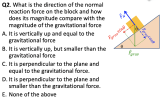 Q2. What is the direction of the normal reaction force on the block and how does its magnitude compare with the magnitude of the gravitational force A. It is vertically up and equal to the B. It is vertically up, but smaller than the C. It is perpendicular to the plane and D. It is perpendicular to the plane and E. None of the above eo gravitational force gravitational force equal to the gravitational force smaller than the gravitational force...
Express your answer with appropriate units You drop a 98g hall vertically onto a force sensor...
 Express your answer with appropriate units You drop a 98g hall vertically onto a force sensor that is 0.40 ta below the bail's inial position The bail bounces off the lonce sensor ahee the collision (Figure 1) shows the time dependence of the lorce exerted by the boll on the force F-- | Value Figure Previous Answers Request Anr Х Incorrect; Try Again; 4 attempts remaining Part B Indcate any assumptions that you mad We assume that the momentum of...
You throw a ball vertically upward with an initial speed of 5 m/s from your dorm...
 You throw a ball vertically upward with an initial speed
of 5 m/s from your dorm window...
QUESTION 6 5 p You throw a ball vertically upward with an initial speed of 5 m/s from your dorm window. If the window is 10 m above the ground, find the time the ball is in flight. Give your answer with three significant figures and do not write the units. 5 p. QUESTION 7 Continuing with exercise 6, calculate the speed of...
You throw a ball vertically upward with an initial speed
of 5 m/s from your dorm window...
QUESTION 6 5 p You throw a ball vertically upward with an initial speed of 5 m/s from your dorm window. If the window is 10 m above the ground, find the time the ball is in flight. Give your answer with three significant figures and do not write the units. 5 p. QUESTION 7 Continuing with exercise 6, calculate the speed of...
You throw a ball vertically upward, and as it leaves your hand, its speed is 16.0...
You throw a ball vertically upward, and as it leaves your hand, its speed is 16.0 m/s. (a) How high (in m) does it rise above the level where it leaves your hand? ? m (b) How long (in s) does it take to reach its highest point? ? s (c) How long (in s) does the ball take to return to the level where it left your hand after it reaches its highest point? ? s (d) Assume that...
 After you pick up a spare, your bowling ball rolls without slipping back toward the ball rack with a linear speed of V; = 2.62 m/s. To reach the rack, the ball rolls up a ramp that rises through a vertical distance of h = 0.47 m. Part A What is the linear speed of the ball when it reaches the top of the ramp? Express your answer using two significant figures. EVGI AED ? 1' = IT'S Submit Request...
 The drag force F acting on a spherical particle of diameter D falling slowly through a viscous fluid at velocity u is found to be influenced by the diameter D, velocity of fall u, and the viscosity . Using the method of dimensional analysis obtain a relationship between the variables. Number of variables is a. (5) Ob. (6) c. (7) d. None of the above Number of the dimensions is e. (3) f. (4) g. (5) Number of the groups...
 Q2. What is the direction of the normal reaction force on the block and how does its magnitude compare with the magnitude of the gravitational force A. It is vertically up and equal to the B. It is vertically up, but smaller than the C. It is perpendicular to the plane and D. It is perpendicular to the plane and E. None of the above eo gravitational force gravitational force equal to the gravitational force smaller than the gravitational force...
 Express your answer with appropriate units You drop a 98g hall vertically onto a force sensor that is 0.40 ta below the bail's inial position The bail bounces off the lonce sensor ahee the collision (Figure 1) shows the time dependence of the lorce exerted by the boll on the force F-- | Value Figure Previous Answers Request Anr Х Incorrect; Try Again; 4 attempts remaining Part B Indcate any assumptions that you mad We assume that the momentum of...
 You throw a ball vertically upward with an initial speed
of 5 m/s from your dorm window...
QUESTION 6 5 p You throw a ball vertically upward with an initial speed of 5 m/s from your dorm window. If the window is 10 m above the ground, find the time the ball is in flight. Give your answer with three significant figures and do not write the units. 5 p. QUESTION 7 Continuing with exercise 6, calculate the speed of...
You throw a ball vertically upward with an initial speed
of 5 m/s from your dorm window...
QUESTION 6 5 p You throw a ball vertically upward with an initial speed of 5 m/s from your dorm window. If the window is 10 m above the ground, find the time the ball is in flight. Give your answer with three significant figures and do not write the units. 5 p. QUESTION 7 Continuing with exercise 6, calculate the speed of...
Most questions answered within 3 hours.
-
Where is the error in this code sequence?
String s1 = "Hello";
String s2 = "ello";...
asked 10 months ago -
Financial data for Joel de Paris, Inc., for last year
follow:
Joel de Paris, Inc.
Balance...
asked 10 months ago -
Consider this reaction:
Al2(SO4)3 (aq)+ BaCl3
(aq) Al2Cl6 (aq)- +
3BaSO4(s) . What is the...
asked 10 months ago -
Suppose that Savneet is considering increasing her
recent random sample from 20 car rentals to 40...
asked 10 months ago -
Trucks arrive at an unloading terminal at an average rate of 120
per hour.
Trucks arrive...
asked 10 months ago -
Why are methanol and ethanol completely soluble in water while
octanol is not very little soluble....
asked 10 months ago -
A facilities manager at a university reads in a research report
that the mean amount of...
asked 10 months ago -
When the CuSO4 is rehydrated by adding water to the anhydrous
compound, is this an endothermic...
asked 10 months ago -
A ray of sunlight is passing from diamond into crown glass; the
angle of incidence is...
asked 10 months ago -
A block of mass 0.249 kg is placed on top of a light, vertical
spring of...
asked 10 months ago -
how do the kidneys compensate in the presences of acidosis
a) trigger hyperventilate
b) reserve acid...
asked 10 months ago -
Question 501 pts
The rental rate of capital to the firm increases. Which of the
following...
asked 10 months ago