When can the M1V1=M2V2 equation be used? To dilute a solution AND in a titration when...
When can the M1V1=M2V2 equation be used?
|
To dilute a solution AND in a titration when there is the same ratio between H+ and OH- |
|
|
To dilute a solution AND in a titration when there is stoichiometric ratio between H+ and OH- |
|
|
To dilute a solution AND in a titration when there is a 1:1 ratio between acid and base |
|
|
To dilute a solution AND in a titration when there is the same ratio between acid and base |
Homework Answers
We can use the M1V1=M2V2 equation be used to dilute a solution and intitration when their is stoichiometric ratio between H+ and OH-.
STOICHIOMETRY is the study of relationship between the relative quantites of substance taking part in reaction
It provide the base for a procedure called titration which is used to determine the concentration of acidic and basic solutions.
Add Answer to:
When can the M1V1=M2V2 equation be used?
To dilute a solution AND in a titration when...
To calculate the concentration of a solution using acid–base titration data. In an acid–base titration, an...
To calculate the concentration of a solution using acid–base titration data. In an acid–base titration, an acid (or base) of known concentration is added to a base (or acid) of unknown concentration until the number of moles of H+ and OH- are equal, a condition called the equivalence point. Since you know the number of moles of H+ (or OH- ) that you added, you can determine the number of moles of OH- (or H+) in the unknown solution. For...
To calculate the concentration of a solution using acid–base titration data. In an acid–base titration, an...
To calculate the concentration of a solution using acid–base titration data. In an acid–base titration, an acid (or base) of known concentration is added to a base (or acid) of unknown concentration until the number of moles of H+ and OH- are equal, a condition called the equivalence point. Since you know the number of moles of H+ (or OH- ) that you added, you can determine the number of moles of OH- (or H+) in the unknown solution. For...
A spent 1.0 percent caustic soda solution (PNaOH = 8.42 lb/gal) with a volumetric flow rate...
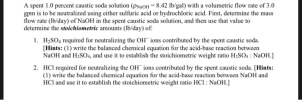 A spent 1.0 percent caustic soda solution (PNaOH = 8.42 lb/gal) with a volumetric flow rate of 3.0 gpm is to be neutralized using either sulfuric acid or hydrochloric acid. First, determine the mass flow rate (lb/day) of NaOH in the spent caustic soda solution, and then use that value to determine the stoichiometric amounts (lb/day) of: 1. H2SO4 required for neutralizing the OH ions contributed by the spent caustic soda. [Hints: (1) write the balanced chemical equation for the...
Problem Statement A spent 1.0 percent caustic soda solution (PNaOH = 8.42 lb/gal) with a volumetric...
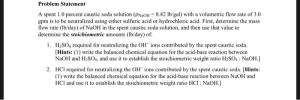 Problem Statement A spent 1.0 percent caustic soda solution (PNaOH = 8.42 lb/gal) with a volumetric flow rate of 3.0 gpm is to be neutralized using either sulfuric acid or hydrochloric acid. First, determine the mass flow rate (Ib/day) of NaOH in the spent caustic soda solution, and then use that value to determine the stoichiometric amounts (Ib/day) of: 1. H2SO4 required for neutralizing the OH ions contributed by the spent caustic soda. [Hints: (1) write the balanced chemical equation...
Titration: Acids and Bases 2. How can you determine which acid is diprotic? 3. using the...
 Titration: Acids and Bases
2. How can you determine which acid is diprotic?
3. using the answers to questions one and two, which acid is
diprotic?
4. Which base has more hydroxide ions per molecule?
Acid Volume Base Base Initial Volume (mL) Base Final Volume (mL) Volume of Base Used (mL) Acid: Base Ratio Acid 1 20 mL Base 1 50 mL 34.5 15.5 4:3 Acid 2 20 mL Base 1 Acid 1 20 mL Base 2 Acid 2 20...
Titration: Acids and Bases
2. How can you determine which acid is diprotic?
3. using the answers to questions one and two, which acid is
diprotic?
4. Which base has more hydroxide ions per molecule?
Acid Volume Base Base Initial Volume (mL) Base Final Volume (mL) Volume of Base Used (mL) Acid: Base Ratio Acid 1 20 mL Base 1 50 mL 34.5 15.5 4:3 Acid 2 20 mL Base 1 Acid 1 20 mL Base 2 Acid 2 20...
please answer Titration Homework 1. Copper reacts with dilute nitric acid according to the equation 3...
 please answer
Titration Homework 1. Copper reacts with dilute nitric acid according to the equation 3 Cu(s) + 8 HNO, (aq) + 3 Cu(NO3)2 (aq) + 2NO(g) + 4H20 (1) If a copper penny weighs 3.020g is dissolved in a small amount of nitric acid and the resulting solution is diluted to 50.0 mL with water, what is the molarity of the Cu(NO3)?
please answer
Titration Homework 1. Copper reacts with dilute nitric acid according to the equation 3 Cu(s) + 8 HNO, (aq) + 3 Cu(NO3)2 (aq) + 2NO(g) + 4H20 (1) If a copper penny weighs 3.020g is dissolved in a small amount of nitric acid and the resulting solution is diluted to 50.0 mL with water, what is the molarity of the Cu(NO3)?
Which of the following is (or are) true for the titration of aqueous citric acid, H...
Which of the following is (or are) true for the titration of aqueous citric acid, H 3C 6H 5O 7, with aqueous sodium hydroxide, NaOH? (Remember the citric acid contains three acidic hydrogens.) A The products of this reaction are H 6O 3 and Na 3C 6H 5O 7. B The stoichiometric ratio of NaOH to H 3C 6H 5O 7 in the balanced equation is 1:3. C The stoichiometric ratio of NaOH to H 3C 6H 5O 7 in...
Titration of a Weak Base Prelaboratory Questions 1. Will addition of HCl to a solution make...
 Titration of a Weak Base Prelaboratory Questions 1. Will addition of HCl to a solution make it more acidic or more basic? Will the pH increase or decrease? How does an end point differ from an equivalence point? 2. were titrated with a standard HCl solution: 3. Aliquots of an unknown tris sample Use the balanced equation to set up the string calculation showing how the tris a. mol of acid, L of acid. mo of base, and L of...
To construct a calibration curve we would need to take our stock solution and dilute it...
To construct a calibration curve we would need to take our stock solution and dilute it to different concentrations. We would then test those different concentration in our spectrophotometer to test their absorbance. If we diluted our samples as follows, calculate the resulting concentrations. (HINT: this is dilution which means we can use M1V1=M2V2, where M1 is our original 150 mM concentration, V1 is the volume of the original concentration that we added water to dilute, M2 is the concentration...
3.What happens to the pH of your buffer solution when you dilute it with DI water?...
 3.What happens to the pH of your buffer solution when you dilute it with DI water? Why? How does this compare to the dilutions of the solution containing just acid or base? 7.Explain and justify when and why it is NOT appropriate to use the Henderson-Hasselbalch equation to calculate the pH of a solution. You should address both (1) what kinds of components should/should not be present, and (2) their relative concentrations.
 A spent 1.0 percent caustic soda solution (PNaOH = 8.42 lb/gal) with a volumetric flow rate of 3.0 gpm is to be neutralized using either sulfuric acid or hydrochloric acid. First, determine the mass flow rate (lb/day) of NaOH in the spent caustic soda solution, and then use that value to determine the stoichiometric amounts (lb/day) of: 1. H2SO4 required for neutralizing the OH ions contributed by the spent caustic soda. [Hints: (1) write the balanced chemical equation for the...
 Problem Statement A spent 1.0 percent caustic soda solution (PNaOH = 8.42 lb/gal) with a volumetric flow rate of 3.0 gpm is to be neutralized using either sulfuric acid or hydrochloric acid. First, determine the mass flow rate (Ib/day) of NaOH in the spent caustic soda solution, and then use that value to determine the stoichiometric amounts (Ib/day) of: 1. H2SO4 required for neutralizing the OH ions contributed by the spent caustic soda. [Hints: (1) write the balanced chemical equation...
 Titration: Acids and Bases
2. How can you determine which acid is diprotic?
3. using the answers to questions one and two, which acid is
diprotic?
4. Which base has more hydroxide ions per molecule?
Acid Volume Base Base Initial Volume (mL) Base Final Volume (mL) Volume of Base Used (mL) Acid: Base Ratio Acid 1 20 mL Base 1 50 mL 34.5 15.5 4:3 Acid 2 20 mL Base 1 Acid 1 20 mL Base 2 Acid 2 20...
Titration: Acids and Bases
2. How can you determine which acid is diprotic?
3. using the answers to questions one and two, which acid is
diprotic?
4. Which base has more hydroxide ions per molecule?
Acid Volume Base Base Initial Volume (mL) Base Final Volume (mL) Volume of Base Used (mL) Acid: Base Ratio Acid 1 20 mL Base 1 50 mL 34.5 15.5 4:3 Acid 2 20 mL Base 1 Acid 1 20 mL Base 2 Acid 2 20...
 please answer
Titration Homework 1. Copper reacts with dilute nitric acid according to the equation 3 Cu(s) + 8 HNO, (aq) + 3 Cu(NO3)2 (aq) + 2NO(g) + 4H20 (1) If a copper penny weighs 3.020g is dissolved in a small amount of nitric acid and the resulting solution is diluted to 50.0 mL with water, what is the molarity of the Cu(NO3)?
please answer
Titration Homework 1. Copper reacts with dilute nitric acid according to the equation 3 Cu(s) + 8 HNO, (aq) + 3 Cu(NO3)2 (aq) + 2NO(g) + 4H20 (1) If a copper penny weighs 3.020g is dissolved in a small amount of nitric acid and the resulting solution is diluted to 50.0 mL with water, what is the molarity of the Cu(NO3)?
 Titration of a Weak Base Prelaboratory Questions 1. Will addition of HCl to a solution make it more acidic or more basic? Will the pH increase or decrease? How does an end point differ from an equivalence point? 2. were titrated with a standard HCl solution: 3. Aliquots of an unknown tris sample Use the balanced equation to set up the string calculation showing how the tris a. mol of acid, L of acid. mo of base, and L of...
 3.What happens to the pH of your buffer solution when you dilute it with DI water? Why? How does this compare to the dilutions of the solution containing just acid or base? 7.Explain and justify when and why it is NOT appropriate to use the Henderson-Hasselbalch equation to calculate the pH of a solution. You should address both (1) what kinds of components should/should not be present, and (2) their relative concentrations.
Most questions answered within 3 hours.
-
Where is the error in this code sequence?
String s1 = "Hello";
String s2 = "ello";...
asked 10 months ago -
Financial data for Joel de Paris, Inc., for last year
follow:
Joel de Paris, Inc.
Balance...
asked 10 months ago -
Consider this reaction:
Al2(SO4)3 (aq)+ BaCl3
(aq) Al2Cl6 (aq)- +
3BaSO4(s) . What is the...
asked 10 months ago -
Suppose that Savneet is considering increasing her
recent random sample from 20 car rentals to 40...
asked 10 months ago -
Trucks arrive at an unloading terminal at an average rate of 120
per hour.
Trucks arrive...
asked 10 months ago -
Why are methanol and ethanol completely soluble in water while
octanol is not very little soluble....
asked 10 months ago -
A facilities manager at a university reads in a research report
that the mean amount of...
asked 10 months ago -
When the CuSO4 is rehydrated by adding water to the anhydrous
compound, is this an endothermic...
asked 10 months ago -
A ray of sunlight is passing from diamond into crown glass; the
angle of incidence is...
asked 10 months ago -
A block of mass 0.249 kg is placed on top of a light, vertical
spring of...
asked 10 months ago -
how do the kidneys compensate in the presences of acidosis
a) trigger hyperventilate
b) reserve acid...
asked 10 months ago -
Question 501 pts
The rental rate of capital to the firm increases. Which of the
following...
asked 10 months ago