Draw a mechanism showing what happened to your product during the addition of HCl to a...
Homework Answers
Answer:
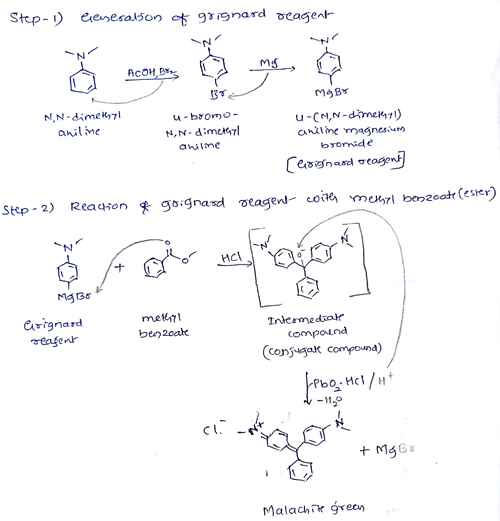
By giving sentence it is conclude that there will be reaction occurs to formation of chloride salt known as highly conjugated dye by using Grignard reagent
Explaination:
Grignard reactions are involved in preparation of conjugate dyes.
two mole of Grignard reagent reacts with methyl benzoate in presence of HCl to form a product called chloride salt known as highly conjugated dye i.e malachite green.
Reaction shown for below: which elaborate the mechanism step for synthesis of conjugated dye i.e malachite green as follows:
Add Answer to:
Draw a mechanism showing what happened to your product during the
addition of HCl to a...
Write balanced reaction equations separately for each of the four steps of your reaction (just give...
Write balanced reaction equations separately for each of the four steps of your reaction (just give the balanced overall equation, not mechanisms). Include all counterions and side products as well as the major reactants and products. a. formation of the n-butyl bromide Grignard reagent b. Magnesium-halogen exchange reaction to make the 4-bromo-N,N-dimethylaniline into a Grignard reagent c. reaction of the Grignard reagent with methyl benzoate. Do not include the addition of HCl step yet. d. reaction of the product in...
2. Predict the product and draw the mechanism for the Grignard reaction shown in the video....
 2. Predict the product and draw the mechanism for the Grignard reaction shown in the video. Show all electron pairs that participate in the reaction, electron flow arrows, and intermediates. Write a paragraph describing what is happening during the mechanism. MgBr Ph H 2.NH.Cl(aq) 3. Why must this reaction be done in two steps? (In other words, what would happen in you mixed the carbonyl. Grignard reagent, and the aqueous ammonium chloride all together?) 4. In this reaction NHCI was...
draw a mechanism for methyl 3 benzoate 2. For the nitration of methyl benzoate: Which product...
 draw a mechanism for methyl 3 benzoate
2. For the nitration of methyl benzoate: Which product did you get? What evidence doyou have for this? Wasyourproduct pure? Whatevidence do you have for this? Explain your a. b. evidence. c. Draw the mechanism for the product you got. d. Calculate percent yield. Show your work
draw a mechanism for methyl 3 benzoate
2. For the nitration of methyl benzoate: Which product did you get? What evidence doyou have for this? Wasyourproduct pure? Whatevidence do you have for this? Explain your a. b. evidence. c. Draw the mechanism for the product you got. d. Calculate percent yield. Show your work
What is the reaction drawn out for the synthesis of malachite green and crystal violet using...
What is the reaction drawn out for the synthesis of malachite green and crystal violet using methyl benzoate for malachite green and diethyl carbonate? grignard reagent was 4-bromo-n-n-dimethyl aniline magnesium bromide, also please show reaction of forming this reagent using 4-bromo-n-n-dimethylaniline, anhydrous tetrohydrofuran and magnesium turnings.
3/4 d) Draw the structure of the MINOR product below. No mechanism needed here. (2 pts)...
 3/4 d) Draw the structure of the MINOR product below. No mechanism needed here. (2 pts) 7) Draw the mechanism of the elimination reaction below (6 pts) EN (1 pt) b) What is the name of the specific mechanism of the reaction? c) What is being eliminated in the reaction? (2 pts) 8) A molecule in the conformation shown below undergoes the same type of elimination reaction as the previous problem. Draw the product of the reaction in full line...
For the HCl-alkene addition reaction shown below
 a) For the HCl-alkene addition reaction shown below, draw the complete curved arrow mechanism to the major product shown below. b) For the HCl-alkene addition reaction, draw the reaction coordinate diagram with all intermediates and transition states. Label AA for each reaction step and AH for the overall addition. Next to the structures on your diagram, give approximate pK, values that are consistent with an endothermic first reaction step.
f. From your knowledge of the radical addition mechanism, what product would you expect from the...
 f. From your knowledge of the radical addition mechanism, what product would you expect from the treatment of 1,3-butadiene with HBr in peroxide containing ether. Support your answer by showing the mechanism for the reaction and the role played by the peroxide. (6 pts)
What would happen if you added the HCl to the Grignard reagent before adding benzophenone? Draw...
What would happen if you added the HCl to the Grignard reagent before adding benzophenone? Draw a reaction mechanism to support your answer.
We have to draw a mechanism for a grignard synthesis done in lab. I don’t know...
We have to draw a mechanism for a grignard synthesis done in lab. I don’t know how to do it because of the amount of stuff we used. We used magnesium, ether, bromobenzene, methyl benzoate, and sulfuric acid. When it’s not written out as a reaction i get confused on mechanisms and nee help
Draw the Claisen reaction for the following mixture showing the mechanism and the expected product.
 Draw the Claisen reaction for the following mixture showing the mechanism and the expected product.
 2. Predict the product and draw the mechanism for the Grignard reaction shown in the video. Show all electron pairs that participate in the reaction, electron flow arrows, and intermediates. Write a paragraph describing what is happening during the mechanism. MgBr Ph H 2.NH.Cl(aq) 3. Why must this reaction be done in two steps? (In other words, what would happen in you mixed the carbonyl. Grignard reagent, and the aqueous ammonium chloride all together?) 4. In this reaction NHCI was...
 draw a mechanism for methyl 3 benzoate
2. For the nitration of methyl benzoate: Which product did you get? What evidence doyou have for this? Wasyourproduct pure? Whatevidence do you have for this? Explain your a. b. evidence. c. Draw the mechanism for the product you got. d. Calculate percent yield. Show your work
draw a mechanism for methyl 3 benzoate
2. For the nitration of methyl benzoate: Which product did you get? What evidence doyou have for this? Wasyourproduct pure? Whatevidence do you have for this? Explain your a. b. evidence. c. Draw the mechanism for the product you got. d. Calculate percent yield. Show your work
 3/4 d) Draw the structure of the MINOR product below. No mechanism needed here. (2 pts) 7) Draw the mechanism of the elimination reaction below (6 pts) EN (1 pt) b) What is the name of the specific mechanism of the reaction? c) What is being eliminated in the reaction? (2 pts) 8) A molecule in the conformation shown below undergoes the same type of elimination reaction as the previous problem. Draw the product of the reaction in full line...
 f. From your knowledge of the radical addition mechanism, what product would you expect from the treatment of 1,3-butadiene with HBr in peroxide containing ether. Support your answer by showing the mechanism for the reaction and the role played by the peroxide. (6 pts)
 Draw the Claisen reaction for the following mixture showing the mechanism and the expected product.
Most questions answered within 3 hours.
-
Where is the error in this code sequence?
String s1 = "Hello";
String s2 = "ello";...
asked 11 months ago -
Financial data for Joel de Paris, Inc., for last year
follow:
Joel de Paris, Inc.
Balance...
asked 11 months ago -
Consider this reaction:
Al2(SO4)3 (aq)+ BaCl3
(aq) Al2Cl6 (aq)- +
3BaSO4(s) . What is the...
asked 11 months ago -
Suppose that Savneet is considering increasing her
recent random sample from 20 car rentals to 40...
asked 11 months ago -
Trucks arrive at an unloading terminal at an average rate of 120
per hour.
Trucks arrive...
asked 11 months ago -
Why are methanol and ethanol completely soluble in water while
octanol is not very little soluble....
asked 11 months ago -
A facilities manager at a university reads in a research report
that the mean amount of...
asked 11 months ago -
When the CuSO4 is rehydrated by adding water to the anhydrous
compound, is this an endothermic...
asked 11 months ago -
A ray of sunlight is passing from diamond into crown glass; the
angle of incidence is...
asked 11 months ago -
A block of mass 0.249 kg is placed on top of a light, vertical
spring of...
asked 11 months ago -
how do the kidneys compensate in the presences of acidosis
a) trigger hyperventilate
b) reserve acid...
asked 11 months ago -
Question 501 pts
The rental rate of capital to the firm increases. Which of the
following...
asked 11 months ago