Purchasing power is the a. amount of goods or services that can be purchased with a...
Purchasing power is the a. amount of goods or services that can be purchased with a unit of money. b. ease with which an asset can be exchanged for money. c. sum of an individual’s money, real assets, and financial assets. d. exchange of goods or services without using money
Homework Answers
Solution :
Purchasing power is the a. amount of goods or services that can be purchased with a unit of money.
It is the power to buy goods or services with a given amount of currency.
Thus the solution is Option a. amount of goods or services that can be purchased with a unit of money.
The following options are incorrect as
b. ease with which an asset can be exchanged for money
Liquidity stands for the ease with which an asset can be exchanged for money
c. sum of an individual’s money, real assets, and financial assets.
The sum of an individual’s money, real assets, and financial assets is known as an individual's Networth
d. exchange of goods or services without using money
Exchange of goods or services without using money is known as Barter
Add Answer to:
Purchasing power is the a. amount of goods or services that can
be purchased with a...
1) The price of one currency in terms of another is called A)...
 1) The price of one currency in terms of another is called A) the exchange rate. B) purchasing power parity. C) the terms of trade. D) a currency band. 2) The three policies which cannot be maintained simultaneously by a nation (sometimes referred to as the "trilemma") do NOT include A) independent control of the money supply. B) independent control of fiscal policy. C) free flow of capital. D) fixed exchange rates 3) The foreign exchange rate refers to A) the rate of change in...
02A. Another term for the purchasing power of money is: a.) the exchange value of money....
02A. Another term for the purchasing power of money is: a.) the exchange value of money. b.) the price of money. c.) the commodity price of money. d.) the asset price of money. 02B.The Quantity Theory of Money applies: a.) regression analysis to the study of money. b.) input–output analysis to the study of money. c.) demand and supply analysis to the study of the economic good money. d.) probability theory to the study of money. 02C.The two ways to...
28. In-1 (%) PPP Line . Increased Purchasing Power of Foreign Goods % in the Foreign...
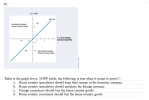 28. In-1 (%) PPP Line . Increased Purchasing Power of Foreign Goods % in the Foreign Currency's Spot Rate .D Decreased Purchasing Power of Foreign Goods Refer to the graph above. If PPP holds, the following is true when it comes to point C: a. Home country speculators should keep their money in the domestic currency. b. Home country speculators should purchase the foreign currency. c. Foreign consumers should buy the home country goods. d. Home country consumers should buy...
02A. Another term for the purchasing power of money is: a.) the exchange value...
02A. Another term for the purchasing power of money is: a.) the exchange value of money. b.) the price of money. c.) the commodity price of money. d.) the asset price of money. 02B. The Quantity Theory of Money applies: regression analysis to the study of money. input–output analysis to the study of money. demand and supply analysis to the study of the economic good money. probability theory to the study of money. 02C. The...
3. Suppose a given basket of goods and services costs 15 dollars in Canada and 14,250...
 3. Suppose a given basket of goods and services costs 15 dollars in Canada and 14,250 won in Korea. If the exchange rate is 900 won per dollar, purchasing power party implies that: A) the exchange rate has attained its long run equilibrium value. B) the dollar must appreciate to restore purchasing power parity, C) the dollar must depreciate to restore purchasing power party. D) the won must appreciate to restore purchasing power parity.
33. Suppose a given basket of goods and services costs 6 dollars in Canada and 4,500...
 33. Suppose a given basket of goods and services costs 6 dollars in Canada and 4,500 won in Korea. If the exchange rate is 900 won per dollar, purchasing power parity implies that: A) the exchange rate has attained its long run equilibrium value. B) the dollar must appreciate to restore purchasing power parity. C) the dollar must depreciate to restore purchasing power parity. D) the won must depreciate to restore purchasing power parity.
1. The money-multiplier process is based on the principle of fractional reserve banking. T/F 2. Contraction...
1. The money-multiplier process is based on the principle of fractional reserve banking. T/F 2. Contraction of the money supply can aggravate a recession. T/F 3. Fiat money has value because it A.) is backed by gold B.) can be divided into smaller units C.) can be exchanged for precious metals at fixed price D.) can be used to buy goods and services E.) All of above 4.) One conceptual problem in assigning assets to M1, M2, and so on,...
A transfer payment is a sum of money a. spent by government for new goods and...
A transfer payment is a sum of money a. spent by government for new goods and services. b. shifted between members of a household. c. required to pay taxes. d. moved between companies for goods and services. e. given by government without a good or service in exchange.
If Purchasing power parity (PPP) holds, a. the real exchange rate increases b. the real exchange...
If Purchasing power parity (PPP) holds, a. the real exchange rate increases b. the real exchange rate decreases c. the real exchange rate does not change d. prices in the foreign country will increase
Economists use the term “money” to refer to a. all wealth. b. all assets, including real assets and...
Economists use the term “money” to refer to a. all wealth. b. all assets, including real assets and financial assets. c. all financial assets, but not real assets. d. those types of wealth that are regularly accepted by sellers in exchange for goods and services
 1) The price of one currency in terms of another is called A) the exchange rate. B) purchasing power parity. C) the terms of trade. D) a currency band. 2) The three policies which cannot be maintained simultaneously by a nation (sometimes referred to as the "trilemma") do NOT include A) independent control of the money supply. B) independent control of fiscal policy. C) free flow of capital. D) fixed exchange rates 3) The foreign exchange rate refers to A) the rate of change in...
 28. In-1 (%) PPP Line . Increased Purchasing Power of Foreign Goods % in the Foreign Currency's Spot Rate .D Decreased Purchasing Power of Foreign Goods Refer to the graph above. If PPP holds, the following is true when it comes to point C: a. Home country speculators should keep their money in the domestic currency. b. Home country speculators should purchase the foreign currency. c. Foreign consumers should buy the home country goods. d. Home country consumers should buy...
 3. Suppose a given basket of goods and services costs 15 dollars in Canada and 14,250 won in Korea. If the exchange rate is 900 won per dollar, purchasing power party implies that: A) the exchange rate has attained its long run equilibrium value. B) the dollar must appreciate to restore purchasing power parity, C) the dollar must depreciate to restore purchasing power party. D) the won must appreciate to restore purchasing power parity.
 33. Suppose a given basket of goods and services costs 6 dollars in Canada and 4,500 won in Korea. If the exchange rate is 900 won per dollar, purchasing power parity implies that: A) the exchange rate has attained its long run equilibrium value. B) the dollar must appreciate to restore purchasing power parity. C) the dollar must depreciate to restore purchasing power parity. D) the won must depreciate to restore purchasing power parity.
Most questions answered within 3 hours.
-
Where is the error in this code sequence?
String s1 = "Hello";
String s2 = "ello";...
asked 11 months ago -
Financial data for Joel de Paris, Inc., for last year
follow:
Joel de Paris, Inc.
Balance...
asked 11 months ago -
Consider this reaction:
Al2(SO4)3 (aq)+ BaCl3
(aq) Al2Cl6 (aq)- +
3BaSO4(s) . What is the...
asked 11 months ago -
Suppose that Savneet is considering increasing her
recent random sample from 20 car rentals to 40...
asked 11 months ago -
Trucks arrive at an unloading terminal at an average rate of 120
per hour.
Trucks arrive...
asked 11 months ago -
Why are methanol and ethanol completely soluble in water while
octanol is not very little soluble....
asked 11 months ago -
A facilities manager at a university reads in a research report
that the mean amount of...
asked 11 months ago -
When the CuSO4 is rehydrated by adding water to the anhydrous
compound, is this an endothermic...
asked 11 months ago -
A ray of sunlight is passing from diamond into crown glass; the
angle of incidence is...
asked 11 months ago -
A block of mass 0.249 kg is placed on top of a light, vertical
spring of...
asked 11 months ago -
how do the kidneys compensate in the presences of acidosis
a) trigger hyperventilate
b) reserve acid...
asked 11 months ago -
Question 501 pts
The rental rate of capital to the firm increases. Which of the
following...
asked 11 months ago