One positive charge and one negative charge, each of magnitude 4x10^-6 C, are located a distance...
One positive charge and one negative charge, each of magnitude 4x10^-6 C, are located a distance of 0.1 m from each other.
a) What’s the magnitude of force exerted on each charge?
b) On a drawing, indicate the direction of the forces acting on each charge.
c) Draw electric field lines between two charges.
Homework Answers

Add Answer to:
One positive charge and one negative charge, each of magnitude
4x10^-6 C, are located a distance...
11. A positive and a negative charge are separated by 2.3 m charge are separated by...
 11. A positive and a negative charge are separated by 2.3 m charge are separated by 2.3 m and exert an electrostatic force of 6 N on each other. If the same charges are placed 1.9 m apart, er. If the same charges are placed 1.9 m apart, what is the magnitude of force exerted on each other? ANS: 12. A system has equipotential surfaces as given below where the dashed lines are 1 m apart. What is the magnitude...
A set of charges sit in the (x, y) plane. Charge q1 is 1nC and located...
A set of charges sit in the (x, y) plane. Charge q1 is 1nC and located at (0, 0). Charge q2 is -2nC and located at (1m, 0). Charge q3 is 2nC and located at (0, 1m) (a) Find the x and y components of the force of q1 on q3. (b) Find the x and y components of the force of q2 on q3. (c) Find the net force (that means magnitude and direction) on q3. Drawing Electric Fields...
Problem 5 A positive point charge (with magnitude lail) is located at z and a negative...
 Problem 5 A positive point charge (with magnitude lail) is located at z and a negative point at z = , y , and a negative point charge (with magnitude lq2l > Ia) is located at zea, va (a) Find the magnitude and direction of the electric field at- ' y = (b) Find the magnitude and direction of the force on an electron (e-e)placed at z (c) Now assume that Iq1-4.0 μο, IJ21 5.0 pC and a 2.0 m....
6) A 5nC charge is placed at the origin of our coordinate system. There are three...
6) A 5nC charge is placed at the origin of our coordinate system. There are three other charges; 5C located 3m in the positive i direction, 2C located 2m in the negative i direction, and -4C located 5m in the positive j direction. What is the net force acting on the 5nC charge? Remember that force is a vector, so your answer must include magnitude and direction. Component form is acceptable. 7) There are two charges, one +2C, the other...
The top left diagram below shows a 1-C positive charge placed in a uniform external electric...
 The top left diagram below shows a 1-C positive charge placed in a uniform external electric field. The electric field in which the charge is placed is represented by field lines (drawn in red), and the resulting electric force on the charge is represented by the blue vector. Suppose the 1-C charge is removed, and is replaced, in turn, by each of the charges shown in the other three diagrams below. Assuming that the external electric field remains the same,...
The top left diagram below shows a 1-C positive charge placed in a uniform external electric...
 The top left diagram below shows a 1-C positive charge placed in
a uniform external electric field. The electric field in which the
charge is placed is represented by field lines (drawn in red), and
the resulting electric force on the charge is represented by the
blue vector. Suppose the 1-C charge is removed, and is replaced, in
turn, by each of the charges shown in the other three diagrams
below. Assuming that the external electric field remains the same,...
The top left diagram below shows a 1-C positive charge placed in
a uniform external electric field. The electric field in which the
charge is placed is represented by field lines (drawn in red), and
the resulting electric force on the charge is represented by the
blue vector. Suppose the 1-C charge is removed, and is replaced, in
turn, by each of the charges shown in the other three diagrams
below. Assuming that the external electric field remains the same,...
Kindly answer the following L. Draw and label the individual forces acting on each charge due...
 Kindly answer the following
L. Draw and label the individual forces acting on each charge due to the other two charges. 3: M. Sketch the direction of the electric field and electric force on (a) a positive test charge and (b) a negative test charge if the source is positive. N. Sketch the direction of the electric field and electric force on (a) a positive test charge and (b) a negative test charge if the source is negative. Whether or...
Kindly answer the following
L. Draw and label the individual forces acting on each charge due to the other two charges. 3: M. Sketch the direction of the electric field and electric force on (a) a positive test charge and (b) a negative test charge if the source is positive. N. Sketch the direction of the electric field and electric force on (a) a positive test charge and (b) a negative test charge if the source is negative. Whether or...
1. Write Coulomb's Law. What are the units for each variable in the formula? 2. Two...
 1. Write Coulomb's Law. What are the units for each variable in the formula? 2. Two objects with charges of +1.0 C and 1.0 C are separated by 1.0km. Find the magnitude of the force that either charge exerts on the other. 3. Two charges attract each other with a force of 16N. What will be the new force if the distance between them is reduced to 1/2 of its original value? 4. Draw the electric field lines around a...
praw and label the individual forces acting on each charge due to the other two charges...
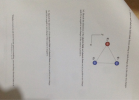 praw and label the individual forces acting on each charge due to the other two charges 41 42 93 M. Sketch the direction of the electric field and electric force on (a) a positive test charge and (b) a negative test charge if the source is positive. N. Sketch the direction of the electric field and electric force on (a) a positive test charge and (b) a negative test charge if the source is negative. become better at it"
Two charges (a negative one and a positive one) are 18 cm apart from each other....
Two charges (a negative one and a positive one) are 18 cm apart from each other. If there is a 36.7 N force on the negative charge then a) What is the magnitude of the force on the positive charge? b) What is the charge on the positive particle? c) If the positive particle were removed what would be the magnitude of the Electric field at the spot where the positive particle used to be?
 11. A positive and a negative charge are separated by 2.3 m charge are separated by 2.3 m and exert an electrostatic force of 6 N on each other. If the same charges are placed 1.9 m apart, er. If the same charges are placed 1.9 m apart, what is the magnitude of force exerted on each other? ANS: 12. A system has equipotential surfaces as given below where the dashed lines are 1 m apart. What is the magnitude...
 Problem 5 A positive point charge (with magnitude lail) is located at z and a negative point at z = , y , and a negative point charge (with magnitude lq2l > Ia) is located at zea, va (a) Find the magnitude and direction of the electric field at- ' y = (b) Find the magnitude and direction of the force on an electron (e-e)placed at z (c) Now assume that Iq1-4.0 μο, IJ21 5.0 pC and a 2.0 m....
 The top left diagram below shows a 1-C positive charge placed in a uniform external electric field. The electric field in which the charge is placed is represented by field lines (drawn in red), and the resulting electric force on the charge is represented by the blue vector. Suppose the 1-C charge is removed, and is replaced, in turn, by each of the charges shown in the other three diagrams below. Assuming that the external electric field remains the same,...
 The top left diagram below shows a 1-C positive charge placed in
a uniform external electric field. The electric field in which the
charge is placed is represented by field lines (drawn in red), and
the resulting electric force on the charge is represented by the
blue vector. Suppose the 1-C charge is removed, and is replaced, in
turn, by each of the charges shown in the other three diagrams
below. Assuming that the external electric field remains the same,...
The top left diagram below shows a 1-C positive charge placed in
a uniform external electric field. The electric field in which the
charge is placed is represented by field lines (drawn in red), and
the resulting electric force on the charge is represented by the
blue vector. Suppose the 1-C charge is removed, and is replaced, in
turn, by each of the charges shown in the other three diagrams
below. Assuming that the external electric field remains the same,...
 Kindly answer the following
L. Draw and label the individual forces acting on each charge due to the other two charges. 3: M. Sketch the direction of the electric field and electric force on (a) a positive test charge and (b) a negative test charge if the source is positive. N. Sketch the direction of the electric field and electric force on (a) a positive test charge and (b) a negative test charge if the source is negative. Whether or...
Kindly answer the following
L. Draw and label the individual forces acting on each charge due to the other two charges. 3: M. Sketch the direction of the electric field and electric force on (a) a positive test charge and (b) a negative test charge if the source is positive. N. Sketch the direction of the electric field and electric force on (a) a positive test charge and (b) a negative test charge if the source is negative. Whether or...
 1. Write Coulomb's Law. What are the units for each variable in the formula? 2. Two objects with charges of +1.0 C and 1.0 C are separated by 1.0km. Find the magnitude of the force that either charge exerts on the other. 3. Two charges attract each other with a force of 16N. What will be the new force if the distance between them is reduced to 1/2 of its original value? 4. Draw the electric field lines around a...
 praw and label the individual forces acting on each charge due to the other two charges 41 42 93 M. Sketch the direction of the electric field and electric force on (a) a positive test charge and (b) a negative test charge if the source is positive. N. Sketch the direction of the electric field and electric force on (a) a positive test charge and (b) a negative test charge if the source is negative. become better at it"
Most questions answered within 3 hours.
-
Where is the error in this code sequence?
String s1 = "Hello";
String s2 = "ello";...
asked 10 months ago -
Financial data for Joel de Paris, Inc., for last year
follow:
Joel de Paris, Inc.
Balance...
asked 10 months ago -
Consider this reaction:
Al2(SO4)3 (aq)+ BaCl3
(aq) Al2Cl6 (aq)- +
3BaSO4(s) . What is the...
asked 10 months ago -
Suppose that Savneet is considering increasing her
recent random sample from 20 car rentals to 40...
asked 10 months ago -
Trucks arrive at an unloading terminal at an average rate of 120
per hour.
Trucks arrive...
asked 10 months ago -
Why are methanol and ethanol completely soluble in water while
octanol is not very little soluble....
asked 10 months ago -
A facilities manager at a university reads in a research report
that the mean amount of...
asked 10 months ago -
When the CuSO4 is rehydrated by adding water to the anhydrous
compound, is this an endothermic...
asked 10 months ago -
A ray of sunlight is passing from diamond into crown glass; the
angle of incidence is...
asked 10 months ago -
A block of mass 0.249 kg is placed on top of a light, vertical
spring of...
asked 10 months ago -
how do the kidneys compensate in the presences of acidosis
a) trigger hyperventilate
b) reserve acid...
asked 10 months ago -
Question 501 pts
The rental rate of capital to the firm increases. Which of the
following...
asked 10 months ago