In the complex [Fe(CN)6]3- which of the following statements are true: Select one: a. all the...
In the complex [Fe(CN)6]3- which of the following statements are true:
Select one:
a. all the orbitals are degenerate
b. the dx2-y2 and dz2 orbitals are highest in energy
c. the dxy and dzy orbitals are lowest in energy
d. the dx2-y2 and dz2 orbitals are lowest in energy
In the octahedral complex [Cr(OH2)6]2+ which d-orbitals are higher in energy?
Select one:
a. dxy, dxz and dx2-y2
b. dz2 and dxy
c. dz2, dx2-y2 and dy2
d. dx2-y2 and dz2
Homework Answers
The complex [Fe(CN)6]3- is an octahedral complex.
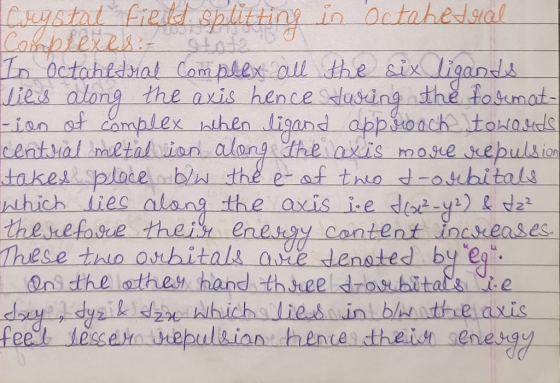
 eg set contains 2 orbitals
i.e. dx2-y2 and dz2 while the t2g set contains 3 orbitals i.e dxy ,
dyz and dzx.
eg set contains 2 orbitals
i.e. dx2-y2 and dz2 while the t2g set contains 3 orbitals i.e dxy ,
dyz and dzx.
Answer ,
1-- b. the dx2-y2 and dz2 orbitals are highest in energy.
2-- d. dx2-y2 and dz2
Add Answer to:
In the complex [Fe(CN)6]3- which of the
following statements are true:
Select one:
a. all the...
Docunient10 Q- Search in Document Mailings Review View Layout Share Comments Autos - ASUS = Home...
 Docunient10 Q- Search in Document Mailings Review View Layout Share Comments Autos - ASUS = Home insart Draw Design Layout Patarences Calibri (E... 14 X ar A R BTU. + xxA PÅ UT Table Design 2 1 O- Aalihli A Madbo ADR Aa Bbc BC.Od Nu Nu Style How Hit IN SM le Mand iwwi ala le tip. Mallcendie AWHI Curl 33 S Styles 1. What type of isomerism does the following 4. In the octahedral complex complex have [CoBr(NHa)s]SO4?...
3) The d orbital splitting pattern for octahedral complexes has three low energy orbitals described by...
 3) The d orbital splitting pattern for octahedral complexes has three low energy orbitals described by their symmetry as t2g and two high energy orbitals described as eg. The reason for the difference in energy is that the ligands point towards the eg point group while the t2g orbitals do not point towards the ligands. Please use the Cav point group of a square pyramidal complex to figure out the symmetry of the d orbitals and build a d orbital...
Which orbital diagram represents the electron configuration of high-spin octahedral complex [Cr(NH3)6]2+? Select the cor...
 Which orbital diagram represents the electron configuration of
high-spin octahedral complex [Cr(NH3)6]2+?
Select the correct
answer below:
d₂2 dx?_v2 sp p гр d₂2 dx² - y2 ep "p 2ър прес d₂2 dx² - y2 ep "p 2ър də də - у dxy dyz dyz
Which orbital diagram represents the electron configuration of
high-spin octahedral complex [Cr(NH3)6]2+?
Select the correct
answer below:
d₂2 dx?_v2 sp p гр d₂2 dx² - y2 ep "p 2ър прес d₂2 dx² - y2 ep "p 2ър də də - у dxy dyz dyz
Which one of the following octahedral complex ions is diamagnetic? Note: NH3 is a strong-field ligand....
Which one of the following octahedral complex ions is diamagnetic? Note: NH3 is a strong-field ligand. (a) [Fe(NH3)6] 3+ (b) [Fe(NH3)6] 2+ (c) [Cr(NH3)6] 3+ (d) [Cr(NH3)6] 2+ (e) [Co(NH3)6] 2+
in K [Pt(Cl)41 Select one: Oa K* represents the lewis acid Ob Pt2+ represents the lewis...
 in K [Pt(Cl)41 Select one: Oa K* represents the lewis acid Ob Pt2+ represents the lewis acid C. [Pt(C1))? represents the lewis acid od Cl represents the lewis acid Which one of the following coordination compounds has a transition metal ion with d (has 3 electrons in d orbitals) electronic configuration? Select one [Cr(NH3).13+ eb [Co(OH2)612+ [CoF1 @d [Fe(CN) Which of the following structures represents the conjugate acid of HPO 2 ? Select one: a H3PO4 o b. HPO4 PO,...
Which of the following ions CANNOT form both a high spin and low spin octahedral complex...
 Which of the following ions CANNOT form both a high spin and low spin octahedral complex ion? Select one or more: +2 a. Co +3 b. Cr +3 c. Mn +3 d. Fe
Question 1: Consider the complex ion [Mn(OH2)6] with 5 unpaired electrons. Which response includes all the...
 Question 1: Consider the complex ion [Mn(OH2)6] with 5 unpaired electrons. Which response includes all the following statements that are true, and no false statements? I. It is diamagnetic. II. It is a low spin complex III. The metal ion is a d ion IV. The ligands are weak field ligands V. It is octahedral (a) I, II (b) II, IV, V (c) I, IV (d) II, V (е) Ш, IV
A) , and in Co(NH3)4Cl 2]NO 3, the counter ion is In K 4[Fe(CN) 6], the...
 A) , and in Co(NH3)4Cl 2]NO 3, the counter ion is In K 4[Fe(CN) 6], the counter ion is akt:cr b.kt; NO3- C. CN ; cr d. CN ; NO3 e. Fe2+, CO3+ B) How many ions are formed when [CO(NH 3) 5CICI 2 dissolves in water? a. 5 d. 4 e. 2 C) What is the oxidation state of the nickel atom in the Ni(CN) 53 complex ion? a. +1 b.+3 C. +2 d. +4 e. +0 ОООО oooo...
How many d-electrons are there in the following species? Fe2+ 6 [Cr(OH)]2+ Please answer all parts...
 How many d-electrons are there in the following species? Fe2+ 6 [Cr(OH)]2+ Please answer all parts of the question. What's the oxidation state of the transition metal in the following compounds? (1) [Cr(NH3)6]2+ O+3 O+2 0+1 00 0-1 (ii) Na[CO(NH3)6C12] O+3 +2 +1 00 0-1 What is the coordination number (CN) and the geometry of the following metal complex? Naz[Mn(EDTA)] (EDTA = ethylenediaminetetraacetic acid) Select one: a. CN = 6 Geometry = octahedral O b. CN = 1 Geometry =...
Which of the following statements about effective nuclear charge and shielding is/are true? Select all the...
Which of the following statements about effective nuclear charge and shielding is/are true? Select all the correct answers however penalties will be applied for incorrect guesses. Select one or more: Higher effective nuclear charges typically give larger atomic radii Electrons in inner orbitals shield more effectively than electrons in outer orbitals Electrons in outer orbitals shield more effectively than electrons in inner orbitals Higher effective nuclear charges typically give smaller atomic radii The effective nuclear charges of the first row...
 Docunient10 Q- Search in Document Mailings Review View Layout Share Comments Autos - ASUS = Home insart Draw Design Layout Patarences Calibri (E... 14 X ar A R BTU. + xxA PÅ UT Table Design 2 1 O- Aalihli A Madbo ADR Aa Bbc BC.Od Nu Nu Style How Hit IN SM le Mand iwwi ala le tip. Mallcendie AWHI Curl 33 S Styles 1. What type of isomerism does the following 4. In the octahedral complex complex have [CoBr(NHa)s]SO4?...
 3) The d orbital splitting pattern for octahedral complexes has three low energy orbitals described by their symmetry as t2g and two high energy orbitals described as eg. The reason for the difference in energy is that the ligands point towards the eg point group while the t2g orbitals do not point towards the ligands. Please use the Cav point group of a square pyramidal complex to figure out the symmetry of the d orbitals and build a d orbital...
 Which orbital diagram represents the electron configuration of
high-spin octahedral complex [Cr(NH3)6]2+?
Select the correct
answer below:
d₂2 dx?_v2 sp p гр d₂2 dx² - y2 ep "p 2ър прес d₂2 dx² - y2 ep "p 2ър də də - у dxy dyz dyz
Which orbital diagram represents the electron configuration of
high-spin octahedral complex [Cr(NH3)6]2+?
Select the correct
answer below:
d₂2 dx?_v2 sp p гр d₂2 dx² - y2 ep "p 2ър прес d₂2 dx² - y2 ep "p 2ър də də - у dxy dyz dyz
 in K [Pt(Cl)41 Select one: Oa K* represents the lewis acid Ob Pt2+ represents the lewis acid C. [Pt(C1))? represents the lewis acid od Cl represents the lewis acid Which one of the following coordination compounds has a transition metal ion with d (has 3 electrons in d orbitals) electronic configuration? Select one [Cr(NH3).13+ eb [Co(OH2)612+ [CoF1 @d [Fe(CN) Which of the following structures represents the conjugate acid of HPO 2 ? Select one: a H3PO4 o b. HPO4 PO,...
 Which of the following ions CANNOT form both a high spin and low spin octahedral complex ion? Select one or more: +2 a. Co +3 b. Cr +3 c. Mn +3 d. Fe
 Question 1: Consider the complex ion [Mn(OH2)6] with 5 unpaired electrons. Which response includes all the following statements that are true, and no false statements? I. It is diamagnetic. II. It is a low spin complex III. The metal ion is a d ion IV. The ligands are weak field ligands V. It is octahedral (a) I, II (b) II, IV, V (c) I, IV (d) II, V (е) Ш, IV
 A) , and in Co(NH3)4Cl 2]NO 3, the counter ion is In K 4[Fe(CN) 6], the counter ion is akt:cr b.kt; NO3- C. CN ; cr d. CN ; NO3 e. Fe2+, CO3+ B) How many ions are formed when [CO(NH 3) 5CICI 2 dissolves in water? a. 5 d. 4 e. 2 C) What is the oxidation state of the nickel atom in the Ni(CN) 53 complex ion? a. +1 b.+3 C. +2 d. +4 e. +0 ОООО oooo...
 How many d-electrons are there in the following species? Fe2+ 6 [Cr(OH)]2+ Please answer all parts of the question. What's the oxidation state of the transition metal in the following compounds? (1) [Cr(NH3)6]2+ O+3 O+2 0+1 00 0-1 (ii) Na[CO(NH3)6C12] O+3 +2 +1 00 0-1 What is the coordination number (CN) and the geometry of the following metal complex? Naz[Mn(EDTA)] (EDTA = ethylenediaminetetraacetic acid) Select one: a. CN = 6 Geometry = octahedral O b. CN = 1 Geometry =...
Most questions answered within 3 hours.
-
Where is the error in this code sequence?
String s1 = "Hello";
String s2 = "ello";...
asked 11 months ago -
Financial data for Joel de Paris, Inc., for last year
follow:
Joel de Paris, Inc.
Balance...
asked 11 months ago -
Consider this reaction:
Al2(SO4)3 (aq)+ BaCl3
(aq) Al2Cl6 (aq)- +
3BaSO4(s) . What is the...
asked 11 months ago -
Suppose that Savneet is considering increasing her
recent random sample from 20 car rentals to 40...
asked 11 months ago -
Trucks arrive at an unloading terminal at an average rate of 120
per hour.
Trucks arrive...
asked 11 months ago -
Why are methanol and ethanol completely soluble in water while
octanol is not very little soluble....
asked 11 months ago -
A facilities manager at a university reads in a research report
that the mean amount of...
asked 11 months ago -
When the CuSO4 is rehydrated by adding water to the anhydrous
compound, is this an endothermic...
asked 11 months ago -
A ray of sunlight is passing from diamond into crown glass; the
angle of incidence is...
asked 11 months ago -
A block of mass 0.249 kg is placed on top of a light, vertical
spring of...
asked 11 months ago -
how do the kidneys compensate in the presences of acidosis
a) trigger hyperventilate
b) reserve acid...
asked 11 months ago -
Question 501 pts
The rental rate of capital to the firm increases. Which of the
following...
asked 11 months ago