Consider the radioactive decay of nucleus A into nucleus B, A −→ B. Let nA and...
Consider the radioactive decay of nucleus A into nucleus B, A −→ B. Let nA and nB denote the numbers of nuclei A and B at a given time. Let λ the the probability that an A nucleus will decay in unit time. In other words, λnA is the number decays per unit time. Assume that B is stable. i. Write down the differential equations for the rates of change of the numbers of each nuclei, i.e., express dnA/dt and dnB/dt. ii. Assume that at initial time we have nA(t = 0) = N and nB(t = 0) = 0. Solve the equations above to find nA(t) and nB(t).
Homework Answers

Add Answer to:
Consider the radioactive decay of nucleus A into nucleus B, A −→
B. Let nA and...
Related to Nuclear Engineering also Question (1) Consider the following radioactive decay chain of fission products,...
 Related to Nuclear Engineering also
Question (1) Consider the following radioactive decay chain of fission products, where nuclide D is stable. AO, BO, and Do are the constant fission rates of production (nuclides/s), and λΑ, AB and AC are the l decay constants. None of the fission products undergo any nuclear reactions other than the radioactive decay shown. (a) Write the set of differential equations describing the radioactive decay chain in terms of the above parameters, and the number of...
Related to Nuclear Engineering also
Question (1) Consider the following radioactive decay chain of fission products, where nuclide D is stable. AO, BO, and Do are the constant fission rates of production (nuclides/s), and λΑ, AB and AC are the l decay constants. None of the fission products undergo any nuclear reactions other than the radioactive decay shown. (a) Write the set of differential equations describing the radioactive decay chain in terms of the above parameters, and the number of...
Problem. The daughter nucleus formed in radioactive decay is often radioactive. In this case we have...
Problem. The daughter nucleus formed in radioactive decay is often radioactive. In this case we have a decay chain as shown below A → B → C That is, atoms of A decay into an atoms of B and atoms of B decay into atoms of C. Let A0 represent the number of parent nuclei at time t = 0, A the number of parent nuclei at time t, and λ1 be the decay constant of the parent. Suppose the...
Suppose a radioactive sample initially contains N0 unstable nuclei. These nuclei will decay into stable nuclei,...
Suppose a radioactive sample initially contains N0 unstable nuclei. These nuclei will decay into stable nuclei, and as they do, the number of unstable nuclei that remain, N(t), will decrease with time. Although there is no way for us to predict exactly when any one nucleus will decay, we can write down an expression for the total number of unstable nuclei that remain after a time t: N(t)=N0e−λt, where λ is known as the decay constant. Note that at t=0,...
Please do part A... doing all would be appreciated 7. (14 POINTS) CH. 41: RADIOACTIVE DECAY...
 Please do part A... doing all would be appreciated
7. (14 POINTS) CH. 41: RADIOACTIVE DECAY OF Ra: The 228 Ra nucleus undergoes alpha decay according to the reaction: 236 Ra +372 Rn + He . Take the masses to be 226.025 406 u for 226 Ra, 222.017 574 u for 222 Rn 4.002 603 u for He (a) (7 points) The half-life of the radioactive nucleus Ra is 1.6x10³ years. What is the decay constant k of Ra ?...
Please do part A... doing all would be appreciated
7. (14 POINTS) CH. 41: RADIOACTIVE DECAY OF Ra: The 228 Ra nucleus undergoes alpha decay according to the reaction: 236 Ra +372 Rn + He . Take the masses to be 226.025 406 u for 226 Ra, 222.017 574 u for 222 Rn 4.002 603 u for He (a) (7 points) The half-life of the radioactive nucleus Ra is 1.6x10³ years. What is the decay constant k of Ra ?...
**SOLVE THIS USING MATHLAB** NOTE: Set the radioactive decay constant 'k' equal to 0.000100128 DIFFERENTIAL EQUATIONS...
 **SOLVE THIS USING MATHLAB**
NOTE: Set the radioactive decay constant 'k' equal to
0.000100128
DIFFERENTIAL EQUATIONS 2. One of the applications of Differential Equations is Growth and Decay. Radioactive decay is an exponential process. If xo is the initial quantity of a radioactive substance at time t= 0, then the amount of that substance that will be present at any time t in the future is given by x(t) = Where 'k' is the radioactive decay constant. Create a script...
**SOLVE THIS USING MATHLAB**
NOTE: Set the radioactive decay constant 'k' equal to
0.000100128
DIFFERENTIAL EQUATIONS 2. One of the applications of Differential Equations is Growth and Decay. Radioactive decay is an exponential process. If xo is the initial quantity of a radioactive substance at time t= 0, then the amount of that substance that will be present at any time t in the future is given by x(t) = Where 'k' is the radioactive decay constant. Create a script...
Radioactive Decay - Half-life and Activity 1 Radioactive decay - Half-life Time 0 1000 21 31...
 Radioactive Decay - Half-life and Activity 1 Radioactive decay - Half-life Time 0 1000 21 31 750 N 1.000.000 500,000 250,000 125,000 62,500 31.250 15.625 7813 3.506 1.953 977 51 6 500 7 BI . 101 250 125 0 tie 21.234.41516171819, 1012 Time in multiples of A radioactive sample's half-life is 30.2 years. 1 year = 365 days, 1 day = 24 hours, 1 hour - 60 minutes, 1 minute = 60 seconds (a) Find its decay constant in year...
1. What are five types of radioactive decay studied in this unit? What is the "byproduct"...
1. What are five types of radioactive decay studied in this unit? What is the "byproduct" for each decay type (in addition to the daughter nucleus)? Alpha Radiation: Beta Radiation: Gamma Radiation: Positron Emission: Electron Capture: 2. Which of the following could we use to predict if a nucleus is stable? A. The number of protons = the number of neutrons if Z<=20 B. It has an even number of protons and neutrons. C. It has an odd number of...
1. (a) Consider the following series of chemical reactions A kdy B k2 c. respectively Letna(t),...
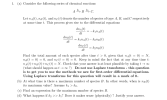 1. (a) Consider the following series of chemical reactions A kdy B k2 c. respectively Letna(t), no(t), and no(t) denote the number of species of type A, B, and at some time t. This process gives rise to the differential equations dna(t). 2 = -kina(t) dt 2 = kına(t) - kang(t) dt dnc(t) = kendt) dt Find the total amount of each species after time t > 0, given that nat = 0) = N, no(t = 0) = 0,...
As a radioactive specimen decays, its activity decreases exponentially as the number of radioacti...
 I only need help with part c). Thanks!
As a radioactive specimen decays, its activity decreases exponentially as the number of radioactive atoms diminishes. Some radioactive species have mean lives in the millions (or even billions) of years, so their exponential decay is not readily apparent. On the other hand, many species have mean lives of minutes or hours, for their exponential decay is easily observed. According to the exponential decay law, the number of radioactive atoms that remain after...
I only need help with part c). Thanks!
As a radioactive specimen decays, its activity decreases exponentially as the number of radioactive atoms diminishes. Some radioactive species have mean lives in the millions (or even billions) of years, so their exponential decay is not readily apparent. On the other hand, many species have mean lives of minutes or hours, for their exponential decay is easily observed. According to the exponential decay law, the number of radioactive atoms that remain after...
3. (a) Write down the exponential law of radioactive decay. How would you deduce the (20...
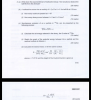 3. (a) Write down the exponential law of radioactive decay. How would you deduce the (20 marks) half-life from this formula? (b) A radioactive source has an activity of 1.5 u Ci att-0. Its half-life is 2.0 hour (i) How many nuclei are present at 0? (10 marks) (10 marks) (c) Spontaneous emission of an α particle in mRa can be presented by the (i) How many decays occur between t0 andt-2 hour? following process ) Calculate the net energy...
 Related to Nuclear Engineering also
Question (1) Consider the following radioactive decay chain of fission products, where nuclide D is stable. AO, BO, and Do are the constant fission rates of production (nuclides/s), and λΑ, AB and AC are the l decay constants. None of the fission products undergo any nuclear reactions other than the radioactive decay shown. (a) Write the set of differential equations describing the radioactive decay chain in terms of the above parameters, and the number of...
Related to Nuclear Engineering also
Question (1) Consider the following radioactive decay chain of fission products, where nuclide D is stable. AO, BO, and Do are the constant fission rates of production (nuclides/s), and λΑ, AB and AC are the l decay constants. None of the fission products undergo any nuclear reactions other than the radioactive decay shown. (a) Write the set of differential equations describing the radioactive decay chain in terms of the above parameters, and the number of...
 Please do part A... doing all would be appreciated
7. (14 POINTS) CH. 41: RADIOACTIVE DECAY OF Ra: The 228 Ra nucleus undergoes alpha decay according to the reaction: 236 Ra +372 Rn + He . Take the masses to be 226.025 406 u for 226 Ra, 222.017 574 u for 222 Rn 4.002 603 u for He (a) (7 points) The half-life of the radioactive nucleus Ra is 1.6x10³ years. What is the decay constant k of Ra ?...
Please do part A... doing all would be appreciated
7. (14 POINTS) CH. 41: RADIOACTIVE DECAY OF Ra: The 228 Ra nucleus undergoes alpha decay according to the reaction: 236 Ra +372 Rn + He . Take the masses to be 226.025 406 u for 226 Ra, 222.017 574 u for 222 Rn 4.002 603 u for He (a) (7 points) The half-life of the radioactive nucleus Ra is 1.6x10³ years. What is the decay constant k of Ra ?...
 **SOLVE THIS USING MATHLAB**
NOTE: Set the radioactive decay constant 'k' equal to
0.000100128
DIFFERENTIAL EQUATIONS 2. One of the applications of Differential Equations is Growth and Decay. Radioactive decay is an exponential process. If xo is the initial quantity of a radioactive substance at time t= 0, then the amount of that substance that will be present at any time t in the future is given by x(t) = Where 'k' is the radioactive decay constant. Create a script...
**SOLVE THIS USING MATHLAB**
NOTE: Set the radioactive decay constant 'k' equal to
0.000100128
DIFFERENTIAL EQUATIONS 2. One of the applications of Differential Equations is Growth and Decay. Radioactive decay is an exponential process. If xo is the initial quantity of a radioactive substance at time t= 0, then the amount of that substance that will be present at any time t in the future is given by x(t) = Where 'k' is the radioactive decay constant. Create a script...
 Radioactive Decay - Half-life and Activity 1 Radioactive decay - Half-life Time 0 1000 21 31 750 N 1.000.000 500,000 250,000 125,000 62,500 31.250 15.625 7813 3.506 1.953 977 51 6 500 7 BI . 101 250 125 0 tie 21.234.41516171819, 1012 Time in multiples of A radioactive sample's half-life is 30.2 years. 1 year = 365 days, 1 day = 24 hours, 1 hour - 60 minutes, 1 minute = 60 seconds (a) Find its decay constant in year...
 1. (a) Consider the following series of chemical reactions A kdy B k2 c. respectively Letna(t), no(t), and no(t) denote the number of species of type A, B, and at some time t. This process gives rise to the differential equations dna(t). 2 = -kina(t) dt 2 = kına(t) - kang(t) dt dnc(t) = kendt) dt Find the total amount of each species after time t > 0, given that nat = 0) = N, no(t = 0) = 0,...
 I only need help with part c). Thanks!
As a radioactive specimen decays, its activity decreases exponentially as the number of radioactive atoms diminishes. Some radioactive species have mean lives in the millions (or even billions) of years, so their exponential decay is not readily apparent. On the other hand, many species have mean lives of minutes or hours, for their exponential decay is easily observed. According to the exponential decay law, the number of radioactive atoms that remain after...
I only need help with part c). Thanks!
As a radioactive specimen decays, its activity decreases exponentially as the number of radioactive atoms diminishes. Some radioactive species have mean lives in the millions (or even billions) of years, so their exponential decay is not readily apparent. On the other hand, many species have mean lives of minutes or hours, for their exponential decay is easily observed. According to the exponential decay law, the number of radioactive atoms that remain after...
 3. (a) Write down the exponential law of radioactive decay. How would you deduce the (20 marks) half-life from this formula? (b) A radioactive source has an activity of 1.5 u Ci att-0. Its half-life is 2.0 hour (i) How many nuclei are present at 0? (10 marks) (10 marks) (c) Spontaneous emission of an α particle in mRa can be presented by the (i) How many decays occur between t0 andt-2 hour? following process ) Calculate the net energy...
Most questions answered within 3 hours.
-
Where is the error in this code sequence?
String s1 = "Hello";
String s2 = "ello";...
asked 11 months ago -
Financial data for Joel de Paris, Inc., for last year
follow:
Joel de Paris, Inc.
Balance...
asked 11 months ago -
Consider this reaction:
Al2(SO4)3 (aq)+ BaCl3
(aq) Al2Cl6 (aq)- +
3BaSO4(s) . What is the...
asked 11 months ago -
Suppose that Savneet is considering increasing her
recent random sample from 20 car rentals to 40...
asked 11 months ago -
Trucks arrive at an unloading terminal at an average rate of 120
per hour.
Trucks arrive...
asked 11 months ago -
Why are methanol and ethanol completely soluble in water while
octanol is not very little soluble....
asked 11 months ago -
A facilities manager at a university reads in a research report
that the mean amount of...
asked 11 months ago -
When the CuSO4 is rehydrated by adding water to the anhydrous
compound, is this an endothermic...
asked 11 months ago -
A ray of sunlight is passing from diamond into crown glass; the
angle of incidence is...
asked 11 months ago -
A block of mass 0.249 kg is placed on top of a light, vertical
spring of...
asked 11 months ago -
how do the kidneys compensate in the presences of acidosis
a) trigger hyperventilate
b) reserve acid...
asked 11 months ago -
Question 501 pts
The rental rate of capital to the firm increases. Which of the
following...
asked 11 months ago