Write a C++ Program: Larger than n In a program, write a function that accepts three...
Write a C++ Program: Larger than n
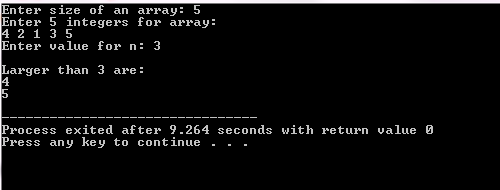
In a program, write a function that accepts three arguments: an array, the size of the array, and a number n. Assume the array contains integers. The function should display all of the numbers in the array that are greater than the number n.
Test your function: a user should enter the size of the array, all elements of the array, and a number n.
Homework Answers
#include<iostream>

using namespace std;

void largerThanN(int* arr, int size, int n){
   cout<<"\nLarger than "<<n<< " are:\n";
   for(int i = 0;i<size;i++){
      if(arr[i] > n)
         cout<<arr[i]<<endl;
   }
}

int main() {
   int n, size;

   cout<<"Enter size of an array: ";
   cin>>size;

   int* arr = new int[size];
   cout<<"Enter "<<size<<" integers for array:"<<endl;
   for(int i = 0;i<size;i++){
      cin>>arr[i];
   }

   cout<<"Enter value for n: ";
   cin>>n;

   largerThanN(arr, size, n);
   return 0;
}
Add Answer to:
Write a C++ Program: Larger than n
In a program, write a function that accepts three...
Write in C++ program Larger than n In a program, write a function that accepts three...
Write in C++ program Larger than n In a program, write a function that accepts three arguments: an array, the size of the array, and a number n. Assume the array contains integers. The function should display all of the numbers in the array that are greater than the number n. Input from the keyboard: The filename and path of a list of integer numbers. The number n to test the file numbers. Output to the console: The...
in a program, write a function that accepts three arguments: an array, the size of the...
in a program, write a function that accepts three arguments: an array, the size of the array, and a number n. Assume the array contains integers. The function should display all of the numbers in the array that are greater than the number n.
use C++ to write the following program. needs to ask the user for n The user...
 use C++ to write the following program.
needs to ask the user for n
The user must put in those 5 values, probably using a for
loop.
NOTE: You can assume the number of values to be entered is
5.
My attempted program below: (not correct, but just a basis)
4. Larger Than n In a program, write a function that accepts three arguments: an array, the size of the array, and a number n. Assume that the array contains...
use C++ to write the following program.
needs to ask the user for n
The user must put in those 5 values, probably using a for
loop.
NOTE: You can assume the number of values to be entered is
5.
My attempted program below: (not correct, but just a basis)
4. Larger Than n In a program, write a function that accepts three arguments: an array, the size of the array, and a number n. Assume that the array contains...
1. The following program calls the function countLarger that accepts three arguments: an integer array, an...
 1. The following program calls the function countLarger that accepts three arguments: an integer array, an integer size that indicates how many elements are in the array, and an integer n. The function countLarger should return the number of integers in the array that are greater than the value of the argument n. Update the program to include the definition of the function countLarger. #include <iostream> using namespace std; int countLarger(int[], int, int); // Function prototype int main() const int...
PYTHON CODE In a program, write a function that accepts two arguments: a list, and a...
 PYTHON CODE
In a program, write a function that accepts two arguments: a
list, and a number n. Assume that the list contains numbers. The
function should display all of the numbers in the list that are
greater than the number n. Output should look like:
Number: 5 List of numbers: [1, 2, 3, 4, 5, 6, 7, 8, 9, 10] List of numbers that are larger than 5: [6, 7, 8, 9, 10]
PYTHON CODE
In a program, write a function that accepts two arguments: a
list, and a number n. Assume that the list contains numbers. The
function should display all of the numbers in the list that are
greater than the number n. Output should look like:
Number: 5 List of numbers: [1, 2, 3, 4, 5, 6, 7, 8, 9, 10] List of numbers that are larger than 5: [6, 7, 8, 9, 10]
python In a program, write a function that accepts two arguments: a list, and a number...
 python
In a program, write a function that accepts two arguments: a list, and a number n. Assume that the list contains numbers. The function should display the number n, the list of numbers, and a sub list of all the numbers in the list that are greater than the number n. Initialize the list and the number n in the main function of your code and call your function, passing the list and number as arguments. Run your code...
python
In a program, write a function that accepts two arguments: a list, and a number n. Assume that the list contains numbers. The function should display the number n, the list of numbers, and a sub list of all the numbers in the list that are greater than the number n. Initialize the list and the number n in the main function of your code and call your function, passing the list and number as arguments. Run your code...
Phyton In a program, write a function that accepts two arguments: a list, and a number...
 Phyton
In a program, write a function that accepts two arguments: a list, and a number n. Assume that the list contains numbers. The function should display all of the numbers in the list that are smaller than the number n.
Phyton
In a program, write a function that accepts two arguments: a list, and a number n. Assume that the list contains numbers. The function should display all of the numbers in the list that are smaller than the number n.
PYTHON: Using Lists and Arrays! 5. In a program, write a function that accepts two arguments:...
PYTHON: Using Lists and Arrays! 5. In a program, write a function that accepts two arguments: a list, and a number n. The program should generate 20 random numbers, in the range of 1 through 100, and assign each number to the list. The program should also ask the user to pick a number from 1 through a 100 and assign that number to n. The function should display all of the number in the list that are greater than...
(C++) Write a function, remove, that takes three parameters: an array of integers, the number of...
(C++) Write a function, remove, that takes three parameters: an array of integers, the number of elements in the array, and an integer (say, removeItem). The function should find and delete the first occurrence of removeItem in the array. (Note that after deleting the element, the number of elements in the array is reduced by 1.) Assume that the array is unsorted. Also, write a program to test the function. Your program should prompt the user to enter 10 digits...
(C++) Write a function that accepts an int array and the array’s size as arguments. The function...
(C++)Write a function that accepts an int array and the array’s size as arguments.The function should create a new array that is twice the size of the argument array.The function should copy the contents of the argument array to the new array, and initialize the unused elements of the second array with 0.The function should return a pointer to the new array.Demonstrate the function by using it in a main program that reads an integer N (that is not more...
 use C++ to write the following program.
needs to ask the user for n
The user must put in those 5 values, probably using a for
loop.
NOTE: You can assume the number of values to be entered is
5.
My attempted program below: (not correct, but just a basis)
4. Larger Than n In a program, write a function that accepts three arguments: an array, the size of the array, and a number n. Assume that the array contains...
use C++ to write the following program.
needs to ask the user for n
The user must put in those 5 values, probably using a for
loop.
NOTE: You can assume the number of values to be entered is
5.
My attempted program below: (not correct, but just a basis)
4. Larger Than n In a program, write a function that accepts three arguments: an array, the size of the array, and a number n. Assume that the array contains...
 1. The following program calls the function countLarger that accepts three arguments: an integer array, an integer size that indicates how many elements are in the array, and an integer n. The function countLarger should return the number of integers in the array that are greater than the value of the argument n. Update the program to include the definition of the function countLarger. #include <iostream> using namespace std; int countLarger(int[], int, int); // Function prototype int main() const int...
 PYTHON CODE
In a program, write a function that accepts two arguments: a
list, and a number n. Assume that the list contains numbers. The
function should display all of the numbers in the list that are
greater than the number n. Output should look like:
Number: 5 List of numbers: [1, 2, 3, 4, 5, 6, 7, 8, 9, 10] List of numbers that are larger than 5: [6, 7, 8, 9, 10]
PYTHON CODE
In a program, write a function that accepts two arguments: a
list, and a number n. Assume that the list contains numbers. The
function should display all of the numbers in the list that are
greater than the number n. Output should look like:
Number: 5 List of numbers: [1, 2, 3, 4, 5, 6, 7, 8, 9, 10] List of numbers that are larger than 5: [6, 7, 8, 9, 10]
 python
In a program, write a function that accepts two arguments: a list, and a number n. Assume that the list contains numbers. The function should display the number n, the list of numbers, and a sub list of all the numbers in the list that are greater than the number n. Initialize the list and the number n in the main function of your code and call your function, passing the list and number as arguments. Run your code...
python
In a program, write a function that accepts two arguments: a list, and a number n. Assume that the list contains numbers. The function should display the number n, the list of numbers, and a sub list of all the numbers in the list that are greater than the number n. Initialize the list and the number n in the main function of your code and call your function, passing the list and number as arguments. Run your code...
 Phyton
In a program, write a function that accepts two arguments: a list, and a number n. Assume that the list contains numbers. The function should display all of the numbers in the list that are smaller than the number n.
Phyton
In a program, write a function that accepts two arguments: a list, and a number n. Assume that the list contains numbers. The function should display all of the numbers in the list that are smaller than the number n.
Most questions answered within 3 hours.
-
Where is the error in this code sequence?
String s1 = "Hello";
String s2 = "ello";...
asked 11 months ago -
Financial data for Joel de Paris, Inc., for last year
follow:
Joel de Paris, Inc.
Balance...
asked 11 months ago -
Consider this reaction:
Al2(SO4)3 (aq)+ BaCl3
(aq) Al2Cl6 (aq)- +
3BaSO4(s) . What is the...
asked 11 months ago -
Suppose that Savneet is considering increasing her
recent random sample from 20 car rentals to 40...
asked 11 months ago -
Trucks arrive at an unloading terminal at an average rate of 120
per hour.
Trucks arrive...
asked 11 months ago -
Why are methanol and ethanol completely soluble in water while
octanol is not very little soluble....
asked 11 months ago -
A facilities manager at a university reads in a research report
that the mean amount of...
asked 11 months ago -
When the CuSO4 is rehydrated by adding water to the anhydrous
compound, is this an endothermic...
asked 11 months ago -
A ray of sunlight is passing from diamond into crown glass; the
angle of incidence is...
asked 11 months ago -
A block of mass 0.249 kg is placed on top of a light, vertical
spring of...
asked 11 months ago -
how do the kidneys compensate in the presences of acidosis
a) trigger hyperventilate
b) reserve acid...
asked 11 months ago -
Question 501 pts
The rental rate of capital to the firm increases. Which of the
following...
asked 11 months ago