What is the 32-bit Hexadecimal equivalent of the IP address 223.1.3.27?
What is the 32-bit Hexadecimal equivalent of the IP address 223.1.3.27?
Homework Answers
32-bit IP addressing is the IP address scheme used in Internet Protocol 4.
To convert into hexadecimal equivalent, convert each section of 8 bits of data into hexadecimal and then join together, where every 2 characters (padded if required) will determine each section.
Process of conversion of decimal to hexadecimal - Repeatedly divide the number by 16 until it becomes zero and then take the remainder in opposite direction in a sequence.
Note - if remainder is greater than 9, map it to letters from a to f (a = 10, b = 11, ....)
For 223,
| Operation | Quotient | Remainder |
| 223 / 16 | 13 | 15 ( f ) |
| 13 / 16 | 0 | 13 ( d ) |
(223)10 = (df)16
For 1,
1 / 16 = 0, 1
(1)10 = (1)16
For 3,
3 / 16 = 0, 3
(3)10 = (3)16
For 27,
| Operation | Quotient | Remainder |
| 27 / 16 | 1 | 11 ( b ) |
| 1 / 16 | 0 | 1 |
(27)10 = (1b)16
Combining all the conversions -
Hex equivalent = df.1.3.1b
Removing dots and padding for 2 symbols each,
Hex equivalent = df01031b
Add Answer to:
What is the 32-bit Hexadecimal equivalent of the IP address
223.1.3.27?
Consider a 32-bit hexadecimal number stored in memory as follows: Address Value 100 2A 101 C2...
Consider a 32-bit hexadecimal number stored in memory as follows: Address Value 100 2A 101 C2 102 08 103 1B If the machine is big endian, what is the value stored at address 100-103 as an unsigned integer? If the machine is little endian, what is the value stored at address 100-103 as an unsigned integer?
An IP address is a 32-bit number that uniquely identifies a host (computer or other device,...
 An IP address is a 32-bit number that uniquely identifies a host (computer or other device, such as a printer or router) on a TCP/IP network. IP addresses are normally expressed in dotted-decimal format, with four numbers separated by periods, such as 192.168.123.132. To understand how subnet masks are used to distinguish be- tween hosts, networks, and subnetworks, examine an IP address in binary notation. For example, the dotted-decimal IP address 192.168.123.132 is (in binary notation) the 32 bit num-...
5. The IP address of the computer is 10.247.197.61 (Figure 9.15). Write this IP address as...
5. The IP address of the computer is 10.247.197.61 (Figure 9.15). Write this IP address as a 32-bit binary IP address. 6. What is the masked address of the host in binary notation? (This is the network ID + subnet ID part of the IP address.
Using C++ allow the user to enter the IP address as four 8 bit unsigned integer...
Using C++ allow the user to enter the IP address as four 8 bit unsigned integer values (just use 4 sequential CIN statements). The program should output the IP address as all 32 bits assigned into 2 variable sized groups (host group and network group) and outputted as 2 unsigned integer values from 1 bit to 31 bits each. Example functionality: Enter and IP address: 192 168 1 5 Which bit would you like to see: 21 Output should be...
What is the hexadecimal representation of the memory variable lacation at address 003FBA0CH in the Little...
What is the hexadecimal representation of the memory variable lacation at address 003FBA0CH in the Little Endian format from the 32-bit binary quantity represented by 10100111110111100101101100001100b?
What are two 32 bit hexadecimal numbers that can be subtracted to create an overflow?
What are two 32 bit hexadecimal numbers that can be subtracted to create an overflow?
Describe the form of data unit for the 5-layer TCP/IP model. Given the following IP source and destination addresses in Hexadecimal format: 3. P source address: 81 7E 7B 01 IP destination address: 81...
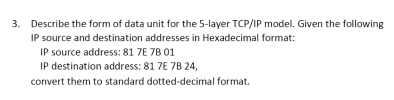 Describe the form of data unit for the 5-layer TCP/IP model. Given the following IP source and destination addresses in Hexadecimal format: 3. P source address: 81 7E 7B 01 IP destination address: 81 7E 7B 24, converi then to standard doited decimal format.
Describe the form of data unit for the 5-layer TCP/IP model. Given the following IP source and destination addresses in Hexadecimal format: 3. P source address: 81 7E 7B 01 IP destination address: 81 7E 7B...
Describe the form of data unit for the 5-layer TCP/IP model. Given the following IP source and destination addresses in Hexadecimal format: 3. P source address: 81 7E 7B 01 IP destination address: 81 7E 7B 24, converi then to standard doited decimal format.
Describe the form of data unit for the 5-layer TCP/IP model. Given the following IP source and destination addresses in Hexadecimal format: 3. P source address: 81 7E 7B 01 IP destination address: 81 7E 7B...
using the information given below . what is the ip address , subnet mask , default...
 using the information given below
. what is the ip address , subnet mask , default gateway?
** corrections
# of bits in subnet for A
:6
# of bits in submet for B:
3
PC-A
R1 G0/0
R GO/1
S1
PC-B ?
assign the IP ADDRESS information with given information
Given, IP address: 202.44.66.0/24 For Subnet A: It needs 2 valid hosts 2 valid hosts + 2 (network and broadcast) = 22 i.e., It needs 2 bit as host...
using the information given below
. what is the ip address , subnet mask , default gateway?
** corrections
# of bits in subnet for A
:6
# of bits in submet for B:
3
PC-A
R1 G0/0
R GO/1
S1
PC-B ?
assign the IP ADDRESS information with given information
Given, IP address: 202.44.66.0/24 For Subnet A: It needs 2 valid hosts 2 valid hosts + 2 (network and broadcast) = 22 i.e., It needs 2 bit as host...
For a direct-mapped cache with a 32-bit address and 32-bit words, the following address bits are...
For a direct-mapped cache with a 32-bit address and 32-bit words, the following address bits are used to access the cache. TAG INDEX OFFSET 31-15 14-8 7-0 a. What is the cache block size (in words)? [13 points] b. How many blocks does the cache have? [12 points]
Q2. (4 pts) A certain microprocessor (uP) has a 37-bit address bus and a 32-bit wide...
Q2. (4 pts) A certain microprocessor (uP) has a 37-bit address bus and a 32-bit wide data bus. Here, similar to Q1, we are using byte packing, that is, we should be able to access each byte in the memory. Assume that you are using a memory chips organized as 128K by 8 bits. Q2-1.Divide the 37-bit address lines into page number bits, offset bits and byte address bits. Q2-2.How many 128K by 8 memory devices would you need to...
 An IP address is a 32-bit number that uniquely identifies a host (computer or other device, such as a printer or router) on a TCP/IP network. IP addresses are normally expressed in dotted-decimal format, with four numbers separated by periods, such as 192.168.123.132. To understand how subnet masks are used to distinguish be- tween hosts, networks, and subnetworks, examine an IP address in binary notation. For example, the dotted-decimal IP address 192.168.123.132 is (in binary notation) the 32 bit num-...
 Describe the form of data unit for the 5-layer TCP/IP model. Given the following IP source and destination addresses in Hexadecimal format: 3. P source address: 81 7E 7B 01 IP destination address: 81 7E 7B 24, converi then to standard doited decimal format.
Describe the form of data unit for the 5-layer TCP/IP model. Given the following IP source and destination addresses in Hexadecimal format: 3. P source address: 81 7E 7B 01 IP destination address: 81 7E 7B...
Describe the form of data unit for the 5-layer TCP/IP model. Given the following IP source and destination addresses in Hexadecimal format: 3. P source address: 81 7E 7B 01 IP destination address: 81 7E 7B 24, converi then to standard doited decimal format.
Describe the form of data unit for the 5-layer TCP/IP model. Given the following IP source and destination addresses in Hexadecimal format: 3. P source address: 81 7E 7B 01 IP destination address: 81 7E 7B...
 using the information given below
. what is the ip address , subnet mask , default gateway?
** corrections
# of bits in subnet for A
:6
# of bits in submet for B:
3
PC-A
R1 G0/0
R GO/1
S1
PC-B ?
assign the IP ADDRESS information with given information
Given, IP address: 202.44.66.0/24 For Subnet A: It needs 2 valid hosts 2 valid hosts + 2 (network and broadcast) = 22 i.e., It needs 2 bit as host...
using the information given below
. what is the ip address , subnet mask , default gateway?
** corrections
# of bits in subnet for A
:6
# of bits in submet for B:
3
PC-A
R1 G0/0
R GO/1
S1
PC-B ?
assign the IP ADDRESS information with given information
Given, IP address: 202.44.66.0/24 For Subnet A: It needs 2 valid hosts 2 valid hosts + 2 (network and broadcast) = 22 i.e., It needs 2 bit as host...
Most questions answered within 3 hours.
-
Where is the error in this code sequence?
String s1 = "Hello";
String s2 = "ello";...
asked 11 months ago -
Financial data for Joel de Paris, Inc., for last year
follow:
Joel de Paris, Inc.
Balance...
asked 11 months ago -
Consider this reaction:
Al2(SO4)3 (aq)+ BaCl3
(aq) Al2Cl6 (aq)- +
3BaSO4(s) . What is the...
asked 11 months ago -
Suppose that Savneet is considering increasing her
recent random sample from 20 car rentals to 40...
asked 11 months ago -
Trucks arrive at an unloading terminal at an average rate of 120
per hour.
Trucks arrive...
asked 11 months ago -
Why are methanol and ethanol completely soluble in water while
octanol is not very little soluble....
asked 11 months ago -
A facilities manager at a university reads in a research report
that the mean amount of...
asked 11 months ago -
When the CuSO4 is rehydrated by adding water to the anhydrous
compound, is this an endothermic...
asked 11 months ago -
A ray of sunlight is passing from diamond into crown glass; the
angle of incidence is...
asked 11 months ago -
A block of mass 0.249 kg is placed on top of a light, vertical
spring of...
asked 11 months ago -
how do the kidneys compensate in the presences of acidosis
a) trigger hyperventilate
b) reserve acid...
asked 11 months ago -
Question 501 pts
The rental rate of capital to the firm increases. Which of the
following...
asked 11 months ago