Using C++ allow the user to enter the IP address as four 8 bit unsigned integer...
Using C++ allow the user to enter the IP address as four 8 bit unsigned integer values (just use 4 sequential CIN statements). The program should output the IP address as all 32 bits assigned into 2 variable sized groups (host group and network group) and outputted as 2 unsigned integer values from 1 bit to 31 bits each.
Example functionality:
Enter and IP address:
192
168
1
5
Which bit would you like to see: 21
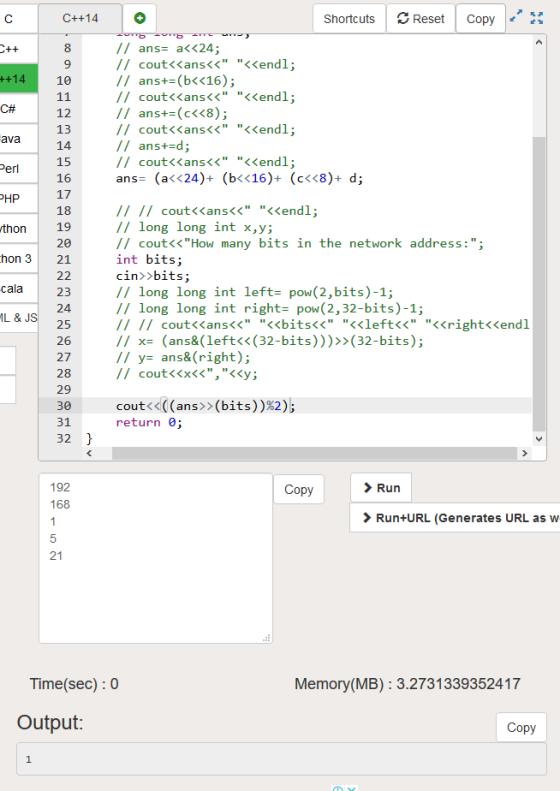
Output should be 1
(Because the binary of the IP address is 11000000101010000000000100000101
Homework Answers
******************************************************************************************
Please Upvote the answer as it matters to me a lot :)
*****************************************************************************************
As per HomeworkLib expert answering guidelines,Experts are supposed to
answer only certain number of questions/sub-parts in a post.Please
raise the remaining as a new question as per HomeworkLib
guidelines.
******************************************************************************************
#include <bits/stdc++.h>
using namespace std;
int main() {
unsigned int a,b,c,d;
cin>>a>>b>>c>>d;
long long int ans;
// ans= a<<24;
// cout<<ans<<" "<<endl;
// ans+=(b<<16);
// cout<<ans<<" "<<endl;
// ans+=(c<<8);
// cout<<ans<<" "<<endl;
// ans+=d;
// cout<<ans<<" "<<endl;
ans= (a<<24)+ (b<<16)+ (c<<8)+ d;
// // cout<<ans<<" "<<endl;
// long long int x,y;
// cout<<"How many bits in the network address:";
int bits;
cin>>bits;
// long long int left= pow(2,bits)-1;
// long long int right= pow(2,32-bits)-1;
// // cout<<ans<<" "<<bits<<"
"<<left<<" "<<right<<endl;
// x= (ans&(left<<(32-bits)))>>(32-bits);
// y= ans&(right);
// cout<<x<<","<<y;
cout<<((ans>>(bits))%2);
return 0;
}
Add Answer to:
Using C++ allow the user to enter the IP address as four 8 bit
unsigned integer...
Write a program that allows the user to enter an unsigned integer (the maximum value of...
Write a program that allows the user to enter an unsigned integer (the maximum value of an unsigned 4-byte int is 232 = 4,294,967,296) and reverses its format (from little to big endian, or vice versa). Print out the user-entered number in hexadecimal and binary, reverse the endianness, and print the reverse in hexadecimal and binary. Integers in most machine architectures are represented in little endian format: the least significant byte is stored in the smallest address; for instance, the...
An IP address is a 32-bit number that uniquely identifies a host (computer or other device,...
 An IP address is a 32-bit number that uniquely identifies a host (computer or other device, such as a printer or router) on a TCP/IP network. IP addresses are normally expressed in dotted-decimal format, with four numbers separated by periods, such as 192.168.123.132. To understand how subnet masks are used to distinguish be- tween hosts, networks, and subnetworks, examine an IP address in binary notation. For example, the dotted-decimal IP address 192.168.123.132 is (in binary notation) the 32 bit num-...
Q1. Hierarchical IP Address 1.1 Give a non-network example of hierarchical addressing, and discuss how it...
Q1. Hierarchical IP Address 1.1 Give a non-network example of hierarchical addressing, and discuss how it reduces the amount of work needed in physical delivery. Do not use any example in the book, the postal service, or the telephone network.1.2 A firm is assigned the network part 128.171. It selects a 10-bit subnet part. a) Draw the bits for the four octets of the IP address of the first host on the first subnet. (Hint: as we don’t use all...
(1) Computer hosts usually have two addresses, an Internet Protocol (IP) address and an Ethernet Media...
(1) Computer hosts usually have two addresses, an Internet Protocol (IP) address and an Ethernet Media Access Control (MAC) address. For the benefit of humans, the IP address is normally represented as a dotted decimal notation, such as 192.168.10.2. Each of the decimal octets in the address or a mask can be converted to 8 binary bits. Remember that the computer only understands binary bits. If all 4 octets were converted to binary, how many bits would there be? (2)...
(Packing Characters into an Integer) The left-shift operator can be used to pack four character values into a four-byt...
(Packing Characters into an Integer) The left-shift operator can be used to pack four character values into a four-byte unsigned int variable. Write a program that inputs four characters from the keyboard and passes them to function packCharacters. To pack four characters into an unsigned int variable, assign the first character to the unsigned intvariable, shift the unsigned int variable left by 8 bit positions and combine the unsigned variable with the second character using the bitwise inclusive OR operator....
This daily will allow you to practice more with the bit wise operators and shifts. Consider...
This daily will allow you to practice more with the bit wise operators and shifts. Consider the following modification of the main program from daily 3: #include void set_flag(unsigned int* flag_holder, int flag_position); void unset_flag(unsigned int * flag_holder, int flag_position); int check_flag(unsigned int flag_holder, int flag_position); void display_32_flags(unsigned int flag_holder); int main(int argc, char* argv[]) { unsigned int flag_holder = 0; set_flag(&flag_holder, 3); set_flag(&flag_holder, 16); set_flag(&flag_holder, 31); display_32_flags(flag_holder); unset_flag(&flag_holder, 31); unset_flag(&flag_holder, 3); set_flag(&flag_holder, 9); display_32_flags(flag_holder); return 0; } Write the...
Introduction: This experiment studies the design of an 8-bit adder/subtractor circuit using VHDL capture. The experiment...
 Introduction: This experiment studies the design of an 8-bit adder/subtractor circuit using VHDL capture. The experiment investigates the implementation of addition and subtraction operations with circuits. This lab uses the virtual simulation environment to validate the design practically in the FPGA board. Equipment: • This experiment requires Quartus Prime and the Intel's DE2-115 FPGA board. • All students should have the Intel QP and ModelSim-Intel-Starter-Edition softwares installed in personal computers. • VPN connection to UNB Network and remote desktop software...
Here is the code I made, but the test case is not working, it goes wrong...
 Here is the code I made, but the test case is not working, it
goes wrong when the binary string convert to decimal. please
help.
#include "stdafx.h"
#include <iostream>
#include <string>
#include <math.h>
#include <locale>
using namespace std;
// function for option 1
void decToBin(int number)
{
int array[16];
int i = 0;
for (int counter = 0;
counter < 16; counter++)
{
array[counter] = 0;
}
while (number > 0)
{...
Here is the code I made, but the test case is not working, it
goes wrong when the binary string convert to decimal. please
help.
#include "stdafx.h"
#include <iostream>
#include <string>
#include <math.h>
#include <locale>
using namespace std;
// function for option 1
void decToBin(int number)
{
int array[16];
int i = 0;
for (int counter = 0;
counter < 16; counter++)
{
array[counter] = 0;
}
while (number > 0)
{...
check my answers for Networking I came up with these answers, can check my answers Question...
check my answers for Networking I came up with these answers, can check my answers Question 1: General What data rate is needed to transmit an uncompressed 4" x 6" photograph every second with a resolution of 1200 dots per inch and 24 bits per dot (pixel)? 691,200 kb/s 28.8 kb/s 8.29 Mb/s 829 Mb/s Question 2: Layering "Layering" is commonly used in computer networks because (check all that apply): -It forces all network software to be written in ‘C’....
 An IP address is a 32-bit number that uniquely identifies a host (computer or other device, such as a printer or router) on a TCP/IP network. IP addresses are normally expressed in dotted-decimal format, with four numbers separated by periods, such as 192.168.123.132. To understand how subnet masks are used to distinguish be- tween hosts, networks, and subnetworks, examine an IP address in binary notation. For example, the dotted-decimal IP address 192.168.123.132 is (in binary notation) the 32 bit num-...
 Introduction: This experiment studies the design of an 8-bit adder/subtractor circuit using VHDL capture. The experiment investigates the implementation of addition and subtraction operations with circuits. This lab uses the virtual simulation environment to validate the design practically in the FPGA board. Equipment: • This experiment requires Quartus Prime and the Intel's DE2-115 FPGA board. • All students should have the Intel QP and ModelSim-Intel-Starter-Edition softwares installed in personal computers. • VPN connection to UNB Network and remote desktop software...
 Here is the code I made, but the test case is not working, it
goes wrong when the binary string convert to decimal. please
help.
#include "stdafx.h"
#include <iostream>
#include <string>
#include <math.h>
#include <locale>
using namespace std;
// function for option 1
void decToBin(int number)
{
int array[16];
int i = 0;
for (int counter = 0;
counter < 16; counter++)
{
array[counter] = 0;
}
while (number > 0)
{...
Here is the code I made, but the test case is not working, it
goes wrong when the binary string convert to decimal. please
help.
#include "stdafx.h"
#include <iostream>
#include <string>
#include <math.h>
#include <locale>
using namespace std;
// function for option 1
void decToBin(int number)
{
int array[16];
int i = 0;
for (int counter = 0;
counter < 16; counter++)
{
array[counter] = 0;
}
while (number > 0)
{...
Most questions answered within 3 hours.
-
Where is the error in this code sequence?
String s1 = "Hello";
String s2 = "ello";...
asked 10 months ago -
Financial data for Joel de Paris, Inc., for last year
follow:
Joel de Paris, Inc.
Balance...
asked 10 months ago -
Consider this reaction:
Al2(SO4)3 (aq)+ BaCl3
(aq) Al2Cl6 (aq)- +
3BaSO4(s) . What is the...
asked 10 months ago -
Suppose that Savneet is considering increasing her
recent random sample from 20 car rentals to 40...
asked 10 months ago -
Trucks arrive at an unloading terminal at an average rate of 120
per hour.
Trucks arrive...
asked 10 months ago -
Why are methanol and ethanol completely soluble in water while
octanol is not very little soluble....
asked 10 months ago -
A facilities manager at a university reads in a research report
that the mean amount of...
asked 10 months ago -
When the CuSO4 is rehydrated by adding water to the anhydrous
compound, is this an endothermic...
asked 10 months ago -
A ray of sunlight is passing from diamond into crown glass; the
angle of incidence is...
asked 10 months ago -
A block of mass 0.249 kg is placed on top of a light, vertical
spring of...
asked 10 months ago -
how do the kidneys compensate in the presences of acidosis
a) trigger hyperventilate
b) reserve acid...
asked 10 months ago -
Question 501 pts
The rental rate of capital to the firm increases. Which of the
following...
asked 10 months ago