What is the smallest integer value of n > 3 such that an algorithm whose running...
What is the smallest integer value of n > 3 such that an algorithm whose running time is 7n runs slower than an algorithm whose running time is 7(log2n)4 on the same machine? Justify your answer. You may provide a plot or/and proof.
Homework Answers
Hey,
Note: Brother in case of any queries, just comment in box I would be very happy to assist all your queries
The smallest value of n is 65536
====================
MATLAB CODE
======================
clc
clear all
close all
f=@(n) 7*n-7*(log2(n))^4;
disp('The value of n is')
fprintf('n=%d',ceil(fzero(f,60000)));
n=1:100000;
plot(n,7*n,n,7*((log2(n)).^4));
hold on;
n=65536;
plot(n,7*n,'*r');
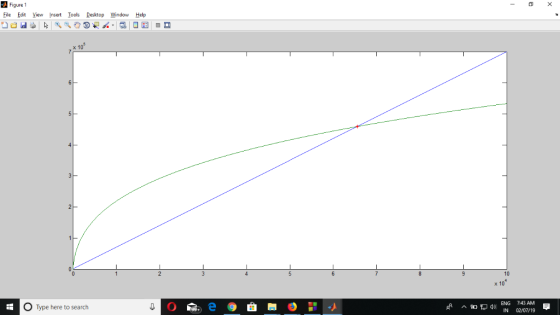
Kindly revert for any queries
Thanks.
Add Answer to:
What is the smallest integer value of n > 3
such that an algorithm whose running...
What is the smallest value of n such that an algorithm whose running time is 100n2...
What is the smallest value of n such that an algorithm whose running time is 100n2 runs faster than an algorithm whose running time is 2n on the same machine?
Could you please help me to solve the problem. Also, could you please answer questions in...
Could you please help me to solve the problem. Also, could you please answer questions in clear hand-writing and show me the full process, thank you (Sometimes I get the answer which was difficult to read).Thanks a lot What is the smallest positive value of n, where n is an integer, such that Algorithm A, whose running time is 100n2 runs faster than Algorithm B, whose running time is 2n , on the same machine (give your answer in whole number(s))
3- What is the growth of the below function: (What is the most accurate answer?) ?(?)...
3- What is the growth of the below function: (What is the most accurate answer?) ?(?) = 2^(????^3) + ?√? + 7???^6 ? + ?^2???? options: a) Θ(n) b) Θ (n3) c) Θ (n2logn) d) Θ (n√?) e) Θ (log6n) What is the growth of the below function: (What is the most accurate answer?) ?(?) = ??????? + 4???^2? + ????^2 options: a) O (logn) b) O (loglogn) c) O (log2n) d) O(logn2) e) Neither 5- Assume you want to...
ALGORITHM RecS(n) // Input: A nonnegative integer n ifn=0 return 0 else return RecS(n+ n n...
 ALGORITHM RecS(n) // Input: A nonnegative integer n ifn=0 return 0 else return RecS(n+ n n n Determine what this algorithm computes. You must justify your answer. made by this algorithm and solve it. You must justify your answer. same thing using for/while loop(s) developed in (3). You must justify your answer. 1) 2) Set up the initial condition and recurrence relation for the number of multiplications 3) Write the pseudocode for the non-recursive version of this algorithm, i.e., compute...
Please answer this in python pseudocode. It's an algorithm question. 1. [10 marks] Consider the function...
 Please answer this in python
pseudocode. It's an algorithm question.
1. [10 marks] Consider the function SumKSmallest(A[0..n – 1), k) that returns the sum of the k smallest elements in an unsorted integer array A of size n. For example, given the array A=[6,-6,3,2,1,2,0,4,3,5] and k=3, the function should return -5. a. [3 marks) Write an algorithm in pseudocode for SumKSmallest using the brute force paradigm. Indicate and justify (within a few sentences) the time complexity of your algorithm. b....
Please answer this in python
pseudocode. It's an algorithm question.
1. [10 marks] Consider the function SumKSmallest(A[0..n – 1), k) that returns the sum of the k smallest elements in an unsorted integer array A of size n. For example, given the array A=[6,-6,3,2,1,2,0,4,3,5] and k=3, the function should return -5. a. [3 marks) Write an algorithm in pseudocode for SumKSmallest using the brute force paradigm. Indicate and justify (within a few sentences) the time complexity of your algorithm. b....
3. (25 points) Let TA and Te be two function returning the running time of algorithms...
 3. (25 points) Let TA and Te be two function returning the running time of algorithms A and B, defined by the recusions TA(n) T(2 and TR(n) T(2n2. Find the largest integer value of a for which algorithm B is asymptotically faster than A. Show your work and justify your answer in the PDF file. Answer in the MyCourses quiz.
Consider a variation of Merge sort called 4-way Merge sort. Instead of splitting the array into...
Consider a variation of Merge sort called 4-way Merge sort. Instead of splitting the array into two parts like Merge sort, 4-way Merge sort splits the array into four parts. 4-way Merge divides the input array into fourths, calls itself for each fourth and then merges the four sorted fourths. a)Implement 4-way Merge sort from Problem 4 to sort an array/vector of integers and name it merge4. Implement the algorithm in the same language you used for the sorting algorithms...
(a) Give the pseudo-code for a recursive algorithm called Find_Smallest(A, n) that returns the value of...
(a) Give the pseudo-code for a recursive algorithm called Find_Smallest(A, n) that returns the value of the smallest element in an array of n integers called A. Assume the elements in the array are at locations A[1]..A[n]. (b) Give a recurrence T(n) for the running time of your algorithm. (c) Solve the recurrence in part (b)
Find the smallest positive integer n such that there are non-isomorphic simple graphs on n vertices...
Find the smallest positive integer n such that there are non-isomorphic simple graphs on n vertices that have the same chromatic polynomial. Explain carefully why the n you give as your answer is indeed the smallest.
Discrete Mathematics - RSA Algorithm and Mod These are problems concerning the RSA algorithm and Modulo. A. In RSA, suppose bob chooses p = 3 and q = 43. Determine one correct value of the public expo...
Discrete Mathematics - RSA Algorithm and Mod These are problems concerning the RSA algorithm and Modulo. A. In RSA, suppose bob chooses p = 3 and q = 43. Determine one correct value of the public exponent e, your choice should be the smallest positive integer that is greater than 1. Justify your answer. B. For the e's value you chose above, compute the corresponding secret exponent d. Show your work. C. Compute 540Mod13 D. Compute 5-1Mod11
 ALGORITHM RecS(n) // Input: A nonnegative integer n ifn=0 return 0 else return RecS(n+ n n n Determine what this algorithm computes. You must justify your answer. made by this algorithm and solve it. You must justify your answer. same thing using for/while loop(s) developed in (3). You must justify your answer. 1) 2) Set up the initial condition and recurrence relation for the number of multiplications 3) Write the pseudocode for the non-recursive version of this algorithm, i.e., compute...
 Please answer this in python
pseudocode. It's an algorithm question.
1. [10 marks] Consider the function SumKSmallest(A[0..n – 1), k) that returns the sum of the k smallest elements in an unsorted integer array A of size n. For example, given the array A=[6,-6,3,2,1,2,0,4,3,5] and k=3, the function should return -5. a. [3 marks) Write an algorithm in pseudocode for SumKSmallest using the brute force paradigm. Indicate and justify (within a few sentences) the time complexity of your algorithm. b....
Please answer this in python
pseudocode. It's an algorithm question.
1. [10 marks] Consider the function SumKSmallest(A[0..n – 1), k) that returns the sum of the k smallest elements in an unsorted integer array A of size n. For example, given the array A=[6,-6,3,2,1,2,0,4,3,5] and k=3, the function should return -5. a. [3 marks) Write an algorithm in pseudocode for SumKSmallest using the brute force paradigm. Indicate and justify (within a few sentences) the time complexity of your algorithm. b....
 3. (25 points) Let TA and Te be two function returning the running time of algorithms A and B, defined by the recusions TA(n) T(2 and TR(n) T(2n2. Find the largest integer value of a for which algorithm B is asymptotically faster than A. Show your work and justify your answer in the PDF file. Answer in the MyCourses quiz.
Most questions answered within 3 hours.
-
Where is the error in this code sequence?
String s1 = "Hello";
String s2 = "ello";...
asked 10 months ago -
Financial data for Joel de Paris, Inc., for last year
follow:
Joel de Paris, Inc.
Balance...
asked 10 months ago -
Consider this reaction:
Al2(SO4)3 (aq)+ BaCl3
(aq) Al2Cl6 (aq)- +
3BaSO4(s) . What is the...
asked 10 months ago -
Suppose that Savneet is considering increasing her
recent random sample from 20 car rentals to 40...
asked 10 months ago -
Trucks arrive at an unloading terminal at an average rate of 120
per hour.
Trucks arrive...
asked 10 months ago -
Why are methanol and ethanol completely soluble in water while
octanol is not very little soluble....
asked 10 months ago -
A facilities manager at a university reads in a research report
that the mean amount of...
asked 10 months ago -
When the CuSO4 is rehydrated by adding water to the anhydrous
compound, is this an endothermic...
asked 10 months ago -
A ray of sunlight is passing from diamond into crown glass; the
angle of incidence is...
asked 10 months ago -
A block of mass 0.249 kg is placed on top of a light, vertical
spring of...
asked 10 months ago -
how do the kidneys compensate in the presences of acidosis
a) trigger hyperventilate
b) reserve acid...
asked 10 months ago -
Question 501 pts
The rental rate of capital to the firm increases. Which of the
following...
asked 10 months ago