Stuck on these, please show work so that I can follow through each step Write the...
Stuck on these, please show work so that I can follow through each step
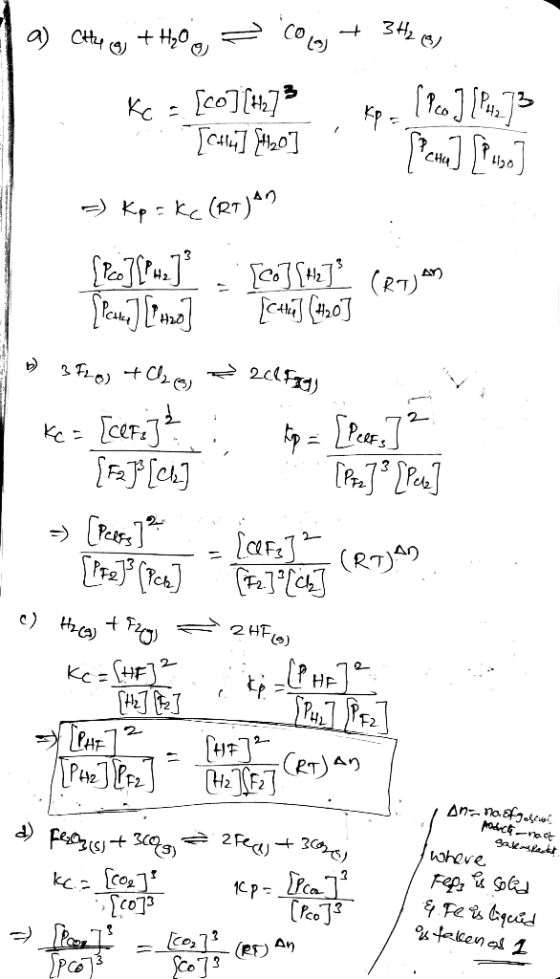
Write the expressions for Kc and Kp (each) for each of these reactions. Then write the mathematical equation relating Kc to Kp for each reaction:
-
CH4(g) + H2O(g) ⇌ CO(g) + 3H2(g)
-
3F2(g) + Cl2(g) ⇌ 2ClF3(g)
-
H2(g) + F2(g) ⇌ 2HF(g)
-
Fe2O3(s) + 3CO(g) ⇌ 2Fe(l) + 3CO2(g)
Homework Answers
pure liqiuds and solids are taken as unity while writing
the Kc and Kp expressions and those are as follows
Add Answer to:
Stuck on these, please show work so that I can follow through
each step
Write the...
14. The following reaction mechanisms are used for the final reaction shown: 203 → 302 Step...
 14. The following reaction mechanisms are used for the final reaction shown: 203 → 302 Step 1: CI+O3 → 02 + Clo Step 2: 03 → 02 +0 Step 3: ClO +002+CI a. What is the catalyst in the reaction? b. What is/are the intermediate product(s) for the reaction? 15. At a particular moment during the reaction, Hl disappears at a rate of 6.50 X 10² M/s. What is the rate of appearance of H2 and the rate of appearance...
1) 2) 3) Please explain step by step so I can understand how answer was obtained...
 1)
2)
3)
Please explain step by step so I can understand how answer was
obtained
Given the following rate law, how does the rate of reaction change if the concentration of Z is tripled? Rate = k [X] [Y]2[z] The rate of reaction will increase by a factor of 06 OOOO At a certain temperature the equilibrium constant, Kc, equals 0.11 for the reaction: 2 ICI(g) = 12(g) + Cl2(g). What is the equilibrium concentration of Cl2 if 4.27...
1)
2)
3)
Please explain step by step so I can understand how answer was
obtained
Given the following rate law, how does the rate of reaction change if the concentration of Z is tripled? Rate = k [X] [Y]2[z] The rate of reaction will increase by a factor of 06 OOOO At a certain temperature the equilibrium constant, Kc, equals 0.11 for the reaction: 2 ICI(g) = 12(g) + Cl2(g). What is the equilibrium concentration of Cl2 if 4.27...
please explain each step in clear writing. Chloroform (CHCI3) is formed from methane and chlorine in...
 please explain each step in clear writing.
Chloroform (CHCI3) is formed from methane and chlorine in the following reaction: CH4 (g)3C12 (g)3HC1(g)+CHCI3 (g) Calculate A, Ho, the enthalpy change for this reaction, using the standard molar enthalpy change of formation of CHCI3 (g), AfH° = -103.1 kJ mol1, and the standard enthalpy changes for the following reactions: CH4 (g)202 (g)2H2O (e) CO2 (g) AH°=-890.4 kJ mol-1 2HC1(g) H2 (g)Cl2 (g) A,.H +184.6 kJ mol1 C(graphite)O2 (g)CO2 (g) A H°=-393.5 kJ...
please explain each step in clear writing.
Chloroform (CHCI3) is formed from methane and chlorine in the following reaction: CH4 (g)3C12 (g)3HC1(g)+CHCI3 (g) Calculate A, Ho, the enthalpy change for this reaction, using the standard molar enthalpy change of formation of CHCI3 (g), AfH° = -103.1 kJ mol1, and the standard enthalpy changes for the following reactions: CH4 (g)202 (g)2H2O (e) CO2 (g) AH°=-890.4 kJ mol-1 2HC1(g) H2 (g)Cl2 (g) A,.H +184.6 kJ mol1 C(graphite)O2 (g)CO2 (g) A H°=-393.5 kJ...
Write the expressions for Kp for the following reactions: 1. a) 2NH3(g) + Co2(g) N2CH40(s) +...
 Write the expressions for Kp for the following reactions: 1. a) 2NH3(g) + Co2(g) N2CH40(s) + H20 (I) b) CuO (s) + H2(g) Cu(l)+H20 (g) 2. At room temperature, a 1.5 L flask contains 3.0 moles of Cl, 0.5 mole of NOCI, and 4.0x10 mole of NO. Calculate Ke at this temperature for the following reaction: 2NO (g) + Cl2(g) 2NOCİ (g) 0.00245 M, does this represent a system at M, [No] 0.2 M and [Ch] If [NOCI] 2.0x 10...
hi! please show all work step by step so I can follow along and understand! thank...
 hi! please show all work step by step so I
can follow along and understand! thank you!
Pre-Equilibria Conditions in Reaction Mechanisms 5Br (aq) + BrO3- (aq) + 6H+(aq) + 3Br2(0) + 3H20(1) The above reaction is expected to obey the mechanism: BrO3(aq) + H+ (aq) HBrO3(aq) Fast equilibrium HBrO3(aq) + H+ (aq) H2BrO3+ (aq) Fast equilibrium H2BrO3(aq) + Br"(aq) *34 (Br-BrO2)(aq) + H20(1) Slow (Br-BrO2)(aq) + 4H+(aq) + 4Br"(aq) *4, products Fast Choose, from the list below, correct expressions...
hi! please show all work step by step so I
can follow along and understand! thank you!
Pre-Equilibria Conditions in Reaction Mechanisms 5Br (aq) + BrO3- (aq) + 6H+(aq) + 3Br2(0) + 3H20(1) The above reaction is expected to obey the mechanism: BrO3(aq) + H+ (aq) HBrO3(aq) Fast equilibrium HBrO3(aq) + H+ (aq) H2BrO3+ (aq) Fast equilibrium H2BrO3(aq) + Br"(aq) *34 (Br-BrO2)(aq) + H20(1) Slow (Br-BrO2)(aq) + 4H+(aq) + 4Br"(aq) *4, products Fast Choose, from the list below, correct expressions...
Please do step by step! Thank you! ❤️ USE THE FACTOR LABEL MMETHOD SHOW YOUR WORK...
 Please do step by step! Thank you! ❤️
USE THE FACTOR LABEL MMETHOD SHOW YOUR WORK CLEARLY ANSWERS WITH NO WORK SHALL NOT GET CREDIT 1. 10 Points. USE THE FACTOR LABEL METHOD SHOW YOUR WORK CLEARLY. The reaction between aluminum and iron(III) oxide can generate temperatures approaching 3000 °C and is used to weld metals: Al2O3 +2Fe 2Al + Fe2O3 In one process, 224 g of Al are reacted with 601 g of Fe2O1. (a) Determine the limiting reactant....
Please do step by step! Thank you! ❤️
USE THE FACTOR LABEL MMETHOD SHOW YOUR WORK CLEARLY ANSWERS WITH NO WORK SHALL NOT GET CREDIT 1. 10 Points. USE THE FACTOR LABEL METHOD SHOW YOUR WORK CLEARLY. The reaction between aluminum and iron(III) oxide can generate temperatures approaching 3000 °C and is used to weld metals: Al2O3 +2Fe 2Al + Fe2O3 In one process, 224 g of Al are reacted with 601 g of Fe2O1. (a) Determine the limiting reactant....
i need help with everything please!! WWLWUNA HOSILNILNIUSPRING 2020) Chapter #14 The following practice problems from...
 i need help with everything please!!
WWLWUNA HOSILNILNIUSPRING 2020) Chapter #14 The following practice problems from Chang's text are not to be submitted. The numbers in brackets refer to problems appearing at the end of the chapter. Equilibrium Constant Expressions (14.8, 14.9) Calculating Equilibrium Constants (14.13 to 14.24: Do as many as you can) Multiple Equilibria (14.29, 14.31) Kinetics and Chemical Equilibrium (14.35, 14.36) Calc. of Equilibrium Conc. (14.39 - 14.48) Do as many as you can. LeChatlier's Principle (14.54,...
i need help with everything please!!
WWLWUNA HOSILNILNIUSPRING 2020) Chapter #14 The following practice problems from Chang's text are not to be submitted. The numbers in brackets refer to problems appearing at the end of the chapter. Equilibrium Constant Expressions (14.8, 14.9) Calculating Equilibrium Constants (14.13 to 14.24: Do as many as you can) Multiple Equilibria (14.29, 14.31) Kinetics and Chemical Equilibrium (14.35, 14.36) Calc. of Equilibrium Conc. (14.39 - 14.48) Do as many as you can. LeChatlier's Principle (14.54,...
please write legible 1. Identify each of the following reactions as a precipitation reaction, an acid-base...
 please write legible
1. Identify each of the following reactions as a precipitation reaction, an acid-base reaction, or as a redox reaction + a. Pb(NO3)2 (aq) + 2 HCl(aq) PbCl (s) + 2 HNO, (aq) b. 2 Hxe + O2 + 2 H2O c. HNO, (aq) + KOH(aq) KNO, (aq) + H20 (1) d. Zna + 2HCl(a) - ZnClaraq) + Halle e. Ba?'(aq) + 2 Br(aq) + 2 Na(aq) + SO/"(aq) BaSO. (s) + 2 Na'(aq) + 2 Br" (aq)...
please write legible
1. Identify each of the following reactions as a precipitation reaction, an acid-base reaction, or as a redox reaction + a. Pb(NO3)2 (aq) + 2 HCl(aq) PbCl (s) + 2 HNO, (aq) b. 2 Hxe + O2 + 2 H2O c. HNO, (aq) + KOH(aq) KNO, (aq) + H20 (1) d. Zna + 2HCl(a) - ZnClaraq) + Halle e. Ba?'(aq) + 2 Br(aq) + 2 Na(aq) + SO/"(aq) BaSO. (s) + 2 Na'(aq) + 2 Br" (aq)...
 14. The following reaction mechanisms are used for the final reaction shown: 203 → 302 Step 1: CI+O3 → 02 + Clo Step 2: 03 → 02 +0 Step 3: ClO +002+CI a. What is the catalyst in the reaction? b. What is/are the intermediate product(s) for the reaction? 15. At a particular moment during the reaction, Hl disappears at a rate of 6.50 X 10² M/s. What is the rate of appearance of H2 and the rate of appearance...
 1)
2)
3)
Please explain step by step so I can understand how answer was
obtained
Given the following rate law, how does the rate of reaction change if the concentration of Z is tripled? Rate = k [X] [Y]2[z] The rate of reaction will increase by a factor of 06 OOOO At a certain temperature the equilibrium constant, Kc, equals 0.11 for the reaction: 2 ICI(g) = 12(g) + Cl2(g). What is the equilibrium concentration of Cl2 if 4.27...
1)
2)
3)
Please explain step by step so I can understand how answer was
obtained
Given the following rate law, how does the rate of reaction change if the concentration of Z is tripled? Rate = k [X] [Y]2[z] The rate of reaction will increase by a factor of 06 OOOO At a certain temperature the equilibrium constant, Kc, equals 0.11 for the reaction: 2 ICI(g) = 12(g) + Cl2(g). What is the equilibrium concentration of Cl2 if 4.27...
 please explain each step in clear writing.
Chloroform (CHCI3) is formed from methane and chlorine in the following reaction: CH4 (g)3C12 (g)3HC1(g)+CHCI3 (g) Calculate A, Ho, the enthalpy change for this reaction, using the standard molar enthalpy change of formation of CHCI3 (g), AfH° = -103.1 kJ mol1, and the standard enthalpy changes for the following reactions: CH4 (g)202 (g)2H2O (e) CO2 (g) AH°=-890.4 kJ mol-1 2HC1(g) H2 (g)Cl2 (g) A,.H +184.6 kJ mol1 C(graphite)O2 (g)CO2 (g) A H°=-393.5 kJ...
please explain each step in clear writing.
Chloroform (CHCI3) is formed from methane and chlorine in the following reaction: CH4 (g)3C12 (g)3HC1(g)+CHCI3 (g) Calculate A, Ho, the enthalpy change for this reaction, using the standard molar enthalpy change of formation of CHCI3 (g), AfH° = -103.1 kJ mol1, and the standard enthalpy changes for the following reactions: CH4 (g)202 (g)2H2O (e) CO2 (g) AH°=-890.4 kJ mol-1 2HC1(g) H2 (g)Cl2 (g) A,.H +184.6 kJ mol1 C(graphite)O2 (g)CO2 (g) A H°=-393.5 kJ...
 Write the expressions for Kp for the following reactions: 1. a) 2NH3(g) + Co2(g) N2CH40(s) + H20 (I) b) CuO (s) + H2(g) Cu(l)+H20 (g) 2. At room temperature, a 1.5 L flask contains 3.0 moles of Cl, 0.5 mole of NOCI, and 4.0x10 mole of NO. Calculate Ke at this temperature for the following reaction: 2NO (g) + Cl2(g) 2NOCİ (g) 0.00245 M, does this represent a system at M, [No] 0.2 M and [Ch] If [NOCI] 2.0x 10...
 hi! please show all work step by step so I
can follow along and understand! thank you!
Pre-Equilibria Conditions in Reaction Mechanisms 5Br (aq) + BrO3- (aq) + 6H+(aq) + 3Br2(0) + 3H20(1) The above reaction is expected to obey the mechanism: BrO3(aq) + H+ (aq) HBrO3(aq) Fast equilibrium HBrO3(aq) + H+ (aq) H2BrO3+ (aq) Fast equilibrium H2BrO3(aq) + Br"(aq) *34 (Br-BrO2)(aq) + H20(1) Slow (Br-BrO2)(aq) + 4H+(aq) + 4Br"(aq) *4, products Fast Choose, from the list below, correct expressions...
hi! please show all work step by step so I
can follow along and understand! thank you!
Pre-Equilibria Conditions in Reaction Mechanisms 5Br (aq) + BrO3- (aq) + 6H+(aq) + 3Br2(0) + 3H20(1) The above reaction is expected to obey the mechanism: BrO3(aq) + H+ (aq) HBrO3(aq) Fast equilibrium HBrO3(aq) + H+ (aq) H2BrO3+ (aq) Fast equilibrium H2BrO3(aq) + Br"(aq) *34 (Br-BrO2)(aq) + H20(1) Slow (Br-BrO2)(aq) + 4H+(aq) + 4Br"(aq) *4, products Fast Choose, from the list below, correct expressions...
 Please do step by step! Thank you! ❤️
USE THE FACTOR LABEL MMETHOD SHOW YOUR WORK CLEARLY ANSWERS WITH NO WORK SHALL NOT GET CREDIT 1. 10 Points. USE THE FACTOR LABEL METHOD SHOW YOUR WORK CLEARLY. The reaction between aluminum and iron(III) oxide can generate temperatures approaching 3000 °C and is used to weld metals: Al2O3 +2Fe 2Al + Fe2O3 In one process, 224 g of Al are reacted with 601 g of Fe2O1. (a) Determine the limiting reactant....
Please do step by step! Thank you! ❤️
USE THE FACTOR LABEL MMETHOD SHOW YOUR WORK CLEARLY ANSWERS WITH NO WORK SHALL NOT GET CREDIT 1. 10 Points. USE THE FACTOR LABEL METHOD SHOW YOUR WORK CLEARLY. The reaction between aluminum and iron(III) oxide can generate temperatures approaching 3000 °C and is used to weld metals: Al2O3 +2Fe 2Al + Fe2O3 In one process, 224 g of Al are reacted with 601 g of Fe2O1. (a) Determine the limiting reactant....
 i need help with everything please!!
WWLWUNA HOSILNILNIUSPRING 2020) Chapter #14 The following practice problems from Chang's text are not to be submitted. The numbers in brackets refer to problems appearing at the end of the chapter. Equilibrium Constant Expressions (14.8, 14.9) Calculating Equilibrium Constants (14.13 to 14.24: Do as many as you can) Multiple Equilibria (14.29, 14.31) Kinetics and Chemical Equilibrium (14.35, 14.36) Calc. of Equilibrium Conc. (14.39 - 14.48) Do as many as you can. LeChatlier's Principle (14.54,...
i need help with everything please!!
WWLWUNA HOSILNILNIUSPRING 2020) Chapter #14 The following practice problems from Chang's text are not to be submitted. The numbers in brackets refer to problems appearing at the end of the chapter. Equilibrium Constant Expressions (14.8, 14.9) Calculating Equilibrium Constants (14.13 to 14.24: Do as many as you can) Multiple Equilibria (14.29, 14.31) Kinetics and Chemical Equilibrium (14.35, 14.36) Calc. of Equilibrium Conc. (14.39 - 14.48) Do as many as you can. LeChatlier's Principle (14.54,...
 please write legible
1. Identify each of the following reactions as a precipitation reaction, an acid-base reaction, or as a redox reaction + a. Pb(NO3)2 (aq) + 2 HCl(aq) PbCl (s) + 2 HNO, (aq) b. 2 Hxe + O2 + 2 H2O c. HNO, (aq) + KOH(aq) KNO, (aq) + H20 (1) d. Zna + 2HCl(a) - ZnClaraq) + Halle e. Ba?'(aq) + 2 Br(aq) + 2 Na(aq) + SO/"(aq) BaSO. (s) + 2 Na'(aq) + 2 Br" (aq)...
please write legible
1. Identify each of the following reactions as a precipitation reaction, an acid-base reaction, or as a redox reaction + a. Pb(NO3)2 (aq) + 2 HCl(aq) PbCl (s) + 2 HNO, (aq) b. 2 Hxe + O2 + 2 H2O c. HNO, (aq) + KOH(aq) KNO, (aq) + H20 (1) d. Zna + 2HCl(a) - ZnClaraq) + Halle e. Ba?'(aq) + 2 Br(aq) + 2 Na(aq) + SO/"(aq) BaSO. (s) + 2 Na'(aq) + 2 Br" (aq)...
Most questions answered within 3 hours.
-
Where is the error in this code sequence?
String s1 = "Hello";
String s2 = "ello";...
asked 10 months ago -
Financial data for Joel de Paris, Inc., for last year
follow:
Joel de Paris, Inc.
Balance...
asked 10 months ago -
Consider this reaction:
Al2(SO4)3 (aq)+ BaCl3
(aq) Al2Cl6 (aq)- +
3BaSO4(s) . What is the...
asked 10 months ago -
Suppose that Savneet is considering increasing her
recent random sample from 20 car rentals to 40...
asked 10 months ago -
Trucks arrive at an unloading terminal at an average rate of 120
per hour.
Trucks arrive...
asked 10 months ago -
Why are methanol and ethanol completely soluble in water while
octanol is not very little soluble....
asked 10 months ago -
A facilities manager at a university reads in a research report
that the mean amount of...
asked 10 months ago -
When the CuSO4 is rehydrated by adding water to the anhydrous
compound, is this an endothermic...
asked 10 months ago -
A ray of sunlight is passing from diamond into crown glass; the
angle of incidence is...
asked 10 months ago -
A block of mass 0.249 kg is placed on top of a light, vertical
spring of...
asked 10 months ago -
how do the kidneys compensate in the presences of acidosis
a) trigger hyperventilate
b) reserve acid...
asked 10 months ago -
Question 501 pts
The rental rate of capital to the firm increases. Which of the
following...
asked 10 months ago