The effect of an inhibitor on an enzyme was tested and the experiment gave the results...
- The effect of an inhibitor on an enzyme was tested and the experiment gave the results below. Plot on Excel the data using a double-reciprocal plot (Lineweaver-Burke), determine Km and Vmax of the no inhibitor and each type of inhibitor and the type of inhibition that is occurring.
[S] µM V (µmol/min) V (µmol/min) V (µmol/min)
with 0.0 nM with 25 nM with 50 nM
Inhibitor Inhibitor Inhibitor
______ ___________ ___________ ___________
0.4 0.22 0.21 0.20
0.67 0.29 0.26 0.24
1.00 0.32 0.30 0.28
2.00 0.40 0.36 0.32
Homework Answers
Answer:
Find 1/[S] and 1/V as below:
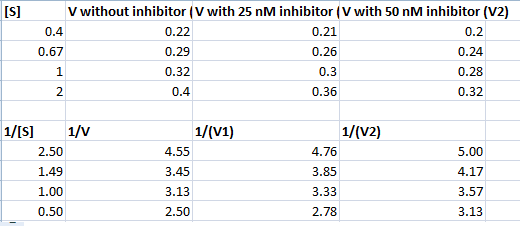
Ploting 1/[S] and 1/V as below:
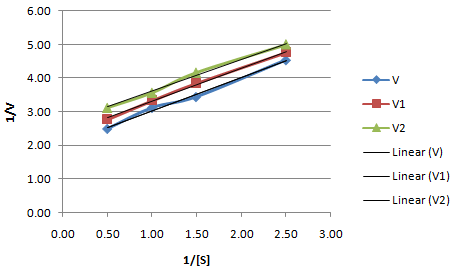
Refering the below figure to find the type of inhibition.
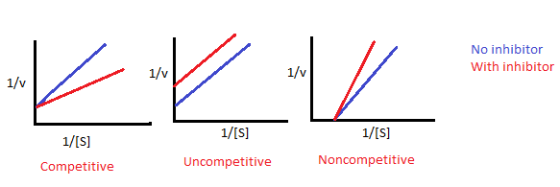
- So the type of inhibition is uncompetititve.
Please Rate My Answer.......Thank......u...
Add Answer to:
The effect of an inhibitor on an enzyme was tested and the
experiment gave the results...
An enzyme-catalyzed reaction to the presence of 5 nM of reversible inhibitor yields a Vmax value...
An enzyme-catalyzed reaction to the presence of 5 nM of reversible inhibitor yields a Vmax value that is 80% of the value in absence of the inhibitor. The KMvalue is unchanged. a) what type of inhibition is occurring? b) what proportion of the enzyme molecule will have bound inhibitor? c) Draw the Lineweaver-Burk (known as double-reciprocal plot) for uninhibited and inhibited reaction. SHOW ALL YOUR WORK PLEASE
The following data was obtained for an enzyme in the absence of an inhibitor, and in...
The following data was obtained for an enzyme in the absence of an inhibitor, and in the presence of two different inhibitors. The concentration of each inhibitor was 10 mM. The total concentration of enzyme was the same for each experiment. [S] {mM} without inhibitor v, {umol/(ml*s)} with inhibitor A v, {umol/(ml*s)} With inhibitor B v, {umol/(ml*s)} 0.0 0.0 0.0 0.0 1.0 3.6 3.2 2.6 2.0 6.3 5.3 4.5 4.0 10.0 7.8 7.1 8.0 14.3 10.1 10.2 12.0 16.7 11.3...
You have an inhibitor for an enzyme that you are studying. The concentration of inhibitor used is...
You have an inhibitor for an enzyme that you are studying. The concentration of inhibitor used is 5.50 µM. The following data was collected for the non-inhibited reaction as well as the reaction that was inhibited. mmol/(mL min) mmol/(mL min) mM Substrate Vo Substrate Vo + Inhibitor 0.200 5.000 3.751 0.400 7.500 4.998 0.800 10.000 5.995 1.000 10.700 6.173 2.000 12.500 6.807 4.000 13.600 7.143 a. Plot this data using Excel or a graphing program. Make sure you give your graph has a...
Prostaglandins are a class of eicosanoids (fatty acid derivatives) with a variety of extremely potent actions...
 Prostaglandins are a class of eicosanoids (fatty acid derivatives) with a variety of extremely potent actions on vertebrate tissues. They are responsible for producing fever and inflammation and its associated pain. Prostaglandins are derived from the 20-carbon fatty acid, arachidonic acid, in a reaction catalyzed by the enzyme, prostaglandin endoperoxide synthase. This uses oxygen to convert arachidonic acid to PGG2 (a prostaglandin). Ibuprofen inhibits this enzyme and is a fever reducer and anti-inflammatory agent. The kinetic data is given below...
A different experiment yields the following kinetic data Substrate] (mM)Vo (uM/min) no inhibitorVo (uM/min)+7 nM inhibitor...
 A different experiment yields the following kinetic data Substrate] (mM)Vo (uM/min) no inhibitorVo (uM/min)+7 nM inhibitor 0.02 0.04 0.10 0.25 1.00 2.50 0.8 2.9 8.6 24 36 50 Plot the data for the kinetics of the enzyme (with and without the inhibitor) in a double reciprocal (Lineweaver-Burk) plot. Keep in mind that the x axis is 1/[S] and the y axis is 1/Vo. If you are using Excel you want to choose the (x,y) scatter plot (without a ne). You...
4. The following data were obtained from an enzyme kinetics experiment. Graph the data using a...
 4. The following data were obtained from an enzyme kinetics experiment. Graph the data using a Lineweaver-Burk plot and determine, by inspection of the graph, the values for Km and Vmax. ISI (M) V (nmol/min) 0.20 0.26 0.33 1.00 1.43 1.67 2.08 3.33 5. You measured the kinetics of an enzyme activity as a function of substrate concentration (see Table). The enzyme concentration was maintained constant at a level of 1 M. [S] AM Vopmol/min 2.9 3.8 4.4 Plot the...
5) (14 marks) The following kinetic data were obtained for an enzyme in the absence of...
 5) (14 marks) The following kinetic data were obtained for an enzyme in the absence of inhibitor (1), and in the presence of an inhibitor at 5 mM concentration (2). Assume[ET] is the same in each experiment. [S] (MM) (1) v(umol/mL sec) 12 (2) v(umol/mL sec) 4.3 1 8 2 4 20 29 14 21 8 35 12 40 26 a. Using a graphing program (excel or sigmaplot) construct a lineweaver burke plot representing the uninhibited reaction and the inhibited...
a. What is the Km and Vmax for PFK1 when treated with OmM (represents control for...
 a. What is the Km and Vmax for PFK1 when treated with OmM (represents control for enzymatic activity) or with 5mM AMP Show work on the graph draw lines for Vmax and Km. Control: Vmax (AMP), 0.32 0.28 0.2 Km 0.24 0.20 (s)-FTY20 (20LM): 0.18 Vmax 0.12 0.08 0.04 Km 0.00 Fructose-6-phosphate (mM) b. Fructose-6-phosphate is the substrate of the reaction. Based on answer in "a", what type of regulation occurs with and what site on PFK1 is AMP likely...
3. Below is a Lineweaver-Burke plot of an enzyme reaction in the presence and absence of...
 3. Below is a Lineweaver-Burke plot of an enzyme reaction in the presence and absence of an inhibitor. 2.4 2.3 2.2 2.1 2 1.9 1.8 1.7 1.6 1.5 1.4 1.3 1.2 1.1 1 0.9 0.8 < 0.7 0.6 0.5 0.4 0.3 0.2 0.1 0 -0.1 -0.2 -0.3 -0.4 -0.5 -0.6 -0.7 -0.8 . . . . . -1 -0.9 -0.8 -0.7 -0.6 -0.5 -0.4 -0.3 -0.2 -0.1 O 0.1 0.2 0.3 0.4 0.5 0.6 0.7 0.8 0.9 1 1.1 1/[S]...
1) An experiment is run with enzyme E at a constant concentration of 1.00 nM. The...
 1) An experiment is run with enzyme E at a constant concentration of 1.00 nM. The following data set was generated: Initial rate v, [SJ, μΜ μΜ/min 2.0 2.9 3.0 3.8 4.0 4.4 5.0 5.0 5.4 6.0 7.0 5.8 8.0 6.2 9.0 6.4 6.7 10.0 From these data, determine Vmax, KM, kcat and the turnover number. In a second series of experiment, the reaction was studied in the presence of 10mM of inhibitor A. The new data set is shown...
 Prostaglandins are a class of eicosanoids (fatty acid derivatives) with a variety of extremely potent actions on vertebrate tissues. They are responsible for producing fever and inflammation and its associated pain. Prostaglandins are derived from the 20-carbon fatty acid, arachidonic acid, in a reaction catalyzed by the enzyme, prostaglandin endoperoxide synthase. This uses oxygen to convert arachidonic acid to PGG2 (a prostaglandin). Ibuprofen inhibits this enzyme and is a fever reducer and anti-inflammatory agent. The kinetic data is given below...
 A different experiment yields the following kinetic data Substrate] (mM)Vo (uM/min) no inhibitorVo (uM/min)+7 nM inhibitor 0.02 0.04 0.10 0.25 1.00 2.50 0.8 2.9 8.6 24 36 50 Plot the data for the kinetics of the enzyme (with and without the inhibitor) in a double reciprocal (Lineweaver-Burk) plot. Keep in mind that the x axis is 1/[S] and the y axis is 1/Vo. If you are using Excel you want to choose the (x,y) scatter plot (without a ne). You...
 4. The following data were obtained from an enzyme kinetics experiment. Graph the data using a Lineweaver-Burk plot and determine, by inspection of the graph, the values for Km and Vmax. ISI (M) V (nmol/min) 0.20 0.26 0.33 1.00 1.43 1.67 2.08 3.33 5. You measured the kinetics of an enzyme activity as a function of substrate concentration (see Table). The enzyme concentration was maintained constant at a level of 1 M. [S] AM Vopmol/min 2.9 3.8 4.4 Plot the...
 5) (14 marks) The following kinetic data were obtained for an enzyme in the absence of inhibitor (1), and in the presence of an inhibitor at 5 mM concentration (2). Assume[ET] is the same in each experiment. [S] (MM) (1) v(umol/mL sec) 12 (2) v(umol/mL sec) 4.3 1 8 2 4 20 29 14 21 8 35 12 40 26 a. Using a graphing program (excel or sigmaplot) construct a lineweaver burke plot representing the uninhibited reaction and the inhibited...
 a. What is the Km and Vmax for PFK1 when treated with OmM (represents control for enzymatic activity) or with 5mM AMP Show work on the graph draw lines for Vmax and Km. Control: Vmax (AMP), 0.32 0.28 0.2 Km 0.24 0.20 (s)-FTY20 (20LM): 0.18 Vmax 0.12 0.08 0.04 Km 0.00 Fructose-6-phosphate (mM) b. Fructose-6-phosphate is the substrate of the reaction. Based on answer in "a", what type of regulation occurs with and what site on PFK1 is AMP likely...
 3. Below is a Lineweaver-Burke plot of an enzyme reaction in the presence and absence of an inhibitor. 2.4 2.3 2.2 2.1 2 1.9 1.8 1.7 1.6 1.5 1.4 1.3 1.2 1.1 1 0.9 0.8 < 0.7 0.6 0.5 0.4 0.3 0.2 0.1 0 -0.1 -0.2 -0.3 -0.4 -0.5 -0.6 -0.7 -0.8 . . . . . -1 -0.9 -0.8 -0.7 -0.6 -0.5 -0.4 -0.3 -0.2 -0.1 O 0.1 0.2 0.3 0.4 0.5 0.6 0.7 0.8 0.9 1 1.1 1/[S]...
 1) An experiment is run with enzyme E at a constant concentration of 1.00 nM. The following data set was generated: Initial rate v, [SJ, μΜ μΜ/min 2.0 2.9 3.0 3.8 4.0 4.4 5.0 5.0 5.4 6.0 7.0 5.8 8.0 6.2 9.0 6.4 6.7 10.0 From these data, determine Vmax, KM, kcat and the turnover number. In a second series of experiment, the reaction was studied in the presence of 10mM of inhibitor A. The new data set is shown...
Most questions answered within 3 hours.
-
Where is the error in this code sequence?
String s1 = "Hello";
String s2 = "ello";...
asked 11 months ago -
Financial data for Joel de Paris, Inc., for last year
follow:
Joel de Paris, Inc.
Balance...
asked 11 months ago -
Consider this reaction:
Al2(SO4)3 (aq)+ BaCl3
(aq) Al2Cl6 (aq)- +
3BaSO4(s) . What is the...
asked 11 months ago -
Suppose that Savneet is considering increasing her
recent random sample from 20 car rentals to 40...
asked 11 months ago -
Trucks arrive at an unloading terminal at an average rate of 120
per hour.
Trucks arrive...
asked 11 months ago -
Why are methanol and ethanol completely soluble in water while
octanol is not very little soluble....
asked 11 months ago -
A facilities manager at a university reads in a research report
that the mean amount of...
asked 11 months ago -
When the CuSO4 is rehydrated by adding water to the anhydrous
compound, is this an endothermic...
asked 11 months ago -
A ray of sunlight is passing from diamond into crown glass; the
angle of incidence is...
asked 11 months ago -
A block of mass 0.249 kg is placed on top of a light, vertical
spring of...
asked 11 months ago -
how do the kidneys compensate in the presences of acidosis
a) trigger hyperventilate
b) reserve acid...
asked 11 months ago -
Question 501 pts
The rental rate of capital to the firm increases. Which of the
following...
asked 11 months ago