If you mix equal volumes of 0.1M NaOH with 0.2M acetic acid, is the resulting solution...
If you mix equal volumes of 0.1M NaOH with 0.2M acetic acid, is the resulting solution a buffer? Why or why not? Given that the pKa of acetic acid is 4.76, what is the pH of the resulting solution?
Homework Answers
Hello, please find the answer in the attachment below.
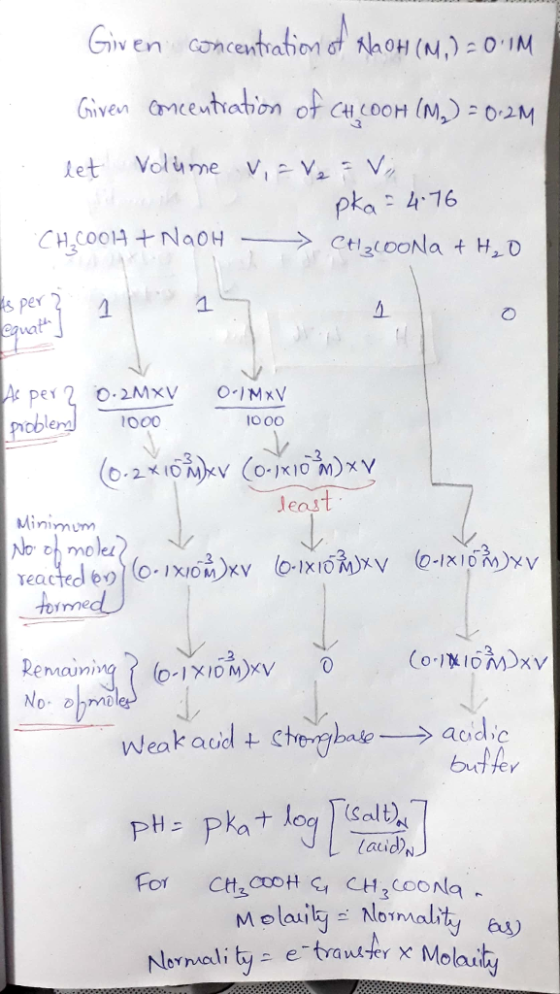
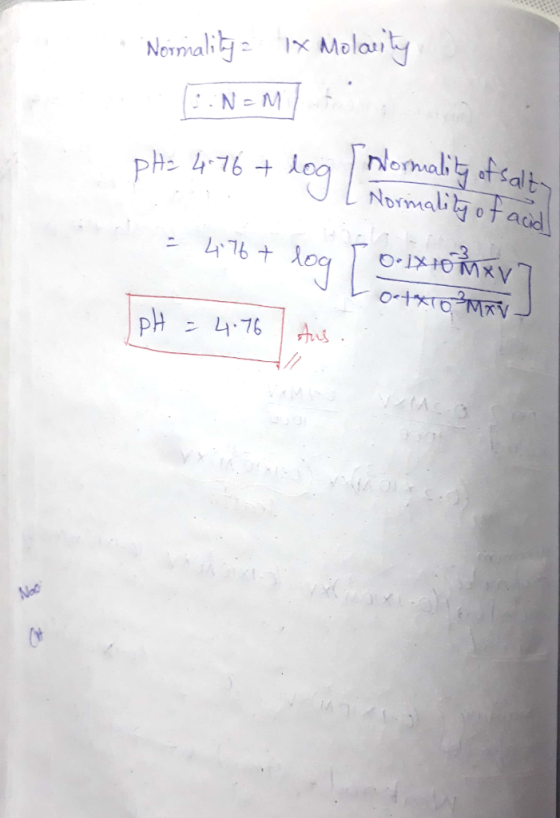
pH=pKa
A buffer solution is that solution which resists any change in its pH value on dilution or on addition of a small amount of a strong acid or a strong alkali.
Types of buffer:
(1) Acidic buffer
(2) Basic buffer
Acidic buffer: These are normally prepared by mixing either equal or different volumes of similar solutions of a weak acid and it's salt.
Ex: (CH3COOH+CH3COONa)
Basic buffer: These buffer solutions are prepared generally, by mixing either equal or different volumes of equimolar solutions of a weak base and it's salt.
Ex: ( NH4OH+NH4Cl)
The pH of an acid or base buffer solution can be calculated by the use of Henderson's equation I.e.
Acidic buffer is prepared by the reaction of weak acid and strong base which gives a salt of weak acid as product.
Basic buffer is prepared by tge reaction of weak base and strong acid which gives a salt of weak base as product.
pH=pKa+ log[salt/acid] => for acidic buffer
pOH=pKb+log[salt/base] => for basic buffer.
In the question the reaction of NaOH and CH3COOH gives CH3COONa a salt of weak acid, hence the reaction is acidic buffer.
Thank you so much! Kindly rate my response as you wish ?
Add Answer to:
If you mix equal volumes of 0.1M NaOH with 0.2M acetic acid, is
the resulting solution...
Prepare 100mL of a 0.2M acetate buffer solution of pH =4.76 (using 17.6N acetic acid and...
Prepare 100mL of a 0.2M acetate buffer solution of pH =4.76 (using 17.6N acetic acid and sodium acetate). a. Calculate the volume of acetic acid and weight of sodium acetate necessary to prepare the buffer solution. pKa of acetic acid is 4.76
Question 4. a.) Calculate the pH of a solution initially 0.1 M in acetic acid and 0.02 M in sodium acetate. The pKa for acetic acid is 4.76. b) Calculate the pH of the buffer if you add 10 ml of 0.1M...
Question 4. a.) Calculate the pH of a solution initially 0.1 M in acetic acid and 0.02 M in sodium acetate. The pKa for acetic acid is 4.76. b) Calculate the pH of the buffer if you add 10 ml of 0.1M HCl to 100 ml of the buffer in part a.
If you mix 10mL of 0.25M sodium acetatewith 35 mL of 0.1M acetic acid, what will...
If you mix 10mL of 0.25M sodium acetatewith 35 mL of 0.1M acetic acid, what will the pH of the resulting buffer be? The molarity?
Explain why equal volumes of 0.1M CH3COOH and 0.1M CH3CO2- function as a buffer solution, but...
Explain why equal volumes of 0.1M CH3COOH and 0.1M CH3CO2- function as a buffer solution, but equal volumes of 0.1M HCl and 0.1M NaCl or equal volumes of 0.1M HCl and 0.1M NaOH do not.
1) 10ml of 0.1M Nitric Acid is added to 20ml of 0.2M Sulfuric (H2SO4) and then...
1) 10ml of 0.1M Nitric Acid is added to 20ml of 0.2M Sulfuric (H2SO4) and then diluted up to 100 ml, what is the resulting pH? Hint: Recall [H3O+] = total moles of [H+]/total Volume 2) Which of the following acid solutions is the MOST acidic? (careful it’s a mix of concentrations as well as Ka and pKa) a) 1.0M Phenol, Ka = 1.3 x 10⁻¹⁰ b) 0.08M Pyruvic acid, pKa = 2.76 c) 0.1M Bromo-Acetic acid pKa =...
If you mix 60mL of 0.2 M acetic acid with 80mL of 0.4 M acetate, what...
If you mix 60mL of 0.2 M acetic acid with 80mL of 0.4 M acetate, what will be the resulting pH. Then how many total milliliters of 1M NaOH can you add to the solution and still have a good buffer? (that is, within 1 pH unit of pKa).
Question 4. a.) Calculate the pH of a solution initially 0.1 M in acetic acid and...
Question 4. a.) Calculate the pH of a solution initially 0.1 M in acetic acid and 0.02 M in sodium acetate. The pKa for acetic acid is 4.76. b) Calculate the pH of the buffer if you add 10 ml of 0.1M HCl to 100 ml of the buffer in part a.
Given 0.5 M solution of acetic acid (pKa = 4.76) and solid sodium acetate (Mr =...
Given 0.5 M solution of acetic acid (pKa = 4.76) and solid sodium acetate (Mr = 82 g/mol), describe how you would go about preparing 500 mL of 0.2M acetate buffer pH 4.0.
You have 775 mL of an 0.15 M acetic acid solution. What volume (V) of 1.80...
You have 775 mL of an 0.15 M acetic acid solution. What volume (V) of 1.80 M NaOH solution must you add in order to prepare an acetate buffer of pH = 4.65? (The pKa of acetic acid is 4.76.)
You have 125 mL of an 0.19 M acetic acid solution. What volume (V) of 1.10...
You have 125 mL of an 0.19 M acetic acid solution. What volume (V) of 1.10 M NaOH solution must you add in order to prepare an acetate buffer of pH = 4.20? (The pKa of acetic acid is 4.76.)
Most questions answered within 3 hours.
-
Where is the error in this code sequence?
String s1 = "Hello";
String s2 = "ello";...
asked 11 months ago -
Financial data for Joel de Paris, Inc., for last year
follow:
Joel de Paris, Inc.
Balance...
asked 11 months ago -
Consider this reaction:
Al2(SO4)3 (aq)+ BaCl3
(aq) Al2Cl6 (aq)- +
3BaSO4(s) . What is the...
asked 11 months ago -
Suppose that Savneet is considering increasing her
recent random sample from 20 car rentals to 40...
asked 11 months ago -
Trucks arrive at an unloading terminal at an average rate of 120
per hour.
Trucks arrive...
asked 11 months ago -
Why are methanol and ethanol completely soluble in water while
octanol is not very little soluble....
asked 11 months ago -
A facilities manager at a university reads in a research report
that the mean amount of...
asked 11 months ago -
When the CuSO4 is rehydrated by adding water to the anhydrous
compound, is this an endothermic...
asked 11 months ago -
A ray of sunlight is passing from diamond into crown glass; the
angle of incidence is...
asked 11 months ago -
A block of mass 0.249 kg is placed on top of a light, vertical
spring of...
asked 11 months ago -
how do the kidneys compensate in the presences of acidosis
a) trigger hyperventilate
b) reserve acid...
asked 11 months ago -
Question 501 pts
The rental rate of capital to the firm increases. Which of the
following...
asked 11 months ago