Provide one example of the following types of reactions involved in glycolysis and citric acid cycle...
Provide one example of the following types of reactions involved in glycolysis and citric acid cycle by showing chemical reactions with full chemical structures: (a) nucleophilic substitution reaction, indicating nucleophile and electrophile in the structure; (b) elimination reaction, indicating what is eliminated; (c) aldose condensation reaction (or the reverse of), indicating which bond is formed (or broken if reverse).
Homework Answers
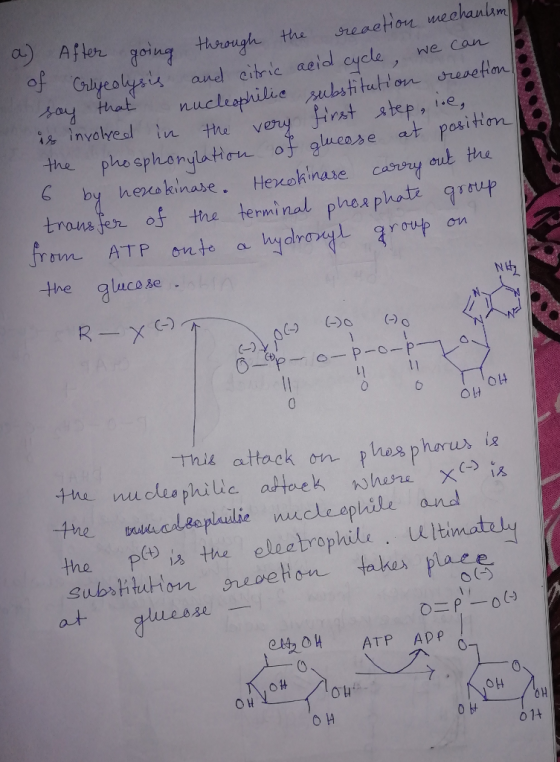
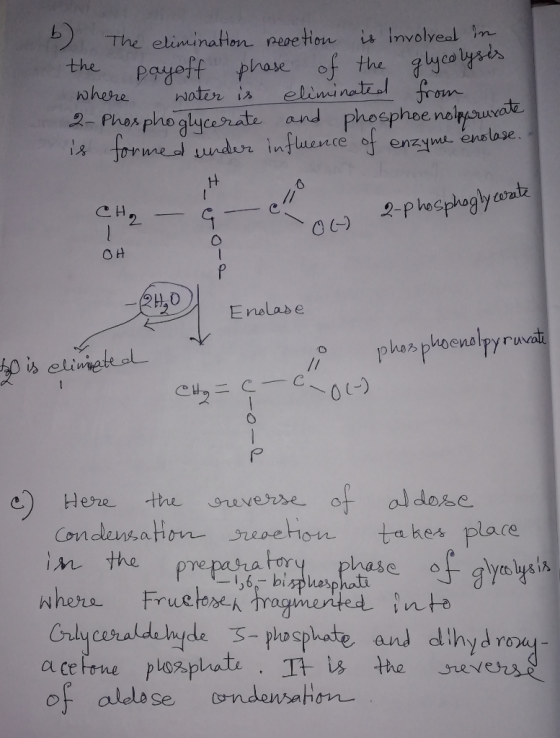
 Here one example of each
reaction (with structures and chemical reactions) is provided in
the attached images which are involved in the glycolysis and citric
acid cycle.
Here one example of each
reaction (with structures and chemical reactions) is provided in
the attached images which are involved in the glycolysis and citric
acid cycle.
Add Answer to:
Provide one example of the following types of reactions involved
in glycolysis and citric acid cycle...
Pick one mechanism from List A. Identify a reaction from the metabolic processes listed in Question...
Pick one mechanism from List A. Identify a reaction from the metabolic processes listed in Question 1 that uses the mechanism you’ve chosen. Diagram that reaction in atomic-level detail, showing curved arrows and intermediates throughout. If you use “R” to denote a chemical structure, be sure to define what “R” is. List A: A phosphate transfer reaction. An aldose to ketose isomerase. Elimination or Addition of water. Question 1: Glycolysis Gluconeogenesis Glycogenolysis Glycogenesis PDHC Citric Acid Cycle The Electron Transport...
1. (a) How many phosphoanhydride bond(s) are present in each of the following biomolecules? ADP:_____________________ AMP:_____________________...
1. (a) How many phosphoanhydride bond(s) are present in each of the following biomolecules? ADP:_____________________ AMP:_____________________ 1,3-Bisphosphoglycerate:______________________ Glucose-6-phosphate:_____________________ Glyceraldehyde-3-phosphate:_____________________ Fructose-1,6-bisphosphate:_____________________ Pyrophosphate (PPi) :______________________ (b) Using chemical names and structures write out the substrate-level phosphorylation steps (and not the full pathway) in glycolysis. Name the enzymes catalyzing these reactions. (c) Which enzyme catalyzes substrate-level phosphorylation in the citric acid cycle? d) Write the reaction using names and structures of the metabolites. (Note: no need to give the full chemical structures of...
1.(a) (2pts.) Draw the structural formula for each amine. (b) provide the IUPAC name the structure...
 1.(a) (2pts.) Draw the structural formula for each amine. (b) provide the IUPAC name the structure below 4-aminobutanal (R)-2-butanamine 2. (6 pts.) Consider the Grignard reaction shown below which forms a C-C bond via an Aw step. In box A, draw the structure of the nucleophile involved in the A step and highlight the nucleophilic atom. In box B, draw the structure of the electrophile involved in the Aw" step and circle the electrophilic atom. In box C, draw the...
QUESTION 5 This question explores the Calvin cycle in plants. A summary of the three stages of CO...
 QUESTION 5 This question explores the Calvin cycle in plants. A summary of the three stages of CO, assimilation in photosynthetic organisms is shown below (Fig. 20-31 from the text book). All the reactions of the Calvin cycle in detail are shown on the last page. Only the first three reactions are directly involved in carbon-fxation, assimilation and reduction, to Stage 3: ATP3 Regeneration of (3) Stage 1a Ribulose 1.5 e (GAP). The rest of the pathway results in the...
1-24 need help really lost Proton Transfer: deprotonation D. 1) Add the appropriate curved arrows for...
 1-24 need help really lost
Proton Transfer: deprotonation D. 1) Add the appropriate curved arrows for the following deprotonation step. Also add the other product notice how the Tema s can be converted to this by use of a strong base such as sodium a sodium ion (Na) is not drawn, in this case it is just a spectatorio PCW27 - Mechanistic steps - Part Name: Time spent 2) Label the above compounds with the appropriate name from the previous...
1-24 need help really lost
Proton Transfer: deprotonation D. 1) Add the appropriate curved arrows for the following deprotonation step. Also add the other product notice how the Tema s can be converted to this by use of a strong base such as sodium a sodium ion (Na) is not drawn, in this case it is just a spectatorio PCW27 - Mechanistic steps - Part Name: Time spent 2) Label the above compounds with the appropriate name from the previous...
use the notes provided to help answer the question above. will rate well The second step...
 use the notes provided to help answer the question
above. will rate well
The second step of the synthesis transformation of the chlorosulfonyl functional group into a sulfonamide) is an example of a a. Nucleophilic displacement (substitution) b Elimination C. Electrophilic aromatic substitution d. Acid hydrolysis Esterification e. THE SULFONIC ACID GROUP AND ITS DERIVATIVES Sulfonic acids are organic analogs of sulfuric acid, a very strong acid. They are highly corrosive, react vigorously with water, and can cause skin bums....
use the notes provided to help answer the question
above. will rate well
The second step of the synthesis transformation of the chlorosulfonyl functional group into a sulfonamide) is an example of a a. Nucleophilic displacement (substitution) b Elimination C. Electrophilic aromatic substitution d. Acid hydrolysis Esterification e. THE SULFONIC ACID GROUP AND ITS DERIVATIVES Sulfonic acids are organic analogs of sulfuric acid, a very strong acid. They are highly corrosive, react vigorously with water, and can cause skin bums....
need help with the boxed bullet point. writing the chemical reaction scheme for the experiment. Synthesis of an A...
 need help with the boxed bullet point. writing the chemical
reaction scheme for the experiment.
Synthesis of an Alkyl Halide: A Nucleophilic Substitution Reaction, Part I Pre-lab Assignment for Synthesis of an Alkyl Halide: A Nucleophilic Substitution Reaction, Part 1 1. From The Organic Chem Lab Survival Manual ( edition) by Zubrick • Review pages 201-204: Standard Reflux. • Review pages 127-140: Extraction • Review pages 164-189: Distillation, Simple Distillation. The Distillation Example, and The Distillation Mistake. 2. Read this...
need help with the boxed bullet point. writing the chemical
reaction scheme for the experiment.
Synthesis of an Alkyl Halide: A Nucleophilic Substitution Reaction, Part I Pre-lab Assignment for Synthesis of an Alkyl Halide: A Nucleophilic Substitution Reaction, Part 1 1. From The Organic Chem Lab Survival Manual ( edition) by Zubrick • Review pages 201-204: Standard Reflux. • Review pages 127-140: Extraction • Review pages 164-189: Distillation, Simple Distillation. The Distillation Example, and The Distillation Mistake. 2. Read this...
Fatty Acid Metabolism. The reactions of the fatty acid spiral are shown below. Use the description...
 Fatty Acid Metabolism. The reactions of the fatty acid spiral are shown below. Use the description on the left side of the page to classify the reactions and fill in the boxes on the right side of the page Activation Step. The activation of the fatty acid begins by the addition of CoA which will carry the fatty acid from the cytosol into the mitochondria. The product, which is a fatty acid with a CoA attached, is known as a...
What results when a secondary alcohol is oxidized? a. a ketone d. an acid b. an...
 What results when a secondary alcohol is oxidized? a. a ketone d. an acid b. an amine e. no reaction c. an aldehyde Which of the following combinations will react spontaneously? A. 12 + Cu2+ B. Pb2+ + Ag C. Zn2+ + Mg D. Sn2+ + Ni2+ The general formula for a cycloalkane can be represented by which of the following? a. C,H, C. CH b. C.H2n+2 d. C.H21-2 In a certain reaction AH =-136 kJ and E, = 96...
____ 1. The diagram below represents serine, a polar, uncharged amino acid. Which functional group gives...
 ____ 1. The diagram below represents serine, a polar, uncharged
amino acid. Which functional group gives serine its
distinct property?
a. H3
b. CH2OH
c. –H
d. COO–
____ 2. The monomers shown below are monomers for which of the
following natural polymers?
a. polysaccharides
b. plastics
c. DNA
d. proteins
____ 3. Which of the following processes illustrates the production
of a protein?
a. specific code for amino acids --> amino acid chain -->
gene --> DNA --> specific...
____ 1. The diagram below represents serine, a polar, uncharged
amino acid. Which functional group gives serine its
distinct property?
a. H3
b. CH2OH
c. –H
d. COO–
____ 2. The monomers shown below are monomers for which of the
following natural polymers?
a. polysaccharides
b. plastics
c. DNA
d. proteins
____ 3. Which of the following processes illustrates the production
of a protein?
a. specific code for amino acids --> amino acid chain -->
gene --> DNA --> specific...
 1.(a) (2pts.) Draw the structural formula for each amine. (b) provide the IUPAC name the structure below 4-aminobutanal (R)-2-butanamine 2. (6 pts.) Consider the Grignard reaction shown below which forms a C-C bond via an Aw step. In box A, draw the structure of the nucleophile involved in the A step and highlight the nucleophilic atom. In box B, draw the structure of the electrophile involved in the Aw" step and circle the electrophilic atom. In box C, draw the...
 QUESTION 5 This question explores the Calvin cycle in plants. A summary of the three stages of CO, assimilation in photosynthetic organisms is shown below (Fig. 20-31 from the text book). All the reactions of the Calvin cycle in detail are shown on the last page. Only the first three reactions are directly involved in carbon-fxation, assimilation and reduction, to Stage 3: ATP3 Regeneration of (3) Stage 1a Ribulose 1.5 e (GAP). The rest of the pathway results in the...
 1-24 need help really lost
Proton Transfer: deprotonation D. 1) Add the appropriate curved arrows for the following deprotonation step. Also add the other product notice how the Tema s can be converted to this by use of a strong base such as sodium a sodium ion (Na) is not drawn, in this case it is just a spectatorio PCW27 - Mechanistic steps - Part Name: Time spent 2) Label the above compounds with the appropriate name from the previous...
1-24 need help really lost
Proton Transfer: deprotonation D. 1) Add the appropriate curved arrows for the following deprotonation step. Also add the other product notice how the Tema s can be converted to this by use of a strong base such as sodium a sodium ion (Na) is not drawn, in this case it is just a spectatorio PCW27 - Mechanistic steps - Part Name: Time spent 2) Label the above compounds with the appropriate name from the previous...
 use the notes provided to help answer the question
above. will rate well
The second step of the synthesis transformation of the chlorosulfonyl functional group into a sulfonamide) is an example of a a. Nucleophilic displacement (substitution) b Elimination C. Electrophilic aromatic substitution d. Acid hydrolysis Esterification e. THE SULFONIC ACID GROUP AND ITS DERIVATIVES Sulfonic acids are organic analogs of sulfuric acid, a very strong acid. They are highly corrosive, react vigorously with water, and can cause skin bums....
use the notes provided to help answer the question
above. will rate well
The second step of the synthesis transformation of the chlorosulfonyl functional group into a sulfonamide) is an example of a a. Nucleophilic displacement (substitution) b Elimination C. Electrophilic aromatic substitution d. Acid hydrolysis Esterification e. THE SULFONIC ACID GROUP AND ITS DERIVATIVES Sulfonic acids are organic analogs of sulfuric acid, a very strong acid. They are highly corrosive, react vigorously with water, and can cause skin bums....
 need help with the boxed bullet point. writing the chemical
reaction scheme for the experiment.
Synthesis of an Alkyl Halide: A Nucleophilic Substitution Reaction, Part I Pre-lab Assignment for Synthesis of an Alkyl Halide: A Nucleophilic Substitution Reaction, Part 1 1. From The Organic Chem Lab Survival Manual ( edition) by Zubrick • Review pages 201-204: Standard Reflux. • Review pages 127-140: Extraction • Review pages 164-189: Distillation, Simple Distillation. The Distillation Example, and The Distillation Mistake. 2. Read this...
need help with the boxed bullet point. writing the chemical
reaction scheme for the experiment.
Synthesis of an Alkyl Halide: A Nucleophilic Substitution Reaction, Part I Pre-lab Assignment for Synthesis of an Alkyl Halide: A Nucleophilic Substitution Reaction, Part 1 1. From The Organic Chem Lab Survival Manual ( edition) by Zubrick • Review pages 201-204: Standard Reflux. • Review pages 127-140: Extraction • Review pages 164-189: Distillation, Simple Distillation. The Distillation Example, and The Distillation Mistake. 2. Read this...
 Fatty Acid Metabolism. The reactions of the fatty acid spiral are shown below. Use the description on the left side of the page to classify the reactions and fill in the boxes on the right side of the page Activation Step. The activation of the fatty acid begins by the addition of CoA which will carry the fatty acid from the cytosol into the mitochondria. The product, which is a fatty acid with a CoA attached, is known as a...
 What results when a secondary alcohol is oxidized? a. a ketone d. an acid b. an amine e. no reaction c. an aldehyde Which of the following combinations will react spontaneously? A. 12 + Cu2+ B. Pb2+ + Ag C. Zn2+ + Mg D. Sn2+ + Ni2+ The general formula for a cycloalkane can be represented by which of the following? a. C,H, C. CH b. C.H2n+2 d. C.H21-2 In a certain reaction AH =-136 kJ and E, = 96...
 ____ 1. The diagram below represents serine, a polar, uncharged
amino acid. Which functional group gives serine its
distinct property?
a. H3
b. CH2OH
c. –H
d. COO–
____ 2. The monomers shown below are monomers for which of the
following natural polymers?
a. polysaccharides
b. plastics
c. DNA
d. proteins
____ 3. Which of the following processes illustrates the production
of a protein?
a. specific code for amino acids --> amino acid chain -->
gene --> DNA --> specific...
____ 1. The diagram below represents serine, a polar, uncharged
amino acid. Which functional group gives serine its
distinct property?
a. H3
b. CH2OH
c. –H
d. COO–
____ 2. The monomers shown below are monomers for which of the
following natural polymers?
a. polysaccharides
b. plastics
c. DNA
d. proteins
____ 3. Which of the following processes illustrates the production
of a protein?
a. specific code for amino acids --> amino acid chain -->
gene --> DNA --> specific...
Most questions answered within 3 hours.
-
Where is the error in this code sequence?
String s1 = "Hello";
String s2 = "ello";...
asked 10 months ago -
Financial data for Joel de Paris, Inc., for last year
follow:
Joel de Paris, Inc.
Balance...
asked 10 months ago -
Consider this reaction:
Al2(SO4)3 (aq)+ BaCl3
(aq) Al2Cl6 (aq)- +
3BaSO4(s) . What is the...
asked 10 months ago -
Suppose that Savneet is considering increasing her
recent random sample from 20 car rentals to 40...
asked 10 months ago -
Trucks arrive at an unloading terminal at an average rate of 120
per hour.
Trucks arrive...
asked 10 months ago -
Why are methanol and ethanol completely soluble in water while
octanol is not very little soluble....
asked 10 months ago -
A facilities manager at a university reads in a research report
that the mean amount of...
asked 10 months ago -
When the CuSO4 is rehydrated by adding water to the anhydrous
compound, is this an endothermic...
asked 10 months ago -
A ray of sunlight is passing from diamond into crown glass; the
angle of incidence is...
asked 10 months ago -
A block of mass 0.249 kg is placed on top of a light, vertical
spring of...
asked 10 months ago -
how do the kidneys compensate in the presences of acidosis
a) trigger hyperventilate
b) reserve acid...
asked 10 months ago -
Question 501 pts
The rental rate of capital to the firm increases. Which of the
following...
asked 10 months ago