In column chromatography, what would be the reason for loading a silica gel column with dicholromethane...
In column chromatography, what would be the reason for loading a silica gel column with dicholromethane and then eluting with an ethyl acetate/heptanes mixture?
Homework Answers
dichloromethane is low boiling point solvent, therefore it will helpful to load silica column, after column packing dichloromethane will be evaporated easily silmply by mild heating, if we use ethyl acetate and hexane eluting solvent during loading polarity may change due to evaporation of solvent, therefore it is adviseable to use dichloromethane during loading and after evaporating eluting solvent ethyl acetate and hexane can be used.
Add Answer to:
In column chromatography, what would be the reason for loading a
silica gel column with dicholromethane...
Discuss how silica gel column chromatography can be used to purify a mixture of compounds.
Discuss how silica gel column chromatography can be used to purify a mixture of compounds.
The student loads the solid onto a column, prepacked with silica gel, and elutes the column...
 The student loads the solid onto a column, prepacked with silica gel, and elutes the column with an appropriate solvent system to allow the components to be completed separated. 11. Based on your understanding of column chromatography, which of the following solvent systems is most likely to yield the best separation of the two components in this mixture? Please explain your answer BRIEFLY (5 pts)! The ranking of solvent polarity is: MeOH>ethyl acetate> hexane (ie, MeOH is the most polar)....
4. Consider the following silica gel TLC plac or compounds A, B, and hexines: developed in...
 4. Consider the following silica gel TLC plac or compounds A, B, and hexines: developed in Fo-o- og a) Determine the Rr values of compounds A, B, and C run on a silica gel TLC plate using hexanes as the solvent b) Which compound, A, B, or C. is the most polar? values if you used acetone instead c) What would you expect to happen to the of hexanes as the eluting solvent? 5) Consider a sample that is a...
1-) Silica gel has a bulk density of about 0.3 g/cm3, so 15 g would occupy...
1-) Silica gel has a bulk density of about 0.3 g/cm3, so 15 g would occupy a volume of 45-50 cm3 (45-50 mL). This quantity is called the: 2-) You are carrying out a chromatographic separation on a 15 mg sample using 6.5 g of silica gel in your column. If you aim for a column height of 10 cm of silica gel, what is the inside diameter of the necessary chromatography column in units of cm? 3-) Consider the...
A mixture of lipids is applied to a silica gel column, and the column is then...
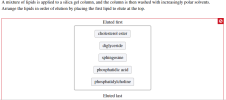 A mixture of lipids is applied to a silica gel column, and the column is then washed with increasingly polar solvents. Arrange the lipids in order of elution by placing the first lipid to elute at the top. Eluted first cholesterol ester diglyceride sphingosine phosphatidic acid phosphatidylcholine Eluted last
A mixture of lipids is applied to a silica gel column, and the column is then...
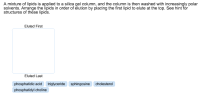 A mixture of lipids is applied to a silica gel column, and the column is then washed with increasingly polar solvents. Arrange the lipids in order of elution by placing the first lipid to elute at the top. See hint for structures of these lipids. Eluted First Eluted Last phosphatidic acid triglyceride sphingosine cholesterol phosphatidyl choline
During a liquid chromatography lab, caffeine and theophylline were separated into an octadecyl silica column (C18)...
 During a liquid chromatography lab, caffeine and theophylline
were separated into an octadecyl silica column (C18) with a mobile
phase consisting of a mixture of water and methanol.
What is the elution scheme?
b) Reason with current theory as background what is expected to happen
the retention factors in case:
- the methanol content in the mobile phase is increased?
- the flow rate is increased?
- the column is replaced with one consisting of octyl silica (C8)?
- switching...
During a liquid chromatography lab, caffeine and theophylline
were separated into an octadecyl silica column (C18) with a mobile
phase consisting of a mixture of water and methanol.
What is the elution scheme?
b) Reason with current theory as background what is expected to happen
the retention factors in case:
- the methanol content in the mobile phase is increased?
- the flow rate is increased?
- the column is replaced with one consisting of octyl silica (C8)?
- switching...
(6 pts) In column chromatography, loading of the column should be done with the most concentrated...
 (6 pts) In column chromatography, loading of the column should be done with the most concentrated solution of analyte possible. What would be the consequence of loading the column with a more dilute solution? 3.
(6 pts) In column chromatography, loading of the column should be done with the most concentrated solution of analyte possible. What would be the consequence of loading the column with a more dilute solution? 3.
(6 pts) In column chromatography, loading of the column should be done with the most concentrated solution of analyte possible. What would be the consequence of loading the column with a more dilute solution? 3.
What is the main purpose of running a column chromatography? Similar to TLC. column chromatography is...
 What is the main purpose of running a column chromatography? Similar to TLC. column chromatography is based on analytes being partitioned between a stationary phase (not moving) and a mobile phase (moving). What is most commonly used as stationary phase in a column? Is this material polar or non-polar? In this experiment, you will use different solvents to run column chromatography separation of different pigments extracted from spinach leaves. These solvents are a mixture of acetone and hexanes. (a) What...
2. An unknown compound was analyzed using thin layer chromatography, its constituted of two components (A...
 2. An unknown compound was analyzed using thin layer chromatography, its constituted of two components (A and B) as shown in the TLC (Silica coated stationary phase; Chloroform and Ethyl acetate as mobile phase). The mixture was then loaded onto column with silica as the stationary phase and the same solvent system was used. (2 points) Column Chromatography TLC time A В Predict the order of elution of the compounds (A and B). which one would be eluted first/last and...
 The student loads the solid onto a column, prepacked with silica gel, and elutes the column with an appropriate solvent system to allow the components to be completed separated. 11. Based on your understanding of column chromatography, which of the following solvent systems is most likely to yield the best separation of the two components in this mixture? Please explain your answer BRIEFLY (5 pts)! The ranking of solvent polarity is: MeOH>ethyl acetate> hexane (ie, MeOH is the most polar)....
 4. Consider the following silica gel TLC plac or compounds A, B, and hexines: developed in Fo-o- og a) Determine the Rr values of compounds A, B, and C run on a silica gel TLC plate using hexanes as the solvent b) Which compound, A, B, or C. is the most polar? values if you used acetone instead c) What would you expect to happen to the of hexanes as the eluting solvent? 5) Consider a sample that is a...
 A mixture of lipids is applied to a silica gel column, and the column is then washed with increasingly polar solvents. Arrange the lipids in order of elution by placing the first lipid to elute at the top. Eluted first cholesterol ester diglyceride sphingosine phosphatidic acid phosphatidylcholine Eluted last
 A mixture of lipids is applied to a silica gel column, and the column is then washed with increasingly polar solvents. Arrange the lipids in order of elution by placing the first lipid to elute at the top. See hint for structures of these lipids. Eluted First Eluted Last phosphatidic acid triglyceride sphingosine cholesterol phosphatidyl choline
 During a liquid chromatography lab, caffeine and theophylline
were separated into an octadecyl silica column (C18) with a mobile
phase consisting of a mixture of water and methanol.
What is the elution scheme?
b) Reason with current theory as background what is expected to happen
the retention factors in case:
- the methanol content in the mobile phase is increased?
- the flow rate is increased?
- the column is replaced with one consisting of octyl silica (C8)?
- switching...
During a liquid chromatography lab, caffeine and theophylline
were separated into an octadecyl silica column (C18) with a mobile
phase consisting of a mixture of water and methanol.
What is the elution scheme?
b) Reason with current theory as background what is expected to happen
the retention factors in case:
- the methanol content in the mobile phase is increased?
- the flow rate is increased?
- the column is replaced with one consisting of octyl silica (C8)?
- switching...
 (6 pts) In column chromatography, loading of the column should be done with the most concentrated solution of analyte possible. What would be the consequence of loading the column with a more dilute solution? 3.
(6 pts) In column chromatography, loading of the column should be done with the most concentrated solution of analyte possible. What would be the consequence of loading the column with a more dilute solution? 3.
(6 pts) In column chromatography, loading of the column should be done with the most concentrated solution of analyte possible. What would be the consequence of loading the column with a more dilute solution? 3.
 What is the main purpose of running a column chromatography? Similar to TLC. column chromatography is based on analytes being partitioned between a stationary phase (not moving) and a mobile phase (moving). What is most commonly used as stationary phase in a column? Is this material polar or non-polar? In this experiment, you will use different solvents to run column chromatography separation of different pigments extracted from spinach leaves. These solvents are a mixture of acetone and hexanes. (a) What...
 2. An unknown compound was analyzed using thin layer chromatography, its constituted of two components (A and B) as shown in the TLC (Silica coated stationary phase; Chloroform and Ethyl acetate as mobile phase). The mixture was then loaded onto column with silica as the stationary phase and the same solvent system was used. (2 points) Column Chromatography TLC time A В Predict the order of elution of the compounds (A and B). which one would be eluted first/last and...
Most questions answered within 3 hours.
-
Where is the error in this code sequence?
String s1 = "Hello";
String s2 = "ello";...
asked 10 months ago -
Financial data for Joel de Paris, Inc., for last year
follow:
Joel de Paris, Inc.
Balance...
asked 10 months ago -
Consider this reaction:
Al2(SO4)3 (aq)+ BaCl3
(aq) Al2Cl6 (aq)- +
3BaSO4(s) . What is the...
asked 10 months ago -
Suppose that Savneet is considering increasing her
recent random sample from 20 car rentals to 40...
asked 10 months ago -
Trucks arrive at an unloading terminal at an average rate of 120
per hour.
Trucks arrive...
asked 10 months ago -
Why are methanol and ethanol completely soluble in water while
octanol is not very little soluble....
asked 10 months ago -
A facilities manager at a university reads in a research report
that the mean amount of...
asked 10 months ago -
When the CuSO4 is rehydrated by adding water to the anhydrous
compound, is this an endothermic...
asked 10 months ago -
A ray of sunlight is passing from diamond into crown glass; the
angle of incidence is...
asked 10 months ago -
A block of mass 0.249 kg is placed on top of a light, vertical
spring of...
asked 10 months ago -
how do the kidneys compensate in the presences of acidosis
a) trigger hyperventilate
b) reserve acid...
asked 10 months ago -
Question 501 pts
The rental rate of capital to the firm increases. Which of the
following...
asked 10 months ago