
Homework Answers
If the loaded analyte is too diluted, then the fractions collected from the column will be diluted as well. When you check the TLC of the fractions, the spots would be faint and even they may not be visible.
In that case, you may miss one or more fractions and your recovery yield of the analyte would be too low.
Add Answer to:
(6 pts) In column chromatography, loading of the column should be done with the most concentrated...
In column chromatography, what would be the reason for loading a silica gel column with dicholromethane...
In column chromatography, what would be the reason for loading a silica gel column with dicholromethane and then eluting with an ethyl acetate/heptanes mixture?
question #2 please Reverse phase chromatography is the most common type of liquid chromatography which the...
 question #2 please
Reverse phase chromatography is the most common type of liquid chromatography which the solid phase is made up of a packing material that is largely hydrophobic and the eluents are of varying polarities. In general, the more polar compounds elute first from the column followed by more hydrophobic compounds. PRELAB QUESTIONS 1. Draw structures for the following analytes for the simulation: a. acetophenone b. benzophenone c. butylparaben d. propiopheneone e. ethylparaben f. propylparaben g. ketoprofen h. 3-nitrophenol...
question #2 please
Reverse phase chromatography is the most common type of liquid chromatography which the solid phase is made up of a packing material that is largely hydrophobic and the eluents are of varying polarities. In general, the more polar compounds elute first from the column followed by more hydrophobic compounds. PRELAB QUESTIONS 1. Draw structures for the following analytes for the simulation: a. acetophenone b. benzophenone c. butylparaben d. propiopheneone e. ethylparaben f. propylparaben g. ketoprofen h. 3-nitrophenol...
Acetylation of ferrocene and column chromatography Lab 4: Question 3 Homework • Unanswered Important ... The...
 Acetylation of ferrocene and column chromatography
Lab 4: Question 3 Homework • Unanswered Important ... The solvent is changed from petroleum ether to diethyl ether after the ferrocene is collected from the column. Why not use diethyl ether the entire time? Because diethyl ether is more polar than petroleum ether Because petroleum ether selectively elutes ferrocene since it contains more ether oxygens than diethyl ether Because diethyl ether would lead to a poorer separation of ferrocene and acetylferrocene Both a...
Acetylation of ferrocene and column chromatography
Lab 4: Question 3 Homework • Unanswered Important ... The solvent is changed from petroleum ether to diethyl ether after the ferrocene is collected from the column. Why not use diethyl ether the entire time? Because diethyl ether is more polar than petroleum ether Because petroleum ether selectively elutes ferrocene since it contains more ether oxygens than diethyl ether Because diethyl ether would lead to a poorer separation of ferrocene and acetylferrocene Both a...
1. What is the purpose of column chromatography 2. What is the stationary phase? Mobile phase?...
 1. What is the purpose of column chromatography 2. What is the stationary phase? Mobile phase? 3. What is the purpose of the cotton (glass wool) in column chromatography? 4. What is the purpose of the sand? 5. Why is it important to prevent the column from drying? 6. What can happen if you disrupt your even layer of silica gel? 7. Which compounds come off the column first, polar or nonpolar? 8. Keyon synthesized acetylferrocene (orange) in organic chemistry...
both the questions those are related to each Another labmate is performing ion exchange column chromatography...
 both the questions those are related to each
Another labmate is performing ion exchange column chromatography to purify a mixture of proteins. She monitored the A20 of the solution eluting from the column over time, and plotted the data as shown in the following graph A280 דודודודו 2 4 6 8 10 12 14 16 18 20 Elution Time (min) Your labmate would really like to resolve her proteins better. How might she modify the efficiency oLine column, and how...
both the questions those are related to each
Another labmate is performing ion exchange column chromatography to purify a mixture of proteins. She monitored the A20 of the solution eluting from the column over time, and plotted the data as shown in the following graph A280 דודודודו 2 4 6 8 10 12 14 16 18 20 Elution Time (min) Your labmate would really like to resolve her proteins better. How might she modify the efficiency oLine column, and how...
these questions are in reference to gel filtration chromatography Fost lab questions on lab 8: Analysis...
 these questions are in reference to gel filtration
chromatography
Fost lab questions on lab 8: Analysis of Laboratory Results 1. If the following mix of molecules were parified using sine exclusion chromatography, what would be the 6 WI onder in which the molecules pass chrough the opening in the bottom of the column? Mixture containingR hemoglobin, 65,000 daltons; myoglobin, 17,000 daltons; myosin, 180,000 daltons. rhe tw First molecule to appear Second molecule to appear Third molecule to appear 2. Ifa...
these questions are in reference to gel filtration
chromatography
Fost lab questions on lab 8: Analysis of Laboratory Results 1. If the following mix of molecules were parified using sine exclusion chromatography, what would be the 6 WI onder in which the molecules pass chrough the opening in the bottom of the column? Mixture containingR hemoglobin, 65,000 daltons; myoglobin, 17,000 daltons; myosin, 180,000 daltons. rhe tw First molecule to appear Second molecule to appear Third molecule to appear 2. Ifa...
map the changes and determine the score Column 49. This question should be done by HAND....
 map the changes and determine the score
Column 49. This question should be done by HAND.
a. This column has evolved to contain all 4 nucleotides in
different species. It is therefore a very variable column in the
character matrix. Determine the most parsimonious number of changes
for the circumstance where the ancestor is each of the 4
nucleotides. In other words, first assume the ancestor is "A". How
many changes would need to happen in the tree to produce...
map the changes and determine the score
Column 49. This question should be done by HAND.
a. This column has evolved to contain all 4 nucleotides in
different species. It is therefore a very variable column in the
character matrix. Determine the most parsimonious number of changes
for the circumstance where the ancestor is each of the 4
nucleotides. In other words, first assume the ancestor is "A". How
many changes would need to happen in the tree to produce...
4. (6 pts) A researcher has extracted malvidin 3-glucoside from grape skins and wishes to ensure...
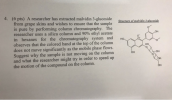 4. (6 pts) A researcher has extracted malvidin 3-glucoside from grape skins and wishes to ensure that the sample is pure by performing column chromatography. The researcher uses a silica column and 90% ethyl acetate in hexanes for the chromatography system and observes that the colored band at the top of the column does not move significantly as the mobile phase flows. Suggest why the sample is not moving on the column and what the researcher might try in order...
T-Mobile 11:45 AM Course Website Name: 7. Column 49. This question should be done by HAND a. This...
 T-Mobile 11:45 AM Course Website Name: 7. Column 49. This question should be done by HAND a. This column has evolved to contain all 4 nucleotides in different species. It is therefore a very variable column in the character matrix. Determine the most parsimonious number of changes for the circumstance where the ancestor is each of the 4 nucleotides. In other words, first assume the ancestor is "A". How many changes would need to happen in the tree to produce...
Case C Thin Layer Chromatography 1. TOXI-LAB is a screening method that uses: chromatography (column /...
 Case C Thin Layer Chromatography 1. TOXI-LAB is a screening method that uses: chromatography (column / planar) The first step consists of the extraction of drug metabolites from biological fluids when we place the sample in a test tube containing a mixture of solvents and buffering salts that cause the extraction of basic and neutral drugs. The solvent extract of the sample is concentrated by heat and evaporation, then is deposited onto a small disc of chromatographic media (small circle...
 question #2 please
Reverse phase chromatography is the most common type of liquid chromatography which the solid phase is made up of a packing material that is largely hydrophobic and the eluents are of varying polarities. In general, the more polar compounds elute first from the column followed by more hydrophobic compounds. PRELAB QUESTIONS 1. Draw structures for the following analytes for the simulation: a. acetophenone b. benzophenone c. butylparaben d. propiopheneone e. ethylparaben f. propylparaben g. ketoprofen h. 3-nitrophenol...
question #2 please
Reverse phase chromatography is the most common type of liquid chromatography which the solid phase is made up of a packing material that is largely hydrophobic and the eluents are of varying polarities. In general, the more polar compounds elute first from the column followed by more hydrophobic compounds. PRELAB QUESTIONS 1. Draw structures for the following analytes for the simulation: a. acetophenone b. benzophenone c. butylparaben d. propiopheneone e. ethylparaben f. propylparaben g. ketoprofen h. 3-nitrophenol...
 Acetylation of ferrocene and column chromatography
Lab 4: Question 3 Homework • Unanswered Important ... The solvent is changed from petroleum ether to diethyl ether after the ferrocene is collected from the column. Why not use diethyl ether the entire time? Because diethyl ether is more polar than petroleum ether Because petroleum ether selectively elutes ferrocene since it contains more ether oxygens than diethyl ether Because diethyl ether would lead to a poorer separation of ferrocene and acetylferrocene Both a...
Acetylation of ferrocene and column chromatography
Lab 4: Question 3 Homework • Unanswered Important ... The solvent is changed from petroleum ether to diethyl ether after the ferrocene is collected from the column. Why not use diethyl ether the entire time? Because diethyl ether is more polar than petroleum ether Because petroleum ether selectively elutes ferrocene since it contains more ether oxygens than diethyl ether Because diethyl ether would lead to a poorer separation of ferrocene and acetylferrocene Both a...
 1. What is the purpose of column chromatography 2. What is the stationary phase? Mobile phase? 3. What is the purpose of the cotton (glass wool) in column chromatography? 4. What is the purpose of the sand? 5. Why is it important to prevent the column from drying? 6. What can happen if you disrupt your even layer of silica gel? 7. Which compounds come off the column first, polar or nonpolar? 8. Keyon synthesized acetylferrocene (orange) in organic chemistry...
 both the questions those are related to each
Another labmate is performing ion exchange column chromatography to purify a mixture of proteins. She monitored the A20 of the solution eluting from the column over time, and plotted the data as shown in the following graph A280 דודודודו 2 4 6 8 10 12 14 16 18 20 Elution Time (min) Your labmate would really like to resolve her proteins better. How might she modify the efficiency oLine column, and how...
both the questions those are related to each
Another labmate is performing ion exchange column chromatography to purify a mixture of proteins. She monitored the A20 of the solution eluting from the column over time, and plotted the data as shown in the following graph A280 דודודודו 2 4 6 8 10 12 14 16 18 20 Elution Time (min) Your labmate would really like to resolve her proteins better. How might she modify the efficiency oLine column, and how...
 these questions are in reference to gel filtration
chromatography
Fost lab questions on lab 8: Analysis of Laboratory Results 1. If the following mix of molecules were parified using sine exclusion chromatography, what would be the 6 WI onder in which the molecules pass chrough the opening in the bottom of the column? Mixture containingR hemoglobin, 65,000 daltons; myoglobin, 17,000 daltons; myosin, 180,000 daltons. rhe tw First molecule to appear Second molecule to appear Third molecule to appear 2. Ifa...
these questions are in reference to gel filtration
chromatography
Fost lab questions on lab 8: Analysis of Laboratory Results 1. If the following mix of molecules were parified using sine exclusion chromatography, what would be the 6 WI onder in which the molecules pass chrough the opening in the bottom of the column? Mixture containingR hemoglobin, 65,000 daltons; myoglobin, 17,000 daltons; myosin, 180,000 daltons. rhe tw First molecule to appear Second molecule to appear Third molecule to appear 2. Ifa...
 map the changes and determine the score
Column 49. This question should be done by HAND.
a. This column has evolved to contain all 4 nucleotides in
different species. It is therefore a very variable column in the
character matrix. Determine the most parsimonious number of changes
for the circumstance where the ancestor is each of the 4
nucleotides. In other words, first assume the ancestor is "A". How
many changes would need to happen in the tree to produce...
map the changes and determine the score
Column 49. This question should be done by HAND.
a. This column has evolved to contain all 4 nucleotides in
different species. It is therefore a very variable column in the
character matrix. Determine the most parsimonious number of changes
for the circumstance where the ancestor is each of the 4
nucleotides. In other words, first assume the ancestor is "A". How
many changes would need to happen in the tree to produce...
 4. (6 pts) A researcher has extracted malvidin 3-glucoside from grape skins and wishes to ensure that the sample is pure by performing column chromatography. The researcher uses a silica column and 90% ethyl acetate in hexanes for the chromatography system and observes that the colored band at the top of the column does not move significantly as the mobile phase flows. Suggest why the sample is not moving on the column and what the researcher might try in order...
 T-Mobile 11:45 AM Course Website Name: 7. Column 49. This question should be done by HAND a. This column has evolved to contain all 4 nucleotides in different species. It is therefore a very variable column in the character matrix. Determine the most parsimonious number of changes for the circumstance where the ancestor is each of the 4 nucleotides. In other words, first assume the ancestor is "A". How many changes would need to happen in the tree to produce...
 Case C Thin Layer Chromatography 1. TOXI-LAB is a screening method that uses: chromatography (column / planar) The first step consists of the extraction of drug metabolites from biological fluids when we place the sample in a test tube containing a mixture of solvents and buffering salts that cause the extraction of basic and neutral drugs. The solvent extract of the sample is concentrated by heat and evaporation, then is deposited onto a small disc of chromatographic media (small circle...
Most questions answered within 3 hours.
-
Where is the error in this code sequence?
String s1 = "Hello";
String s2 = "ello";...
asked 10 months ago -
Financial data for Joel de Paris, Inc., for last year
follow:
Joel de Paris, Inc.
Balance...
asked 10 months ago -
Consider this reaction:
Al2(SO4)3 (aq)+ BaCl3
(aq) Al2Cl6 (aq)- +
3BaSO4(s) . What is the...
asked 10 months ago -
Suppose that Savneet is considering increasing her
recent random sample from 20 car rentals to 40...
asked 10 months ago -
Trucks arrive at an unloading terminal at an average rate of 120
per hour.
Trucks arrive...
asked 10 months ago -
Why are methanol and ethanol completely soluble in water while
octanol is not very little soluble....
asked 10 months ago -
A facilities manager at a university reads in a research report
that the mean amount of...
asked 10 months ago -
When the CuSO4 is rehydrated by adding water to the anhydrous
compound, is this an endothermic...
asked 10 months ago -
A ray of sunlight is passing from diamond into crown glass; the
angle of incidence is...
asked 10 months ago -
A block of mass 0.249 kg is placed on top of a light, vertical
spring of...
asked 10 months ago -
how do the kidneys compensate in the presences of acidosis
a) trigger hyperventilate
b) reserve acid...
asked 10 months ago -
Question 501 pts
The rental rate of capital to the firm increases. Which of the
following...
asked 10 months ago