The following gas-phase reaction follows first-order kinetics. CIO2F======> CIOF+O The activation energy of this reaction is...
The following gas-phase reaction follows first-order kinetics.
CIO2F======> CIOF+O
The activation energy of this reaction is 186 kJ/mol. The value of k at 322°C is 6.76 x 10⁻⁴ S-1 .
a. What would be the value of k for this reaction at room temperature, 25°C?
k = _____ S-1
b. At what temperature would this reaction have a k value of ?
Temperature = ______ oC
Homework Answers

Add Answer to:
The following gas-phase reaction follows first-order
kinetics.
CIO2F======> CIOF+O
The activation energy of this reaction is...
The following gas-phase reaction follows first-order kinetics. CIO2F======> CIOF+O The activation energy of this reaction is...
The following gas-phase reaction follows first-order kinetics. CIO2F======> CIOF+O The activation energy of this reaction is 186 kJ/mol. The value of k at 322°C is 6.76 x 10⁻⁴ S-1 . a. What would be the value of k for this reaction at room temperature, 25°C? k = _____ S-1 b. At what temperature would this reaction have a k value of 9.50 x 10⁻² S-1 ? Temperature = ______ oC
mead CHM 112 8. The activation energy for t he reaction CIO,F(B)CIOFO) is 186 KJ/mol. If...
 mead CHM 112 8. The activation energy for t he reaction CIO,F(B)CIOFO) is 186 KJ/mol. If the value of k i s 6.76 x 10" s-1 at 322℃ what is the value of k at 50 ℃? Use: In(k2)-In(k)--Ea ( 1-1 )
The decomposition of phosphine, PH3, follows first-order kinetics: 4 PH3(g) → P4(g) + 6 H2(g) Calculate...
 The decomposition of phosphine, PH3, follows first-order kinetics: 4 PH3(g) → P4(g) + 6 H2(g) Calculate the activation energy, Eq, in kJ/mol for the reaction, given that the rate constant k (at 25 °C) = 0.00852 s 1 and k (at 50 °C) = 0.756 s 1. 231 kJ/mol 144 kJ/mol O 56.5 kJ/mol О 99.3 kJ/mol O 111 kJ/mol
. (a) If a first-order reaction has an activation energy of 104.6 kJ/mol and, in the...
. (a) If a first-order reaction has an activation energy of 104.6 kJ/mol and, in the equation k = k0 exp (-Ea/RT), k0 has a value of 5×10¹³/s, at what temperature will the reaction have a half-life of (i) 1 h; (ii) 1 day? [Note: the value of R is 8.314 kJ/kmol·K.] (b) If the sterilization of a biomaterial was heating at 121°C for 5 min, it could only be heated at 111°C due to the failure of the heating...
The gas phase reaction 2 N2O5(g) → 4 NO2(g) + O2(g) has an activation energy of...
The gas phase reaction 2 N2O5(g) → 4 NO2(g) + O2(g) has an activation energy of 103 kJ/mol, and the first order rate constant is 1.01×10⁻⁴ min-1 at 278 K. What is the rate constant at 308 K? ________min-1
1) 2) 3) The decomposition of dinitrogen tetroxide to nitrogen dioxide at 400°C follows first-order kinetics...
 1)
2)
3)
The decomposition of dinitrogen tetroxide to nitrogen dioxide at 400°C follows first-order kinetics with a rate constant of 3.84 X10⁻³-1. Starting with pure N204, how many minutes will it take for 38.0% to decompose? Suppose the surface-catalyzed hydrogenation reaction of an unsaturated hydrocarbon has a rate constant of 0.374 M/min. The reaction is observed to follow zero-order kinetics. If the initial concentration of the hydrocarbon is 2.90 M, what is the half-life of the reaction in seconds?...
1)
2)
3)
The decomposition of dinitrogen tetroxide to nitrogen dioxide at 400°C follows first-order kinetics with a rate constant of 3.84 X10⁻³-1. Starting with pure N204, how many minutes will it take for 38.0% to decompose? Suppose the surface-catalyzed hydrogenation reaction of an unsaturated hydrocarbon has a rate constant of 0.374 M/min. The reaction is observed to follow zero-order kinetics. If the initial concentration of the hydrocarbon is 2.90 M, what is the half-life of the reaction in seconds?...
Question 49 8 pts The isomerization of methylisocyanide, CH3NC - CH3CN, follows first-order kinetics. The half-lives...
The isomerization of methyl isocyanide, CH3NC - CH3CN, follows first-order kinetics. The half-lives were found to be 161 min at 199°C and 12.5 min at 230°C. Calculate the activation energy for this reaction. (R-8.314 J/mol K) 124 kJ/mol 6.17 x 10⁻³kJ/mol 78.2 kJ/mol 163 kJ/mol 31.4 kJ/mo
5b. The hydrolysis of 1-chloro-Imethylheptane in 80% ethanol follows first order kinetics. The values of the...
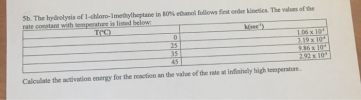 5b. The hydrolysis of 1-chloro-Imethylheptane in 80% ethanol follows first order kinetics. The values of the rate constant with temperature is listed below: T("C) k(see) 0 1.06 x 10% 25 3.19 x 10 2.92 x 10 Calculate the activation energy for the reaction an the value of the rate at infinitely high temperature..
6. The uncoiling of deoxyribonucleic acid (DNA) is a first order reaction with an activation energy...
 6. The uncoiling of deoxyribonucleic acid (DNA) is a first order reaction with an activation energy of 420. kJ/mol. If the rate constant is 2.94 x 10⁻²⁵-1 at 37°C, what is the rate constant when the temperature is decreased to 25°C?
2. The activation energy for the following first-order reaction is 102 kJ/mol. N2O(g) → 2NO(g) +...
 2. The activation energy for the following first-order reaction is 102 kJ/mol. N2O(g) → 2NO(g) + 1/2O2(g) The value of the rate constant (k) is 1.35 x 10-s-1 at 35°C. What is the value of k at 20°C? (6 points)
 mead CHM 112 8. The activation energy for t he reaction CIO,F(B)CIOFO) is 186 KJ/mol. If the value of k i s 6.76 x 10" s-1 at 322℃ what is the value of k at 50 ℃? Use: In(k2)-In(k)--Ea ( 1-1 )
 The decomposition of phosphine, PH3, follows first-order kinetics: 4 PH3(g) → P4(g) + 6 H2(g) Calculate the activation energy, Eq, in kJ/mol for the reaction, given that the rate constant k (at 25 °C) = 0.00852 s 1 and k (at 50 °C) = 0.756 s 1. 231 kJ/mol 144 kJ/mol O 56.5 kJ/mol О 99.3 kJ/mol O 111 kJ/mol
 1)
2)
3)
The decomposition of dinitrogen tetroxide to nitrogen dioxide at 400°C follows first-order kinetics with a rate constant of 3.84 X10⁻³-1. Starting with pure N204, how many minutes will it take for 38.0% to decompose? Suppose the surface-catalyzed hydrogenation reaction of an unsaturated hydrocarbon has a rate constant of 0.374 M/min. The reaction is observed to follow zero-order kinetics. If the initial concentration of the hydrocarbon is 2.90 M, what is the half-life of the reaction in seconds?...
1)
2)
3)
The decomposition of dinitrogen tetroxide to nitrogen dioxide at 400°C follows first-order kinetics with a rate constant of 3.84 X10⁻³-1. Starting with pure N204, how many minutes will it take for 38.0% to decompose? Suppose the surface-catalyzed hydrogenation reaction of an unsaturated hydrocarbon has a rate constant of 0.374 M/min. The reaction is observed to follow zero-order kinetics. If the initial concentration of the hydrocarbon is 2.90 M, what is the half-life of the reaction in seconds?...
 5b. The hydrolysis of 1-chloro-Imethylheptane in 80% ethanol follows first order kinetics. The values of the rate constant with temperature is listed below: T("C) k(see) 0 1.06 x 10% 25 3.19 x 10 2.92 x 10 Calculate the activation energy for the reaction an the value of the rate at infinitely high temperature..
 6. The uncoiling of deoxyribonucleic acid (DNA) is a first order reaction with an activation energy of 420. kJ/mol. If the rate constant is 2.94 x 10⁻²⁵-1 at 37°C, what is the rate constant when the temperature is decreased to 25°C?
 2. The activation energy for the following first-order reaction is 102 kJ/mol. N2O(g) → 2NO(g) + 1/2O2(g) The value of the rate constant (k) is 1.35 x 10-s-1 at 35°C. What is the value of k at 20°C? (6 points)
Most questions answered within 3 hours.
-
Where is the error in this code sequence?
String s1 = "Hello";
String s2 = "ello";...
asked 10 months ago -
Financial data for Joel de Paris, Inc., for last year
follow:
Joel de Paris, Inc.
Balance...
asked 10 months ago -
Consider this reaction:
Al2(SO4)3 (aq)+ BaCl3
(aq) Al2Cl6 (aq)- +
3BaSO4(s) . What is the...
asked 10 months ago -
Suppose that Savneet is considering increasing her
recent random sample from 20 car rentals to 40...
asked 10 months ago -
Trucks arrive at an unloading terminal at an average rate of 120
per hour.
Trucks arrive...
asked 10 months ago -
Why are methanol and ethanol completely soluble in water while
octanol is not very little soluble....
asked 10 months ago -
A facilities manager at a university reads in a research report
that the mean amount of...
asked 10 months ago -
When the CuSO4 is rehydrated by adding water to the anhydrous
compound, is this an endothermic...
asked 10 months ago -
A ray of sunlight is passing from diamond into crown glass; the
angle of incidence is...
asked 10 months ago -
A block of mass 0.249 kg is placed on top of a light, vertical
spring of...
asked 10 months ago -
how do the kidneys compensate in the presences of acidosis
a) trigger hyperventilate
b) reserve acid...
asked 10 months ago -
Question 501 pts
The rental rate of capital to the firm increases. Which of the
following...
asked 10 months ago