
Homework Answers
Add Answer to:
6. The uncoiling of deoxyribonucleic acid (DNA) is a first order reaction with an activation energy...
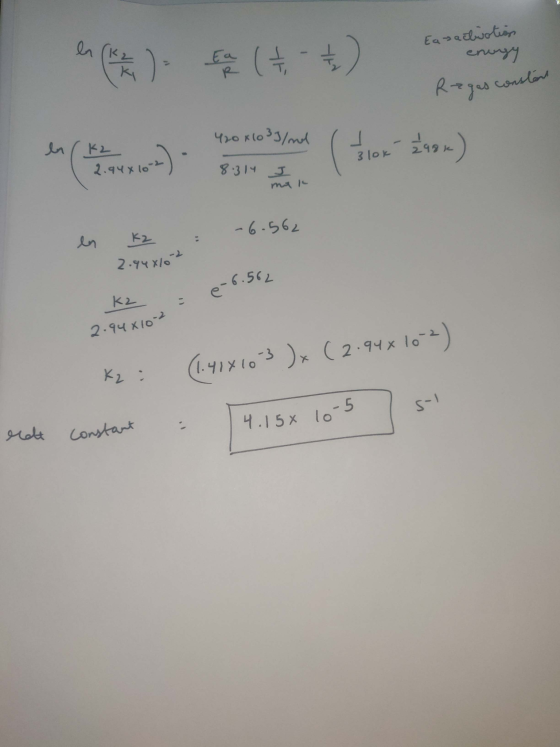
The uncoiling of DNA is a first order reaction. Its activation energy is 420 kJ at...
 The uncoiling of DNA is a first order reaction. Its activation energy is 420 kJ at 37degree C, the rate constant is 4.90 times 10^-4 min^-1. What is the half-life of the uncoiling if the organism has a temperature of 37degree C (104degreeF).
3) The rate constant of a first order reaction is 2.6 x 10+ s' at 255 °C. If the activation energy is 99.9 KJ/mol,...
 3) The rate constant of a first order reaction is 2.6 x 10+ s' at 255 °C. If the activation energy is 99.9 KJ/mol, calculate the temperature at which its rate constant is 4.8 x 10⁴ sl.
if a first order reaction has an activation energy of 48.0 kj/mol and frequency factor of...
if a first order reaction has an activation energy of 48.0 kj/mol and frequency factor of 2.4X10^6. what is the rate constant at 20.0*C and at 30.0*C?
A first order reaction is found to have an activation energy of 105.2 kJ mol-1 ....
A first order reaction is found to have an activation energy of 105.2 kJ mol-1 . If the rate constant for this reaction is 4.60 ×10⁻⁶s -1 at 275 K, and the initial reagent concentration is 2.50 mol L -1 , what is the remaining concentration after 500 seconds at a higher temperature of 325 K?
The following gas-phase reaction follows first-order kinetics. CIO2F======> CIOF+O The activation energy of this reaction is...
The following gas-phase reaction follows first-order kinetics. CIO2F======> CIOF+O The activation energy of this reaction is 186 kJ/mol. The value of k at 322°C is 6.76 x 10⁻⁴ S-1 . a. What would be the value of k for this reaction at room temperature, 25°C? k = _____ S-1 b. At what temperature would this reaction have a k value of ? Temperature = ______ oC
The following gas-phase reaction follows first-order kinetics. CIO2F======> CIOF+O The activation energy of this reaction is...
The following gas-phase reaction follows first-order kinetics. CIO2F======> CIOF+O The activation energy of this reaction is 186 kJ/mol. The value of k at 322°C is 6.76 x 10⁻⁴ S-1 . a. What would be the value of k for this reaction at room temperature, 25°C? k = _____ S-1 b. At what temperature would this reaction have a k value of 9.50 x 10⁻² S-1 ? Temperature = ______ oC
2. The activation energy for the following first-order reaction is 102 kJ/mol. N2O(g) → 2NO(g) +...
 2. The activation energy for the following first-order reaction is 102 kJ/mol. N2O(g) → 2NO(g) + 1/2O2(g) The value of the rate constant (k) is 1.35 x 10-s-1 at 35°C. What is the value of k at 20°C? (6 points)
12. The first-order rate constant for the reaction of methyl chloride (CH3Cl) with water to produce...
12. The first-order rate constant for the reaction of methyl chloride (CH3Cl) with water to produce methanol (CH3OH) and hydrochloric acid (HCl) is 3.32 × 10⁻¹⁰ s−1 at 25°C. Calculate the rate constant at 52.1°C if the activation energy is 116 kJ/mol. _____ ×10^____ s−1 (Enter your answer in scientific notation.) 14. The rate constant of a first-order reaction is 2.75 × 10⁻⁴ s−1 at 350.°C. If the activation energy is 101 kJ/mol, calculate the temperature at which its rate constant...
Cyclopropane isomerizes to propylene according to a first order reaction: cyclopropane → propylene The activation energy...
 Cyclopropane isomerizes to propylene according to a first order reaction: cyclopropane → propylene The activation energy is Ea=272 kJ/mol. At 773K, the reaction rate constant is 6.1 x 10⁻⁴ 5-1 a. Calculate the pre-exponential factor, A, for this reaction b. Calculate the rate constant for this reaction at 298K.
A first order chemical reaction has an energy of activation of 90.0 kJ/mol and a rate...
A first order chemical reaction has an energy of activation of 90.0 kJ/mol and a rate constant of 0.0275 s-1 at 20oC. Find the rate constant for the chemical reaction at 50oC. R = 8.31447215 J/(mol×K)
 The uncoiling of DNA is a first order reaction. Its activation energy is 420 kJ at 37degree C, the rate constant is 4.90 times 10^-4 min^-1. What is the half-life of the uncoiling if the organism has a temperature of 37degree C (104degreeF).
 3) The rate constant of a first order reaction is 2.6 x 10+ s' at 255 °C. If the activation energy is 99.9 KJ/mol, calculate the temperature at which its rate constant is 4.8 x 10⁴ sl.
 2. The activation energy for the following first-order reaction is 102 kJ/mol. N2O(g) → 2NO(g) + 1/2O2(g) The value of the rate constant (k) is 1.35 x 10-s-1 at 35°C. What is the value of k at 20°C? (6 points)
 Cyclopropane isomerizes to propylene according to a first order reaction: cyclopropane → propylene The activation energy is Ea=272 kJ/mol. At 773K, the reaction rate constant is 6.1 x 10⁻⁴ 5-1 a. Calculate the pre-exponential factor, A, for this reaction b. Calculate the rate constant for this reaction at 298K.
Most questions answered within 3 hours.
-
Where is the error in this code sequence?
String s1 = "Hello";
String s2 = "ello";...
asked 11 months ago -
Financial data for Joel de Paris, Inc., for last year
follow:
Joel de Paris, Inc.
Balance...
asked 11 months ago -
Consider this reaction:
Al2(SO4)3 (aq)+ BaCl3
(aq) Al2Cl6 (aq)- +
3BaSO4(s) . What is the...
asked 11 months ago -
Suppose that Savneet is considering increasing her
recent random sample from 20 car rentals to 40...
asked 11 months ago -
Trucks arrive at an unloading terminal at an average rate of 120
per hour.
Trucks arrive...
asked 11 months ago -
Why are methanol and ethanol completely soluble in water while
octanol is not very little soluble....
asked 11 months ago -
A facilities manager at a university reads in a research report
that the mean amount of...
asked 11 months ago -
When the CuSO4 is rehydrated by adding water to the anhydrous
compound, is this an endothermic...
asked 11 months ago -
A ray of sunlight is passing from diamond into crown glass; the
angle of incidence is...
asked 11 months ago -
A block of mass 0.249 kg is placed on top of a light, vertical
spring of...
asked 11 months ago -
how do the kidneys compensate in the presences of acidosis
a) trigger hyperventilate
b) reserve acid...
asked 11 months ago -
Question 501 pts
The rental rate of capital to the firm increases. Which of the
following...
asked 11 months ago