Which of the following is not an advantage of the haplodiplontic lifecycle in the transition to...
Which of the following is not an advantage of the haplodiplontic lifecycle in the transition to land?
A. More mitosis are fertilization and the zygote remains unicellular, energy reserves dedicated to the sporophyte
B. Nourishment of the egg and embryo by the parent plant
C. Multicellular haploid phase
D. Spores than resist dessication
Homework Answers
haplodiplontic life cycle means both haploid and diploid stages of the plant growth has an equally represented. the haploid spores include the haploid spores ( resistant to desiccation), which give rise to haploid gametophyte, and mitosis in the gametophyte produces sperms and egg which fuse to form the zygote, the zygote develops into a sporophyte, which produces spores by meiosis.
so the haplodiplontic lifecycle helps to survive in the land because the spores produced by the sporophyte are resistant to desiccation
so the answer is D. Spores than resist dessication
Add Answer to:
Which of the following is not an advantage of the haplodiplontic
lifecycle in the transition to...
In the alternation of generations lifecycle in plants... A. There is a diploid multicellular phase (sporophyte)...
 In the alternation of generations lifecycle in plants... A. There is a diploid multicellular phase (sporophyte) and haploid multicellular phase (gametophyte) The zygote undergoes mitosis to form a multicellular embryo. Meiosis and syngamy both occur.
Sketch the lifecycle of a bryophyte (alternation of generations). Place the following labels on the sketch:...
Sketch the lifecycle of a bryophyte (alternation of generations). Place the following labels on the sketch: sporophyte, gametophyte, gametes, spores, mitosis, meiosis, diploid, haploid, fertilization, zygote. Sporophytes are attached to which sex gametophyte? _______________________ Are spores haploid or diploid? ______________________ Which life form, gametophyte or sporophyte, undergoes meiosis? ______________________ In mosses (and all bryophytes), which is the dominant life form, sporophyte or gametophyte? ____________________ A) Is the gametophyte of the fern directly protected by the sporophyte? B) Where could you...
arrange the following structures or prosses into a diagram showing the life cycle of a moss...
 arrange the following structures or prosses into a
diagram showing the life cycle of a moss plant
1 What is meant by alternation of generations? alternation of generations between haploid and diploid the grocess their life that life Cycle cycle in alternate 2 What type of nuclear division is involved in the development of a sporophyte plant? Of the spores? meiosis ; Mitosis REVIEW QUESTIONS 3 Arrange the following structures or processes into a diagram showing the life cycle of...
arrange the following structures or prosses into a
diagram showing the life cycle of a moss plant
1 What is meant by alternation of generations? alternation of generations between haploid and diploid the grocess their life that life Cycle cycle in alternate 2 What type of nuclear division is involved in the development of a sporophyte plant? Of the spores? meiosis ; Mitosis REVIEW QUESTIONS 3 Arrange the following structures or processes into a diagram showing the life cycle of...
Plant Diversity The scales of the female cones bear ovules, which enclose the female sporangia. Cells...
 Plant Diversity The scales of the female cones bear ovules, which enclose the female sporangia. Cells in the female sporangia also undergo meiosis to produce spores. One of the spores from each meiotic division develops into a female gametophyte by mitosis. As the pollen germinates and produces sperm nuclei by mitosis, the female gametophyte produces an egg. One sperm nucleus reaches the egg through the pollen tube and fertilizes it. Notice in Figure 6 that the male gametangium has been...
BIOL 1020 Homework Evolution & Natural Selection 4 NATURAL SELECTION: 1. In your OWN words, explain...
 BIOL 1020 Homework Evolution & Natural Selection 4 NATURAL SELECTION: 1. In your OWN words, explain what natural selection is. What is required? What is the result? 2. True or false? For natural selection to work, a population must have genetic variation. Explain your answer. 3. List three sources of genetic variation in a population. Identify which sources are most important for asexually reproducing organisms. Which method is most important for sexually reproducing organisms? 4. List three mechanisms which cause...
I just need to fill in the blanks for this paper. If it is too long...
I just need to fill in the blanks for this paper. If it is too long of a question, I understand... just help if you can. Embryogenesis and plant life cycle Plant life cycle shows both similarities and also major differences from animal life cycle. In both cases ……….. (haploid/diploid) (1N/2N) organism goes through to ……….. (mitosis/ meiosis) to produce gametes, but plant life cycle has an extra step in which it produces a ……….. (diploid/haploid) plant before it produces...
All land plants have single cell haploid and single cell diploid states single cell haploid and...
 All land plants have single cell haploid and single cell diploid states single cell haploid and multicellular diploid states multicellular haploid and single cell diploid states multicellular haploid and multicellular diploid states A. B. C. D. E. diplontic life cycles 7. A gametophyte is B. c. 2n 3n 4n 5n A sporophyte is In 2n 3n C. D. E. 9. The dominant (bigger) state in mosses, liverworts, and hornworts is the A gametophyte sporophyte C. sporangium D. archegonium E. antheridium...
Which of the following is the result of meiosis? (Select all that apply) A The production...
 Which of the following is the result of meiosis? (Select all that apply) A The production of four genetically identical daughter cells B. The production of four genetically different daughter cels C. No change in chromosome number from the parent cel D. A doubling of the chromosome number E. A reduction in the chromosome number by haif 13. Mitosis and cytokinesis function in which of the following? (Select all that apply) A. Asexual reproduction in unicellular eukaryotic organisms B. Gamete...
Question 1 0.5 pts Which of the following statements describes the evolutionary advantage of producing a...
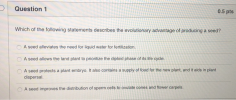 Question 1 0.5 pts Which of the following statements describes the evolutionary advantage of producing a seed? A seed alleviates the need for liquid water for fertilization. A seed allows the land plant to prioritize the diploid phase of its life cycle. A seed protects a plant embryo. It also contains a supply of food for the new plant, and it aids in plant dispersal. A seed improves the distribution of sperm cells to ovulate cones and flower carpels.
my assigned organism is Naked mole rat (Heterocephalus glaber). please type it. The first step in...
my assigned organism is Naked mole rat (Heterocephalus glaber). please type it. The first step in understanding how information is passed from one generation to the next is understanding how cells divide, particularly how the DNA is passed on to the resulting cells. In this discussion, you will describe the life cycle of an animal or plant of your choosing. The animal or plant you choose must have a sexual life cycle (although it may also have an asexual life...
 In the alternation of generations lifecycle in plants... A. There is a diploid multicellular phase (sporophyte) and haploid multicellular phase (gametophyte) The zygote undergoes mitosis to form a multicellular embryo. Meiosis and syngamy both occur.
 arrange the following structures or prosses into a
diagram showing the life cycle of a moss plant
1 What is meant by alternation of generations? alternation of generations between haploid and diploid the grocess their life that life Cycle cycle in alternate 2 What type of nuclear division is involved in the development of a sporophyte plant? Of the spores? meiosis ; Mitosis REVIEW QUESTIONS 3 Arrange the following structures or processes into a diagram showing the life cycle of...
arrange the following structures or prosses into a
diagram showing the life cycle of a moss plant
1 What is meant by alternation of generations? alternation of generations between haploid and diploid the grocess their life that life Cycle cycle in alternate 2 What type of nuclear division is involved in the development of a sporophyte plant? Of the spores? meiosis ; Mitosis REVIEW QUESTIONS 3 Arrange the following structures or processes into a diagram showing the life cycle of...
 Plant Diversity The scales of the female cones bear ovules, which enclose the female sporangia. Cells in the female sporangia also undergo meiosis to produce spores. One of the spores from each meiotic division develops into a female gametophyte by mitosis. As the pollen germinates and produces sperm nuclei by mitosis, the female gametophyte produces an egg. One sperm nucleus reaches the egg through the pollen tube and fertilizes it. Notice in Figure 6 that the male gametangium has been...
 BIOL 1020 Homework Evolution & Natural Selection 4 NATURAL SELECTION: 1. In your OWN words, explain what natural selection is. What is required? What is the result? 2. True or false? For natural selection to work, a population must have genetic variation. Explain your answer. 3. List three sources of genetic variation in a population. Identify which sources are most important for asexually reproducing organisms. Which method is most important for sexually reproducing organisms? 4. List three mechanisms which cause...
 All land plants have single cell haploid and single cell diploid states single cell haploid and multicellular diploid states multicellular haploid and single cell diploid states multicellular haploid and multicellular diploid states A. B. C. D. E. diplontic life cycles 7. A gametophyte is B. c. 2n 3n 4n 5n A sporophyte is In 2n 3n C. D. E. 9. The dominant (bigger) state in mosses, liverworts, and hornworts is the A gametophyte sporophyte C. sporangium D. archegonium E. antheridium...
 Which of the following is the result of meiosis? (Select all that apply) A The production of four genetically identical daughter cells B. The production of four genetically different daughter cels C. No change in chromosome number from the parent cel D. A doubling of the chromosome number E. A reduction in the chromosome number by haif 13. Mitosis and cytokinesis function in which of the following? (Select all that apply) A. Asexual reproduction in unicellular eukaryotic organisms B. Gamete...
 Question 1 0.5 pts Which of the following statements describes the evolutionary advantage of producing a seed? A seed alleviates the need for liquid water for fertilization. A seed allows the land plant to prioritize the diploid phase of its life cycle. A seed protects a plant embryo. It also contains a supply of food for the new plant, and it aids in plant dispersal. A seed improves the distribution of sperm cells to ovulate cones and flower carpels.
Most questions answered within 3 hours.
-
Where is the error in this code sequence?
String s1 = "Hello";
String s2 = "ello";...
asked 11 months ago -
Financial data for Joel de Paris, Inc., for last year
follow:
Joel de Paris, Inc.
Balance...
asked 11 months ago -
Consider this reaction:
Al2(SO4)3 (aq)+ BaCl3
(aq) Al2Cl6 (aq)- +
3BaSO4(s) . What is the...
asked 11 months ago -
Suppose that Savneet is considering increasing her
recent random sample from 20 car rentals to 40...
asked 11 months ago -
Trucks arrive at an unloading terminal at an average rate of 120
per hour.
Trucks arrive...
asked 11 months ago -
Why are methanol and ethanol completely soluble in water while
octanol is not very little soluble....
asked 11 months ago -
A facilities manager at a university reads in a research report
that the mean amount of...
asked 11 months ago -
When the CuSO4 is rehydrated by adding water to the anhydrous
compound, is this an endothermic...
asked 11 months ago -
A ray of sunlight is passing from diamond into crown glass; the
angle of incidence is...
asked 11 months ago -
A block of mass 0.249 kg is placed on top of a light, vertical
spring of...
asked 11 months ago -
how do the kidneys compensate in the presences of acidosis
a) trigger hyperventilate
b) reserve acid...
asked 11 months ago -
Question 501 pts
The rental rate of capital to the firm increases. Which of the
following...
asked 11 months ago