A carbon resistor is to be used as a thermometer. On a winter day when the...
A carbon resistor is to be used as a thermometer. On a winter day when the temperature is 4.00 ∘C, the resistance of the carbon resistor is 217.7 Ω . What is the temperature on a spring day when the resistance is 215.4 Ω ? Take the temperature coefficient of resistivity for carbon to be α = −5.00×10⁻⁴ C−1 .?
Homework Answers
Resistance of resistor at 4°C=R1=217.7 Ohms
New resistance=R2=215.4 Ohms
Let the Temperature at which the resistance will be 215.4 Ohms be T
Coefficient of resistivity = -5.00*10^-4 /°C
R2=R1*(1+(-5*10^-4*(T-217.7))
215.4=217.7*(1+(-5*10^-4)*(T-217.7))
T=196.57 °C
Therefore Temperature at which resistance will be 215.5 ohms is 196.57°C
Add Answer to:
A carbon resistor is to be used as a thermometer. On a winter
day when the...
A carbon resistor is to be used as a thermometer. On a winter day when the...
A carbon resistor is to be used as a thermometer. On a winter day when the temperature is 4°C, the resistance of the carbon resistor is 217.3 Ω. What is the temperature on a spring day when the resistance is 215.7 Ω? (Take the temperature coefficient of resistivity for carbon to be α = -5.00 × 10⁻⁴ ºC-1) (Give your answer in decimal using "degreeC" (ºC) as unit)
A carbon resistor is to be used as a thermometer. On a winter day when the...
A carbon resistor is to be used as a thermometer. On a winter day when the temperature is 4.0 ∘C, the resistance of the carbon resistor is 218.0 Ω . Part A What is the temperature on a spring day when the resistance is 215.2 Ω ? (Take the reference temperature T0 to be 4.0 ∘C.)
A carbon resistor is to be used as a thermometer. On a winter day when the...
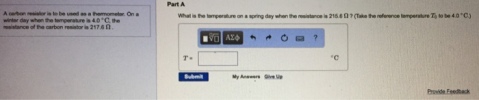 A carbon resistor is to be used as a thermometer. On a winter day when the temperature is 4.0 degree C, the resistance of the carbon resistor is 217.6 Ohm. What is the temperature on a spring day when the resistance is 215.6 Ohm? (Take the reference temperature T_0 to be 4.0 degree C.)
stuck on these 2 questions 1. A resistor made of Nichrome wire is used in an...
stuck on these 2 questions 1. A resistor made of Nichrome wire is used in an application where its resistance cannot change more than 2.53% from its value at 20.0°C. What is the highest temperature at which this resistor can be reliably used? The temperature coefficient of resistivity for Nichrome is 0.4 ✕ 10−3 (°C)−1. 2. An electronic device designed to operate at any temperature in the range from −9.9°C to 78.7°C contains pure carbon resistors. What is the percent...
Consider the following (a) Find the current through the resistor in the figure above. (Take R...
 Consider the following (a) Find the current through the resistor in the figure above. (Take R 8 2.) (b) If the resistor is made of carbon, what will its resistance be when its temperature is increased by 69.0 C°? (The temperature coefficient of resistivity for carbon is -5.0 x 10⁻⁴ (°c)-1.)
A platinum resistance thermometer has a resistance of 200 Ω when placed in an ice 0◦C...
A platinum resistance thermometer has a resistance of 200 Ω when placed in an ice 0◦C bath and 232.6 Ω when immersed in a crucible containing a melting substance. What is the melting point of the substance? The temperature coefficient of the platinum is 0.00392 (◦C)−1 . The resistor was calibrated at a temperature of 20◦C. Answer in units of ◦C.
A platinum resistance thermometer has a resistance of 200 Ω when placed in an ice 0◦C...
A platinum resistance thermometer has a resistance of 200 Ω when placed in an ice 0◦C bath and 204.7 Ω when immersed in a crucible containing a melting substance. What is the melting point of the substance? The temperature coefficient of the platinum is 0.00392 (◦C)−1 . The resistor was calibrated at a temperature of 20◦C. Answer in units of ◦C.
A platinum resistance thermometer has a re- sistance of 200 ohms. A platinum resistance thermometer has...
 A platinum resistance thermometer has a re-
sistance of 200 ohms.
A platinum resistance thermometer has a resistance of 200 ohm when placed in an ice 0 degree C bath and 290.8 Ohm when immersed in a crucible containing a melting substance. What is the melting point of the substance? The temperature coefficient of the platinum is 0.00392 (degreeC)^-1 . The resistor was calibrated at a temperature of 20 degree C. Answer in units of degree C. A platinum resistance...
A platinum resistance thermometer has a re-
sistance of 200 ohms.
A platinum resistance thermometer has a resistance of 200 ohm when placed in an ice 0 degree C bath and 290.8 Ohm when immersed in a crucible containing a melting substance. What is the melting point of the substance? The temperature coefficient of the platinum is 0.00392 (degreeC)^-1 . The resistor was calibrated at a temperature of 20 degree C. Answer in units of degree C. A platinum resistance...
A 100-W lightbulb has a resistance of about 12 Ω when cold (20 ∘C) and 136 Ω when on (hot). Estimate the temperature of the filament when hot assuming an average temperature coefficient of resistivity α=0.0045(C)−1.
 Please, no referring. A 100-W lightbulb has a resistance of about 12 Ω when cold (20 ∘C) and
136 Ω when on (hot). Estimate the temperature of the filament when hot
assuming an average temperature coefficient of resistivity
α=0.0045(C)−1.
Please, no referring. A 100-W lightbulb has a resistance of about 12 Ω when cold (20 ∘C) and
136 Ω when on (hot). Estimate the temperature of the filament when hot
assuming an average temperature coefficient of resistivity
α=0.0045(C)−1.
A 100-W lightbulb has a resistance of about 12 Ω when cold (20 ∘C) and 152...
A 100-W lightbulb has a resistance of about 12 Ω when cold (20 ∘C) and 152 Ω when on (hot). Estimate the temperature of the filament when hot assuming an average temperature coefficient of resistivity α=0.0045(C)−1.
 A carbon resistor is to be used as a thermometer. On a winter day when the temperature is 4.0 degree C, the resistance of the carbon resistor is 217.6 Ohm. What is the temperature on a spring day when the resistance is 215.6 Ohm? (Take the reference temperature T_0 to be 4.0 degree C.)
 Consider the following (a) Find the current through the resistor in the figure above. (Take R 8 2.) (b) If the resistor is made of carbon, what will its resistance be when its temperature is increased by 69.0 C°? (The temperature coefficient of resistivity for carbon is -5.0 x 10⁻⁴ (°c)-1.)
 A platinum resistance thermometer has a re-
sistance of 200 ohms.
A platinum resistance thermometer has a resistance of 200 ohm when placed in an ice 0 degree C bath and 290.8 Ohm when immersed in a crucible containing a melting substance. What is the melting point of the substance? The temperature coefficient of the platinum is 0.00392 (degreeC)^-1 . The resistor was calibrated at a temperature of 20 degree C. Answer in units of degree C. A platinum resistance...
A platinum resistance thermometer has a re-
sistance of 200 ohms.
A platinum resistance thermometer has a resistance of 200 ohm when placed in an ice 0 degree C bath and 290.8 Ohm when immersed in a crucible containing a melting substance. What is the melting point of the substance? The temperature coefficient of the platinum is 0.00392 (degreeC)^-1 . The resistor was calibrated at a temperature of 20 degree C. Answer in units of degree C. A platinum resistance...
Most questions answered within 3 hours.
-
Where is the error in this code sequence?
String s1 = "Hello";
String s2 = "ello";...
asked 10 months ago -
Financial data for Joel de Paris, Inc., for last year
follow:
Joel de Paris, Inc.
Balance...
asked 10 months ago -
Consider this reaction:
Al2(SO4)3 (aq)+ BaCl3
(aq) Al2Cl6 (aq)- +
3BaSO4(s) . What is the...
asked 10 months ago -
Suppose that Savneet is considering increasing her
recent random sample from 20 car rentals to 40...
asked 10 months ago -
Trucks arrive at an unloading terminal at an average rate of 120
per hour.
Trucks arrive...
asked 10 months ago -
Why are methanol and ethanol completely soluble in water while
octanol is not very little soluble....
asked 10 months ago -
A facilities manager at a university reads in a research report
that the mean amount of...
asked 10 months ago -
When the CuSO4 is rehydrated by adding water to the anhydrous
compound, is this an endothermic...
asked 10 months ago -
A ray of sunlight is passing from diamond into crown glass; the
angle of incidence is...
asked 10 months ago -
A block of mass 0.249 kg is placed on top of a light, vertical
spring of...
asked 10 months ago -
how do the kidneys compensate in the presences of acidosis
a) trigger hyperventilate
b) reserve acid...
asked 10 months ago -
Question 501 pts
The rental rate of capital to the firm increases. Which of the
following...
asked 10 months ago