A solution contains only these ions: mercury (I), lead (II), copper (II), bismuth (III), nickel (II),...
A solution contains only these ions: mercury (I), lead (II), copper (II), bismuth (III), nickel (II), zinc, barium, and calcium. Prepare a flow chart to show how you would separate and identify the eight ions in this solution
Homework Answers

Add Answer to:
A solution contains only these ions: mercury (I), lead (II),
copper (II), bismuth (III), nickel (II),...
2. (5 pts) A solution contains lead (II), copper(I) and silver ions. An HCl solution is...
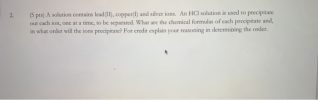 2. (5 pts) A solution contains lead (II), copper(I) and silver ions. An HCl solution is used to precipitate out each ion, one at a time, to be separated. What are the chemical formulas of each precipitate and, in what order will the ions precipitate? For credit explain your reasoning in determining the order.
Q43. Write formulas for the following cations: a. Potassium: b. calcium: c. ammonium: d. lead(II) :...
Q43. Write formulas for the following cations: a. Potassium: b. calcium: c. ammonium: d. lead(II) : e. copper(I) : f. zinc: g. titanium(IV) : h. silver: i. nickel(III): j. hydrogen: k. tin(II) : l. mercury(II) : m. iron(III) : Q44. Write formulas for the following anions: a. fluoride: b. oxide: c. iodide: d. carbonate: e. hydrogen carbonate: f. phosphate: g. sulfide: h. sulfate: i. nitride: j. nitrate: k. phosphide: l. chloride:
double check answers to see if they're all right hydroiodic acid 26 HI (aq) calcium hydroxide...
 double check answers to see if they're all right
hydroiodic acid 26 HI (aq) calcium hydroxide Ca(OH) rubidium arsenate RbjAsO 27 silver phosphate 2 AgsPO beryllium nitride Be N2 28 hydrogen chloride НСТ hydrosulfuric acid H2S (aq) 29 hydrochloric acid 4 HCl (aq) antimony(II) nitrate 30 Sb(NO) ammonium sulfate 5 (NHa) SO lead(II) bromide РЬВг2 31 zinc sulfide 6 ZnS sulfuric acid 32 HSO. (aq) cadmium dichromate CdCr2O 7 cobalt(II) chloride 33 CoCl barium chlorate Ba(CIO) hydrogen selenide 34 HSe...
double check answers to see if they're all right
hydroiodic acid 26 HI (aq) calcium hydroxide Ca(OH) rubidium arsenate RbjAsO 27 silver phosphate 2 AgsPO beryllium nitride Be N2 28 hydrogen chloride НСТ hydrosulfuric acid H2S (aq) 29 hydrochloric acid 4 HCl (aq) antimony(II) nitrate 30 Sb(NO) ammonium sulfate 5 (NHa) SO lead(II) bromide РЬВг2 31 zinc sulfide 6 ZnS sulfuric acid 32 HSO. (aq) cadmium dichromate CdCr2O 7 cobalt(II) chloride 33 CoCl barium chlorate Ba(CIO) hydrogen selenide 34 HSe...
The United States nickel contains about 25% nickel metal and 75% copper metal. Could you use...
The United States nickel contains about 25% nickel metal and 75% copper metal. Could you use the same experimental procedure to determine the percentage of copper metal in a nickel coin that you used for a penny? Why or why not? Describe any modifications to the procedure that would be required. Hint: think about the reactions involved and the complex ions that would be formed. Here's kind of a summary of the procedure if it helps in answering this question:...
A solution contains 0.021 M Cl? and 0.017 M I?. A solution containing copper (I) ions is added to selectively precipita...
A solution contains 0.021 M Cl? and 0.017 M I?. A solution containing copper (I) ions is added to selectively precipitate one of the ions. At what concentration of copper (I) ion will a precipitate begin to form? What is the identity of the precipitate? Ksp(CuCl) = 1.0 × 10⁻⁶, Ksp(CuI) = 5.1 × 10⁻¹². please show work! A) 4 .8 × 10-5 M, CuCl B) 3 .0 × 10-10 M, CuI C) 3 .0 × 10-10 M, CuCl D)...
How would I do the follow equation? What are the steps? Identify and write the (unbalanced)...
How would I do the follow equation? What are the steps? Identify and write the (unbalanced) oxidation and reduction half-reactions for the following reactions. (a) Solid copper dissolves in an acidic solution containing nitrate ions to form copper (II) ions and nitrogen dioxide gas. (b) Solid zinc dissolves in hydrochloric acid to form zinc ions (+2 charge) in solution and hydrogen gas. (c) Solid iron (III) oxide reacts with solid carbon to produce solid iron and and gaseous carbon dioxide.
If there are some group I ions mixed in with group II ions together, 1. what...
If there are some group I ions mixed in with group II ions together, 1. what would happen when you follow the procedures of adding thioacetamide and heat in boiling water bath? (HInt: check the Ksp of group I ions with sulfide) 2. How would you separate the two groups of ions and identify the ions qualitatively? (Hint: some procedures are in the manual for groups I and II)
please help i cant figure them out Consider the insoluble compound nickel(II) carbonate, NiCO3. The nickel...
 please help i cant figure them out
Consider the insoluble compound nickel(II) carbonate, NiCO3. The nickel ion also forms a complex with cyanide ions. Write a net ionic equation to show why the solubility of NiCO3(s) increases in the presence of cyanide and calculate the equilibrium constant for this reaction. Solubility product constant data is found in the Chemistry References. For Ni(CN)4?: K = 2.0 1031. Use the pull-down boxes to specify states such as (aq) or (s). A solution...
please help i cant figure them out
Consider the insoluble compound nickel(II) carbonate, NiCO3. The nickel ion also forms a complex with cyanide ions. Write a net ionic equation to show why the solubility of NiCO3(s) increases in the presence of cyanide and calculate the equilibrium constant for this reaction. Solubility product constant data is found in the Chemistry References. For Ni(CN)4?: K = 2.0 1031. Use the pull-down boxes to specify states such as (aq) or (s). A solution...
Solid Nal is slowly added to a solution that is 0.0099 M Cut and 0.0089 M...
 Solid Nal is slowly added to a solution that is 0.0099 M Cut and 0.0089 M Ag*. Which compound will begin to precipitate first? O Nal O Cul o Agi Calculate [Agt ] when Cul just begins to precipitate. 8.21 x 1007 Enter your answer in scientific notation. What percent of Agt remains in solution at this point? 0.01095 10- Solubility Products of Some Slightly Soluble lonic Compounds at 25°C Compound 3p Compound Aluminum hydroxide (Al(OH)3) 10- Lead(II) chromate (PCO)...
Copper plating was accomplished using either graphite or copper as the electrodes. How would you expect the copper(II) ion concentration of the solution change (i.e. would [Cu2] increase, decreas...
 Copper plating was accomplished using either graphite or copper as the electrodes. How would you expect the copper(II) ion concentration of the solution change (i.e. would [Cu2] increase, decrease, or remain the same?) during the plating process if the graphite anode were replaced with a copper one in the electrolysis of CuBr2? Explain your answer 5. Calculate the mass and thickness in mm of the chromium plate on an object if a current of 450.0 mamps were allowed to flow...
 2. (5 pts) A solution contains lead (II), copper(I) and silver ions. An HCl solution is used to precipitate out each ion, one at a time, to be separated. What are the chemical formulas of each precipitate and, in what order will the ions precipitate? For credit explain your reasoning in determining the order.
 double check answers to see if they're all right
hydroiodic acid 26 HI (aq) calcium hydroxide Ca(OH) rubidium arsenate RbjAsO 27 silver phosphate 2 AgsPO beryllium nitride Be N2 28 hydrogen chloride НСТ hydrosulfuric acid H2S (aq) 29 hydrochloric acid 4 HCl (aq) antimony(II) nitrate 30 Sb(NO) ammonium sulfate 5 (NHa) SO lead(II) bromide РЬВг2 31 zinc sulfide 6 ZnS sulfuric acid 32 HSO. (aq) cadmium dichromate CdCr2O 7 cobalt(II) chloride 33 CoCl barium chlorate Ba(CIO) hydrogen selenide 34 HSe...
double check answers to see if they're all right
hydroiodic acid 26 HI (aq) calcium hydroxide Ca(OH) rubidium arsenate RbjAsO 27 silver phosphate 2 AgsPO beryllium nitride Be N2 28 hydrogen chloride НСТ hydrosulfuric acid H2S (aq) 29 hydrochloric acid 4 HCl (aq) antimony(II) nitrate 30 Sb(NO) ammonium sulfate 5 (NHa) SO lead(II) bromide РЬВг2 31 zinc sulfide 6 ZnS sulfuric acid 32 HSO. (aq) cadmium dichromate CdCr2O 7 cobalt(II) chloride 33 CoCl barium chlorate Ba(CIO) hydrogen selenide 34 HSe...
 please help i cant figure them out
Consider the insoluble compound nickel(II) carbonate, NiCO3. The nickel ion also forms a complex with cyanide ions. Write a net ionic equation to show why the solubility of NiCO3(s) increases in the presence of cyanide and calculate the equilibrium constant for this reaction. Solubility product constant data is found in the Chemistry References. For Ni(CN)4?: K = 2.0 1031. Use the pull-down boxes to specify states such as (aq) or (s). A solution...
please help i cant figure them out
Consider the insoluble compound nickel(II) carbonate, NiCO3. The nickel ion also forms a complex with cyanide ions. Write a net ionic equation to show why the solubility of NiCO3(s) increases in the presence of cyanide and calculate the equilibrium constant for this reaction. Solubility product constant data is found in the Chemistry References. For Ni(CN)4?: K = 2.0 1031. Use the pull-down boxes to specify states such as (aq) or (s). A solution...
 Solid Nal is slowly added to a solution that is 0.0099 M Cut and 0.0089 M Ag*. Which compound will begin to precipitate first? O Nal O Cul o Agi Calculate [Agt ] when Cul just begins to precipitate. 8.21 x 1007 Enter your answer in scientific notation. What percent of Agt remains in solution at this point? 0.01095 10- Solubility Products of Some Slightly Soluble lonic Compounds at 25°C Compound 3p Compound Aluminum hydroxide (Al(OH)3) 10- Lead(II) chromate (PCO)...
 Copper plating was accomplished using either graphite or copper as the electrodes. How would you expect the copper(II) ion concentration of the solution change (i.e. would [Cu2] increase, decrease, or remain the same?) during the plating process if the graphite anode were replaced with a copper one in the electrolysis of CuBr2? Explain your answer 5. Calculate the mass and thickness in mm of the chromium plate on an object if a current of 450.0 mamps were allowed to flow...
Most questions answered within 3 hours.
-
Where is the error in this code sequence?
String s1 = "Hello";
String s2 = "ello";...
asked 10 months ago -
Financial data for Joel de Paris, Inc., for last year
follow:
Joel de Paris, Inc.
Balance...
asked 10 months ago -
Consider this reaction:
Al2(SO4)3 (aq)+ BaCl3
(aq) Al2Cl6 (aq)- +
3BaSO4(s) . What is the...
asked 10 months ago -
Suppose that Savneet is considering increasing her
recent random sample from 20 car rentals to 40...
asked 10 months ago -
Trucks arrive at an unloading terminal at an average rate of 120
per hour.
Trucks arrive...
asked 10 months ago -
Why are methanol and ethanol completely soluble in water while
octanol is not very little soluble....
asked 10 months ago -
A facilities manager at a university reads in a research report
that the mean amount of...
asked 10 months ago -
When the CuSO4 is rehydrated by adding water to the anhydrous
compound, is this an endothermic...
asked 10 months ago -
A ray of sunlight is passing from diamond into crown glass; the
angle of incidence is...
asked 10 months ago -
A block of mass 0.249 kg is placed on top of a light, vertical
spring of...
asked 10 months ago -
how do the kidneys compensate in the presences of acidosis
a) trigger hyperventilate
b) reserve acid...
asked 10 months ago -
Question 501 pts
The rental rate of capital to the firm increases. Which of the
following...
asked 10 months ago