an object is placed on a frictionless horizontal surface. a constant horizontal force of 80 Newton...
an object is placed on a frictionless horizontal surface. a constant horizontal force of 80 Newton is applied to the object. the block starts from rest and moves 11.0 miles in 5.00 seconds. (a) what is the mass of the object? (b) if the force is withdrawn at the end of 5 seconds, how far does the block move in the next 5 seconds?
Homework Answers
(a) A constant force produces a constant acceleration, so the motion of the object is uniformly accelerated motion. The motion is governed by the kinematic equations for uniformly accelerated motion. The distance covered by the object in time t is given by
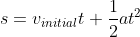
Given the object starts from rest  we get

Solving for acceleration we get

Substituting  and t = 5.00s we get
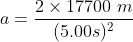

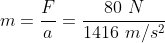
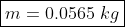
The mass, force, and acceleration are related by Newton's second law of motion F=ma, we have
(b) The final velocity of the object is

Given the object starts from rest
we get

The velocity after 5 seconds is


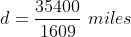
When the force was removed the object was traveling at 7080 m/s. The distance covered by the object in the next 5 seconds is

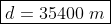
Using 1 mile = 1609 m we get

Add Answer to:
an object is placed on a frictionless horizontal surface. a
constant horizontal force of 80 Newton...
A dockwater applies a constant horizontal force of 80.0 N to a block of ice ona...
A dockwater applies a constant horizontal force of 80.0 N to a block of ice ona smooth horizontal floor. The frictional force is negligible. The block starts from rest and moces 11.0 m in 5.00s. (a) What is the mass of the block of ice? (b) If the worker stops pushing at the end of 5.00 s. how far does the block move in the next 5.00s?
A dockworker applies a constant horizontal force of 70.0 N to a block of ice on...
 A dockworker applies a constant horizontal force of 70.0 N to a block of ice on a smooth horizontal floor. The frictional force is negligible. The block starts from rest and moves 15.0 m in 6.00 s. What is the mass of the block of ice? If the worker stops pushing at the end of 6.00 s, how far does the block move in the next 6.00 s?
magnitudes of the 5.) A 10 Newton force and a 25 Newton force act concurrently on...
 magnitudes of the 5.) A 10 Newton force and a 25 Newton force act concurrently on an object. What are the biggest and smallest possible resultant forces form those forces? A 10 Newton force is applied to a Sg block at an angle of 30° above the horizontal. The block slides across the frictionless, horizontal surface a. What is the acceleration of the block? b. What is the normal force acting on the block from the surface? yn 7) A...
A person applies a constant horizontal force of 84 N to a block of ice on...
A person applies a constant horizontal force of 84 N to a block of ice on a smooth horizontal floor. Neglect friction. The block starts from rest and moves 11 m in 4.9 s. (calculators permitted in this question) (a) What is the mass of the block of ice? m???ice = kg (b) If the person stops pushing at the end of 4.9 s, how far does the block move in the next 4.9 s? d = m
A dockworker applies a constant horizontal force of 73.0 N to a block of ice on a smooth horizontal floor. The friction...
A dockworker applies a constant horizontal force of 73.0 N to a block of ice on a smooth horizontal floor. The frictional force is negligible. The block starts from rest and moves a distance 13.0 m in a time 4.50 s. (a)What is the mass of the block of ice?----- I found this to be 56.9kg and got it right. (b)If the worker stops pushing at the end of 4.50 s, how far does the block move in the next...
A 1.30-kg object is attached to a spring and placed on frictionless, horizontal surface. A horizontal...
 A 1.30-kg object is attached to a spring and placed on
frictionless, horizontal surface. A horizontal force of 21.0 N is
required to hold the object at rest when it is pulled 0.200m from
its equilibrium position......
Would you write out the intermediate steps, too, please?
A 1.30-kg object is attached to a spring and placed on frictionless, horizontal surface. A horizontal force of 21.0 N is required to hold the object at rest when it is pulled 0.200 m...
A 1.30-kg object is attached to a spring and placed on
frictionless, horizontal surface. A horizontal force of 21.0 N is
required to hold the object at rest when it is pulled 0.200m from
its equilibrium position......
Would you write out the intermediate steps, too, please?
A 1.30-kg object is attached to a spring and placed on frictionless, horizontal surface. A horizontal force of 21.0 N is required to hold the object at rest when it is pulled 0.200 m...
Newton's Laws of Motion 12. The diagram below shows a horizontal 8.0-newton force applied to a...
 Newton's Laws of Motion 12. The diagram below shows a horizontal 8.0-newton force applied to a 4.0-kilogram block on a frictionless table. 4.0 kg F8.0 N Frictionless Table What is the magnitude of the block's acceleration? 13. Two forces are applied to a 2.0-kilogram block on a frictionless horizontal surface, as shown in the diagram below. F, -2.0 N F2-8.0 N 2.0 kg Frictionless Surface What is the acceleration of the block? What additional force, when applied to the object...
A mass of 3kg is resting on a horizontal frictionless surface. Force 1 is applied to...
A mass of 3kg is resting on a horizontal frictionless surface. Force 1 is applied to it at 59 degrees above the horizontal, force 2 has a magnitude of 33N and is applied vertically upwards, force 3 has a magnitude of 10N and is applied vertically downwards and force 4 has a magnitude of 57N and is applied in the negative x direction to the object. If the amount of force 1 is such that the mass just begins to...
a 2.0 kg mass moves along a frictionless horizontal surface at a speed of 5.0 m/s....
a 2.0 kg mass moves along a frictionless horizontal surface at a speed of 5.0 m/s. The mass encounters a 30 degree inclined surface with a constant friction force of 1.5 N. At 1 m high (vertical) the surface levels off and is again frictionless. the mass then encounters a spring with k=10 N/m a) how far is the spring compressed after the mass comes to rest? b) how far down the inclined plane will the mass move after bouncing...
QUESTION 5 A mass of 12 kg is placed on a horizontal surface with friction with...
QUESTION 5 A mass of 12 kg is placed on a horizontal surface with friction with a coefficient of static friction of 0.81 and coefficient of kinetic friction of 0.44. A force of 13 Newtons is applied in the -y direction and a force of 16 Newtons is also applied in the -y direction. Another force is applied in the +x direction (see sketch). The force applied in the +x direction is increased until it is 1.9 times the force...
 A dockworker applies a constant horizontal force of 70.0 N to a block of ice on a smooth horizontal floor. The frictional force is negligible. The block starts from rest and moves 15.0 m in 6.00 s. What is the mass of the block of ice? If the worker stops pushing at the end of 6.00 s, how far does the block move in the next 6.00 s?
 magnitudes of the 5.) A 10 Newton force and a 25 Newton force act concurrently on an object. What are the biggest and smallest possible resultant forces form those forces? A 10 Newton force is applied to a Sg block at an angle of 30° above the horizontal. The block slides across the frictionless, horizontal surface a. What is the acceleration of the block? b. What is the normal force acting on the block from the surface? yn 7) A...
 A 1.30-kg object is attached to a spring and placed on
frictionless, horizontal surface. A horizontal force of 21.0 N is
required to hold the object at rest when it is pulled 0.200m from
its equilibrium position......
Would you write out the intermediate steps, too, please?
A 1.30-kg object is attached to a spring and placed on frictionless, horizontal surface. A horizontal force of 21.0 N is required to hold the object at rest when it is pulled 0.200 m...
A 1.30-kg object is attached to a spring and placed on
frictionless, horizontal surface. A horizontal force of 21.0 N is
required to hold the object at rest when it is pulled 0.200m from
its equilibrium position......
Would you write out the intermediate steps, too, please?
A 1.30-kg object is attached to a spring and placed on frictionless, horizontal surface. A horizontal force of 21.0 N is required to hold the object at rest when it is pulled 0.200 m...
 Newton's Laws of Motion 12. The diagram below shows a horizontal 8.0-newton force applied to a 4.0-kilogram block on a frictionless table. 4.0 kg F8.0 N Frictionless Table What is the magnitude of the block's acceleration? 13. Two forces are applied to a 2.0-kilogram block on a frictionless horizontal surface, as shown in the diagram below. F, -2.0 N F2-8.0 N 2.0 kg Frictionless Surface What is the acceleration of the block? What additional force, when applied to the object...
Most questions answered within 3 hours.
-
Where is the error in this code sequence?
String s1 = "Hello";
String s2 = "ello";...
asked 10 months ago -
Financial data for Joel de Paris, Inc., for last year
follow:
Joel de Paris, Inc.
Balance...
asked 10 months ago -
Consider this reaction:
Al2(SO4)3 (aq)+ BaCl3
(aq) Al2Cl6 (aq)- +
3BaSO4(s) . What is the...
asked 10 months ago -
Suppose that Savneet is considering increasing her
recent random sample from 20 car rentals to 40...
asked 10 months ago -
Trucks arrive at an unloading terminal at an average rate of 120
per hour.
Trucks arrive...
asked 10 months ago -
Why are methanol and ethanol completely soluble in water while
octanol is not very little soluble....
asked 10 months ago -
A facilities manager at a university reads in a research report
that the mean amount of...
asked 10 months ago -
When the CuSO4 is rehydrated by adding water to the anhydrous
compound, is this an endothermic...
asked 10 months ago -
A ray of sunlight is passing from diamond into crown glass; the
angle of incidence is...
asked 10 months ago -
A block of mass 0.249 kg is placed on top of a light, vertical
spring of...
asked 10 months ago -
how do the kidneys compensate in the presences of acidosis
a) trigger hyperventilate
b) reserve acid...
asked 10 months ago -
Question 501 pts
The rental rate of capital to the firm increases. Which of the
following...
asked 10 months ago