from typing import List THREE_BY_THREE = [[1, 2, 1], [4, 6, 5], [7, 8, 9]] FOUR_BY_FOUR...
from typing import List
THREE_BY_THREE = [[1, 2, 1],
[4, 6, 5],
[7, 8, 9]]
FOUR_BY_FOUR = [[1, 2, 6, 5],
[4, 5, 3, 2],
[7, 9, 8, 1],
[1, 2, 1, 4]]
UNIQUE_3X3 = [[1, 2, 3],
[9, 8, 7],
[4, 5, 6]]
UNIQUE_4X4 = [[10, 2, 3, 30],
[9, 8, 7, 11],
[4, 5, 6, 12],
[13, 14, 15, 16]]
def get_average_elevation(elevation_map: List[List[int]]) ->
float:
"""Return the average elevation across all cells in the elevation
map
elevation_map.
Precondition: elevation_map is a valid elevation map.
>>> get_average_elevation(UNIQUE_3X3)
5.0
>>> get_average_elevation(FOUR_BY_FOUR)
3.8125
"""
pass # remove this line when you implement this
function
Homework Answers
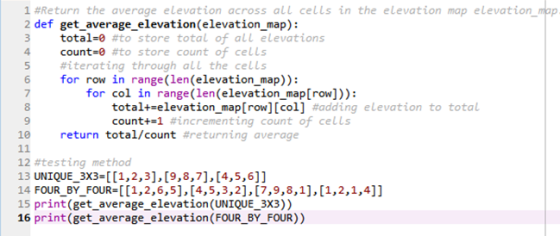
SOURCE CODE IN PYTHON:
#Return the average elevation across all cells in the elevation
map elevation_map.
def get_average_elevation(elevation_map):
total=0 #to store total of all elevations
count=0 #to store count of cells
#iterating through all the cells
for row in range(len(elevation_map)):
for col in range(len(elevation_map[row])):
total+=elevation_map[row][col] #adding elevation to total
count+=1 #incrementing count of cells
return total/count #returning average
#testing method
UNIQUE_3X3=[[1,2,3],[9,8,7],[4,5,6]]
FOUR_BY_FOUR=[[1,2,6,5],[4,5,3,2],[7,9,8,1],[1,2,1,4]]
print(get_average_elevation(UNIQUE_3X3))
print(get_average_elevation(FOUR_BY_FOUR))
OUTPUT:

Add Answer to:
from typing import List
THREE_BY_THREE = [[1, 2, 1],
[4, 6, 5],
[7, 8, 9]]
FOUR_BY_FOUR...
using Python --- from typing import List THREE_BY_THREE = [[1, 2, 1], [4, 6, 5], [7,...
using Python --- from typing import List THREE_BY_THREE = [[1, 2, 1], [4, 6, 5], [7, 8, 9]] FOUR_BY_FOUR = [[1, 2, 6, 5], [4, 5, 3, 2], [7, 9, 8, 1], [1, 2, 1, 4]] UNIQUE_3X3 = [[1, 2, 3], [9, 8, 7], [4, 5, 6]] UNIQUE_4X4 = [[10, 2, 3, 30], [9, 8, 7, 11], [4, 5, 6, 12], [13, 14, 15, 16]] def find_peak(elevation_map: List[List[int]]) -> List[int]: """Return the cell that is the highest point in the...
from __future__ import annotations import random from typing import TYPE_CHECKING, List, Any from course import sort_students...
from __future__ import annotations import random from typing import TYPE_CHECKING, List, Any from course import sort_students if TYPE_CHECKING: from survey import Survey from course import Course, Student def slice_list(lst: List[Any], n: int) -> List[List[Any]]: """ Return a list containing slices of <lst> in order. Each slice is a list of size <n> containing the next <n> elements in <lst>. The last slice may contain fewer than <n> elements in order to make sure that the returned list contains all elements...
can you finish implementing the functions below ********************************************************************************************************** import urllib.request from typing import List, TextIO #...
can you finish implementing the functions below ********************************************************************************************************** import urllib.request from typing import List, TextIO # Precondition for all functions in this module: Each line of the url # file contains the average monthly temperatures for a year (separated # by spaces) starting with January. The file must also have 3 header # lines. DATA_URL = 'http://robjhyndman.com/tsdldata/data/cryer2.dat' def open_temperature_file(url: str) -> TextIO: '''Open the specified url, read past the three-line header, and return the open file. ''' ... def avg_temp_march(f:...
List of Indexes Complete the following function. Note that neither item List nor index list should...
 List of Indexes Complete the following function. Note that neither item List nor index list should be mutated 1 from typing import List 3 def find value indexes (iten list: list. index List: Listint). V: object) + List[int]: may appear multiple times in iton list. index list contains zero or more indexes. Return a list of the indexes from index list at which v appears in ite list. Precondition: the values in index_list are valid indexes in its list. >>>...
from __future__ import annotations from typing import Any, Optional class _Node: """A node in a linked...
from __future__ import annotations from typing import Any, Optional class _Node: """A node in a linked list. Note that this is considered a "private class", one which is only meant to be used in this module by the LinkedList class, but not by client code. === Attributes === item: The data stored in this node. next: The next node in the list, or None if there are no more nodes. """ item: Any next: Optional[_Node] def __init__(self, item: Any) ->...
Python 1 import matplotlib.pyplot as plt 2 import numpy as np 3 4 abscissa = np.arange(20) 5 plt....
 python
1
import matplotlib.pyplot as plt
2
import numpy as np
3
4
abscissa = np.arange(20)
5
plt.gca().set_prop_cycle(
’
color
’
, [
’
red
’
,
’
green
’
,
’
blue
’
,
’
black
’
])
6
7
class MyLine:
8
9
def __init__(self,
*
args,
**
options):
10
#TO DO: IMPLEMENT FUNCTION
11
pass
12
13
def draw(self):
14
plt.plot(abscissa,self.line(abscissa))
15
16
def get_line(self):
17
return "y = {0:.2f}x + {1:.2f}".format(self.slope,
self.intercept)
18
19
def __str__(self):...
python
1
import matplotlib.pyplot as plt
2
import numpy as np
3
4
abscissa = np.arange(20)
5
plt.gca().set_prop_cycle(
’
color
’
, [
’
red
’
,
’
green
’
,
’
blue
’
,
’
black
’
])
6
7
class MyLine:
8
9
def __init__(self,
*
args,
**
options):
10
#TO DO: IMPLEMENT FUNCTION
11
pass
12
13
def draw(self):
14
plt.plot(abscissa,self.line(abscissa))
15
16
def get_line(self):
17
return "y = {0:.2f}x + {1:.2f}".format(self.slope,
self.intercept)
18
19
def __str__(self):...
Let U = (1, 2, 3, 4, 5, 6, 7, 8, 9, 10), A = (1,...
 Let U = (1, 2, 3, 4, 5, 6, 7, 8, 9, 10), A = (1, 3, 5, 7, 9), 8 (2, 4, 6, 8, 10), and C (1, 2, 3, 4, 5, 10). List the elements of each set. (Enter your answers using roster notation. Enter EMPTY or for the empty set.) (a) 4 {2, 4, 6, 8, 10) (Đ) 1 0 0 {2,4, 10) X (1) cuc {}
ONE_TEN = [1, 2, 3, 4, 5, 6, 7, 8, 9, 10] Demonstrate replacing values with...
ONE_TEN = [1, 2, 3, 4, 5, 6, 7, 8, 9, 10] Demonstrate replacing values with the larger of their neighbors and demonstrate shifting to the right replacing the furthermost element with the first element in the list. data = list(ONE_TEN) def replaceNeighbors(data): for i in range(len(data)): if data[i] < data[i+1]: data[i] == data[i+1] replaceNeighbors(data) print("After replacing with neighbors: ", data) data = list(ONE_TEN) def shiftRight(data): data= data[-1] + dta[:-1] shiftRight(data) print("After shifting right: ", data) im having trouble with...
Complete the methods from random import randint class Spinner: """A spinner for a board game. A...
Complete the methods from random import randint class Spinner: """A spinner for a board game. A spinner has a certain number of slots, numbered starting at 0 and increasing by 1 each slot. For example, if the spinner has 6 slots, they are numbered 0 through 5, inclusive. A spinner also has an arrow that points to one of these slots. === Attributes === slots: The number of slots in this spinner. position: The slot number that the spinner's arrow...
def _merge(lst: list, start: int, mid: int, end: int) -> None: """Sort the items in lst[start:end]...
def _merge(lst: list, start: int, mid: int, end: int) -> None: """Sort the items in lst[start:end] in non-decreasing order. Precondition: lst[start:mid] and lst[mid:end] are sorted. """ result = [] left = start right = mid while left < mid and right < end: if lst[left] < lst[right]: result.append(lst[left]) left += 1 else: result.append(lst[right]) right += 1 # This replaces lst[start:end] with the correct sorted version. lst[start:end] = result + lst[left:mid] + lst[right:end] def find_runs(lst: list) -> List[Tuple[int, int]]: """Return a...
 List of Indexes Complete the following function. Note that neither item List nor index list should be mutated 1 from typing import List 3 def find value indexes (iten list: list. index List: Listint). V: object) + List[int]: may appear multiple times in iton list. index list contains zero or more indexes. Return a list of the indexes from index list at which v appears in ite list. Precondition: the values in index_list are valid indexes in its list. >>>...
 python
1
import matplotlib.pyplot as plt
2
import numpy as np
3
4
abscissa = np.arange(20)
5
plt.gca().set_prop_cycle(
’
color
’
, [
’
red
’
,
’
green
’
,
’
blue
’
,
’
black
’
])
6
7
class MyLine:
8
9
def __init__(self,
*
args,
**
options):
10
#TO DO: IMPLEMENT FUNCTION
11
pass
12
13
def draw(self):
14
plt.plot(abscissa,self.line(abscissa))
15
16
def get_line(self):
17
return "y = {0:.2f}x + {1:.2f}".format(self.slope,
self.intercept)
18
19
def __str__(self):...
python
1
import matplotlib.pyplot as plt
2
import numpy as np
3
4
abscissa = np.arange(20)
5
plt.gca().set_prop_cycle(
’
color
’
, [
’
red
’
,
’
green
’
,
’
blue
’
,
’
black
’
])
6
7
class MyLine:
8
9
def __init__(self,
*
args,
**
options):
10
#TO DO: IMPLEMENT FUNCTION
11
pass
12
13
def draw(self):
14
plt.plot(abscissa,self.line(abscissa))
15
16
def get_line(self):
17
return "y = {0:.2f}x + {1:.2f}".format(self.slope,
self.intercept)
18
19
def __str__(self):...
 Let U = (1, 2, 3, 4, 5, 6, 7, 8, 9, 10), A = (1, 3, 5, 7, 9), 8 (2, 4, 6, 8, 10), and C (1, 2, 3, 4, 5, 10). List the elements of each set. (Enter your answers using roster notation. Enter EMPTY or for the empty set.) (a) 4 {2, 4, 6, 8, 10) (Đ) 1 0 0 {2,4, 10) X (1) cuc {}
Most questions answered within 3 hours.
-
Where is the error in this code sequence?
String s1 = "Hello";
String s2 = "ello";...
asked 10 months ago -
Financial data for Joel de Paris, Inc., for last year
follow:
Joel de Paris, Inc.
Balance...
asked 10 months ago -
Consider this reaction:
Al2(SO4)3 (aq)+ BaCl3
(aq) Al2Cl6 (aq)- +
3BaSO4(s) . What is the...
asked 10 months ago -
Suppose that Savneet is considering increasing her
recent random sample from 20 car rentals to 40...
asked 10 months ago -
Trucks arrive at an unloading terminal at an average rate of 120
per hour.
Trucks arrive...
asked 10 months ago -
Why are methanol and ethanol completely soluble in water while
octanol is not very little soluble....
asked 10 months ago -
A facilities manager at a university reads in a research report
that the mean amount of...
asked 10 months ago -
When the CuSO4 is rehydrated by adding water to the anhydrous
compound, is this an endothermic...
asked 10 months ago -
A ray of sunlight is passing from diamond into crown glass; the
angle of incidence is...
asked 10 months ago -
A block of mass 0.249 kg is placed on top of a light, vertical
spring of...
asked 10 months ago -
how do the kidneys compensate in the presences of acidosis
a) trigger hyperventilate
b) reserve acid...
asked 10 months ago -
Question 501 pts
The rental rate of capital to the firm increases. Which of the
following...
asked 10 months ago