Using the following equation off a NTC thermistor data sheet, derive an expression for sensitivity of...
Using the following equation off a NTC thermistor data sheet, derive an expression for sensitivity of the thermistor.
Rt = R25exp(A+B/T + C/T² + D/T³)
A = -14.6337196
B = 4791.842
C = -115334
D = -3730535
Homework Answers

Add Answer to:
Using the following equation off a NTC thermistor data
sheet, derive an expression for sensitivity of...
c. Derive the following expression Using the expression in part c, derive an expression for terms...
 c. Derive the following expression Using the expression in part c, derive an expression for terms of only Rand P. d. ASof an ideal gas in How does the molar entropy change with increasing pressure for an ideal gas? Justify you answer using the result in part d e.
Suppose the parameter b (p= RT/V-b )is temperature dependent. Derive an expression for Cp-Cv forthe equation...
Suppose the parameter b (p= RT/V-b )is temperature dependent. Derive an expression for Cp-Cv forthe equation of state: p=RT/ V-b[T] (assume that the temperature dependence in b is weak and linear in T, i.e b[T] = b0 +b1T)
Q2. Consider a thermistor device, where the following relationship between temperature T (°C) and resistance R...
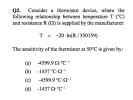 Q2. Consider a thermistor device, where the following relationship between temperature T (°C) and resistance R (S2) is supplied by the manufacturer: T -20 . ln(R / 350159) = The sensitivity of the thermistor at 50°C is given by: (a) -4599.9 Ω"C-1 (b) -1437°C2-1 (c) -4599.9 oC.Ω! (d) -1 437 Ω"C-1
be calculated using The isothermal Joule-Thomson coefficient jer may Derive an expression for Joule-Thomson coefficient μ...
 be calculated using The isothermal Joule-Thomson coefficient jer may Derive an expression for Joule-Thomson coefficient μ for a gas with this eguation of state (4 points) V-nb Derive an expression for Joule-Thomson coefficient μ for a gas with this equation of state (1.5 points) b RT op乃-下
Question 1 1. Using an equation like equation 3, derive the expression for k given in...
 Question 1
1. Using an equation like equation 3, derive the expression for k given in equation 4. 2. What solvent mixture are you using in parts A-C? In part D? Whoat effect will the different solvent system used in part D have on the rate of reaction? Explain. 3. Given the Arrhenius equation (Equation 5) and the brief discussion of it below, how will you actually calculate Eact? In other words, show the equation you will use. (Eact ???)...
Question 1
1. Using an equation like equation 3, derive the expression for k given in equation 4. 2. What solvent mixture are you using in parts A-C? In part D? Whoat effect will the different solvent system used in part D have on the rate of reaction? Explain. 3. Given the Arrhenius equation (Equation 5) and the brief discussion of it below, how will you actually calculate Eact? In other words, show the equation you will use. (Eact ???)...
The material constant B is to be determined for a particular thermistor using the circuit below. The thermistor has a resistance of 60 k at 25C. The reference resistor in the circuit, R1, has a resi...
 The material constant B is to be determined for a particular
thermistor using the circuit below. The thermistor has a resistance
of 60 k at 25C. The reference resistor in the circuit, R1, has a
resistance of 130.5 k 2. The dissipation constant is 0.09mW/C. The
voltage source used for the measurement is constant at 1.564 V. The
thermistor is to be used at emperatures ranging from 100 to 150C.
Determine the value of B
Thermistors mple2 :The material constant...
The material constant B is to be determined for a particular
thermistor using the circuit below. The thermistor has a resistance
of 60 k at 25C. The reference resistor in the circuit, R1, has a
resistance of 130.5 k 2. The dissipation constant is 0.09mW/C. The
voltage source used for the measurement is constant at 1.564 V. The
thermistor is to be used at emperatures ranging from 100 to 150C.
Determine the value of B
Thermistors mple2 :The material constant...
A free electron is described by the wave function: Using the linear momentum operator, derive an expression for the mo...
 A free electron is described by the wave function:
Using the linear momentum operator, derive an expression for
the momentum of the electron. Is your answer consistent with de
Broglie's equation?
Write answers clearly on the sheet. Show all working and underline your final answer 1. A free electron is described by the wave function, *(x) = Ae ** Using the linear momentum operator, P = -ih d/dx, derive an expression for the momentum of the electron. Is your answer...
A free electron is described by the wave function:
Using the linear momentum operator, derive an expression for
the momentum of the electron. Is your answer consistent with de
Broglie's equation?
Write answers clearly on the sheet. Show all working and underline your final answer 1. A free electron is described by the wave function, *(x) = Ae ** Using the linear momentum operator, P = -ih d/dx, derive an expression for the momentum of the electron. Is your answer...
1.) Derive an expression for (Δλ/λ)^2 from the equation d sinθ using the method of error...
1.) Derive an expression for (Δλ/λ)^2 from the equation d sinθ using the method of error propagation
using an equation like eq 3, derive the expression for k given in eq 4 Equation...
 using an equation like eq 3, derive the expression for k given
in eq 4
Equation 3 Co2 2.303 log [R-CIDO [R-Cl]o - 0.5[R-CN) kt1/2 = 2.303 log 2 = k = 0.693 / 112 Similarly, we can also solve fork in terms of t1/10, the time required for one-tenth of the starting material to react. Equation 4 k = 0.1054 /t 1/10
using an equation like eq 3, derive the expression for k given
in eq 4
Equation 3 Co2 2.303 log [R-CIDO [R-Cl]o - 0.5[R-CN) kt1/2 = 2.303 log 2 = k = 0.693 / 112 Similarly, we can also solve fork in terms of t1/10, the time required for one-tenth of the starting material to react. Equation 4 k = 0.1054 /t 1/10
Using Maxwell's equations, derive the expression of the generic wave equation, for a perfect dielectric, and...
Using Maxwell's equations, derive the expression of the generic wave equation, for a perfect dielectric, and a conducting media. Hence derive the expressions for alpha and beta for a perfect dielectric, and a conducting media. alpha - attenuation constant beta - phase constant
 c. Derive the following expression Using the expression in part c, derive an expression for terms of only Rand P. d. ASof an ideal gas in How does the molar entropy change with increasing pressure for an ideal gas? Justify you answer using the result in part d e.
 Q2. Consider a thermistor device, where the following relationship between temperature T (°C) and resistance R (S2) is supplied by the manufacturer: T -20 . ln(R / 350159) = The sensitivity of the thermistor at 50°C is given by: (a) -4599.9 Ω"C-1 (b) -1437°C2-1 (c) -4599.9 oC.Ω! (d) -1 437 Ω"C-1
 be calculated using The isothermal Joule-Thomson coefficient jer may Derive an expression for Joule-Thomson coefficient μ for a gas with this eguation of state (4 points) V-nb Derive an expression for Joule-Thomson coefficient μ for a gas with this equation of state (1.5 points) b RT op乃-下
 Question 1
1. Using an equation like equation 3, derive the expression for k given in equation 4. 2. What solvent mixture are you using in parts A-C? In part D? Whoat effect will the different solvent system used in part D have on the rate of reaction? Explain. 3. Given the Arrhenius equation (Equation 5) and the brief discussion of it below, how will you actually calculate Eact? In other words, show the equation you will use. (Eact ???)...
Question 1
1. Using an equation like equation 3, derive the expression for k given in equation 4. 2. What solvent mixture are you using in parts A-C? In part D? Whoat effect will the different solvent system used in part D have on the rate of reaction? Explain. 3. Given the Arrhenius equation (Equation 5) and the brief discussion of it below, how will you actually calculate Eact? In other words, show the equation you will use. (Eact ???)...
 The material constant B is to be determined for a particular
thermistor using the circuit below. The thermistor has a resistance
of 60 k at 25C. The reference resistor in the circuit, R1, has a
resistance of 130.5 k 2. The dissipation constant is 0.09mW/C. The
voltage source used for the measurement is constant at 1.564 V. The
thermistor is to be used at emperatures ranging from 100 to 150C.
Determine the value of B
Thermistors mple2 :The material constant...
The material constant B is to be determined for a particular
thermistor using the circuit below. The thermistor has a resistance
of 60 k at 25C. The reference resistor in the circuit, R1, has a
resistance of 130.5 k 2. The dissipation constant is 0.09mW/C. The
voltage source used for the measurement is constant at 1.564 V. The
thermistor is to be used at emperatures ranging from 100 to 150C.
Determine the value of B
Thermistors mple2 :The material constant...
 A free electron is described by the wave function:
Using the linear momentum operator, derive an expression for
the momentum of the electron. Is your answer consistent with de
Broglie's equation?
Write answers clearly on the sheet. Show all working and underline your final answer 1. A free electron is described by the wave function, *(x) = Ae ** Using the linear momentum operator, P = -ih d/dx, derive an expression for the momentum of the electron. Is your answer...
A free electron is described by the wave function:
Using the linear momentum operator, derive an expression for
the momentum of the electron. Is your answer consistent with de
Broglie's equation?
Write answers clearly on the sheet. Show all working and underline your final answer 1. A free electron is described by the wave function, *(x) = Ae ** Using the linear momentum operator, P = -ih d/dx, derive an expression for the momentum of the electron. Is your answer...
 using an equation like eq 3, derive the expression for k given
in eq 4
Equation 3 Co2 2.303 log [R-CIDO [R-Cl]o - 0.5[R-CN) kt1/2 = 2.303 log 2 = k = 0.693 / 112 Similarly, we can also solve fork in terms of t1/10, the time required for one-tenth of the starting material to react. Equation 4 k = 0.1054 /t 1/10
using an equation like eq 3, derive the expression for k given
in eq 4
Equation 3 Co2 2.303 log [R-CIDO [R-Cl]o - 0.5[R-CN) kt1/2 = 2.303 log 2 = k = 0.693 / 112 Similarly, we can also solve fork in terms of t1/10, the time required for one-tenth of the starting material to react. Equation 4 k = 0.1054 /t 1/10
Most questions answered within 3 hours.
-
Where is the error in this code sequence?
String s1 = "Hello";
String s2 = "ello";...
asked 11 months ago -
Financial data for Joel de Paris, Inc., for last year
follow:
Joel de Paris, Inc.
Balance...
asked 11 months ago -
Consider this reaction:
Al2(SO4)3 (aq)+ BaCl3
(aq) Al2Cl6 (aq)- +
3BaSO4(s) . What is the...
asked 11 months ago -
Suppose that Savneet is considering increasing her
recent random sample from 20 car rentals to 40...
asked 11 months ago -
Trucks arrive at an unloading terminal at an average rate of 120
per hour.
Trucks arrive...
asked 11 months ago -
Why are methanol and ethanol completely soluble in water while
octanol is not very little soluble....
asked 11 months ago -
A facilities manager at a university reads in a research report
that the mean amount of...
asked 11 months ago -
When the CuSO4 is rehydrated by adding water to the anhydrous
compound, is this an endothermic...
asked 11 months ago -
A ray of sunlight is passing from diamond into crown glass; the
angle of incidence is...
asked 11 months ago -
A block of mass 0.249 kg is placed on top of a light, vertical
spring of...
asked 11 months ago -
how do the kidneys compensate in the presences of acidosis
a) trigger hyperventilate
b) reserve acid...
asked 11 months ago -
Question 501 pts
The rental rate of capital to the firm increases. Which of the
following...
asked 11 months ago