1. Explain the difference in the inhibitory mechanisms between small interfering RNA (siRNA) and Dominant negative....
1. Explain the difference in the inhibitory mechanisms between small interfering RNA (siRNA) and Dominant negative. Also, explain how you can detect their inhibitory effect (i.e. quantitative PCR, Western-blotting using what type of antibody).
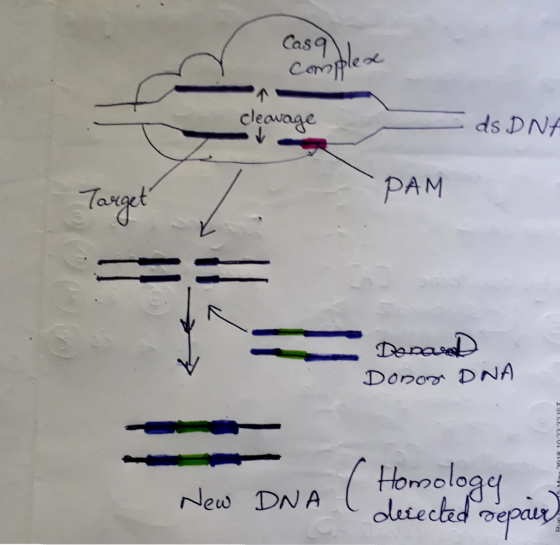
2. Explain/draw how CRISPR/Cas9 generate homozygote of the mutated gene. Use terms: double-strand break, guide RNA
please keep it simple so i can understand (:
Homework Answers
1. Small interfering RNA (siRNA) or silencing RNA is double stranded RNA with 20-25 base pairs.They are introduced into the cell by transfection. siRNA prevents translation by gene silencing.
siRNA is formed by the cleavage of long dsRNA by an endo-ribonuclease called Dicer , after that the siRNA enters the cell. Then the functional siRNAs are recognized by the Ago2/RISC complex(RNA-Induced Silencing Complex) which degrades one strand and the other strand guides the inhibitory complex to complementary mRNA.Then the targeted mRNAs are degraded through cleavage by the RISC complex. As a result the cut mRNA is recognised as abnormal and no translation occurs. This is the gene silencing method by siRNA.
Dominant negative inhibition is commonly seen when a a mutant subunit of a multisubunit protein is coexpressed with the wild-type protein. As a result the functional oligomer is silenced. In other words we can say that the function of a wild type gene product is silenced by the coexpressed mutant variant of the same gene product. This type of inhibition is fragment-specific. if an inhibitory fragment binds with the intact enzyme (mutated) it forms a complex which will leads to enzyme inactivation. And this complex will interrupt the folding pathway of our wild type enzyme.
Detection of this type of inhibition is done by Immunoprecipitation. The inhibitory fragment is transferred into a plasmid and label it with some epitope tags at the C terminal. This is done with the help of a PCR . The coexpressing genes are also transformed. After that cell extracts are taken and immunoprecipitation is carried out with the appropriate materials. The immunoprecipitated sample is washed and electrophoresed on a SDS polyacrylamide gel. Then the proteins in the gel are electroblotted onto polyvinylidene difluoride membranes and detect using some chemiluminescence system.
2. CRISPR (Clustered Regularly Interspaced Short Palindromic Repeats)-associated (Cas) genes are used to repair mutations. CRISPR is designed accordingly.
DNA from viruses is cut into small fragments and they are incorporated into CRISPR (a series of short repeats). Then these genes are transcribed , after that the transcripts are processed to generate small RNAs called crRNA (CRISPR RNA). This new crRNA will guide the effector endonucleases to target DNA based on sequence complementarity . The endonucleases will cause a double strand break at the site of mutation and the donor DNA that contained a synonymous codon for the correct amino acid which will repair the cut with the correct sequence.
Add Answer to:
1. Explain the difference in the inhibitory mechanisms between
small interfering RNA (siRNA) and Dominant negative....
Most questions answered within 3 hours.
-
Where is the error in this code sequence?
String s1 = "Hello";
String s2 = "ello";...
asked 10 months ago -
Financial data for Joel de Paris, Inc., for last year
follow:
Joel de Paris, Inc.
Balance...
asked 10 months ago -
Consider this reaction:
Al2(SO4)3 (aq)+ BaCl3
(aq) Al2Cl6 (aq)- +
3BaSO4(s) . What is the...
asked 10 months ago -
Suppose that Savneet is considering increasing her
recent random sample from 20 car rentals to 40...
asked 10 months ago -
Trucks arrive at an unloading terminal at an average rate of 120
per hour.
Trucks arrive...
asked 10 months ago -
Why are methanol and ethanol completely soluble in water while
octanol is not very little soluble....
asked 10 months ago -
A facilities manager at a university reads in a research report
that the mean amount of...
asked 10 months ago -
When the CuSO4 is rehydrated by adding water to the anhydrous
compound, is this an endothermic...
asked 10 months ago -
A ray of sunlight is passing from diamond into crown glass; the
angle of incidence is...
asked 10 months ago -
A block of mass 0.249 kg is placed on top of a light, vertical
spring of...
asked 10 months ago -
how do the kidneys compensate in the presences of acidosis
a) trigger hyperventilate
b) reserve acid...
asked 10 months ago -
Question 501 pts
The rental rate of capital to the firm increases. Which of the
following...
asked 10 months ago