In the AD/AS model, a country's full-employment real GDP is represented by ____________ (Hint: There is...
In the AD/AS model, a country's full-employment real GDP is represented by ____________ (Hint: There is only one correct answer, but you can mark more than one answer if you're not sure.)
-prices.
-aggregate demand
-long-run aggregate supply
-shortrun aggregate supply
-an increase in the price level
-employment is not part of the AD/AS model or graph
Homework Answers
Option C.
- In the AD/AS model, a country's full employment real GDP is represented by a long run aggregate supply curve.
- The long run aggregate supply curve is a curve which represents the real value of all the goods and services after the economy has adjusted itself in the long run.
- This curve is usually represented by a vertical line and it represents the real GDP after it is fully employed.
Add Answer to:
In the AD/AS model, a country's full-employment real GDP is
represented by ____________ (Hint: There is...
Suppose the current level of real GDP for an economy is below its potential level of...
Suppose the current level of real GDP for an economy is below its potential level of RGDP. Starting with this situation, and in the absence of any government action, what should next happen in the AD-AS model? Group of answer choices A. A decrease in the Long-Run Aggregate Supply B. An increase in Aggregate Demand C. A decrease in Aggregate Demand D. An increase in the Short-Run Aggregate Supply E. An increase in the Long-Run Aggregate Supply F. A decrease...
Suppose the current level of real GDP for an economy is below its potential level of...
Suppose the current level of real GDP for an economy is below its potential level of RGDP. Starting with this situation, and in the absence of any government action, what should next happen in the AD-AS model? Group of answer choices A. A decrease in the Long-Run Aggregate Supply B. An increase in Aggregate Demand C. A decrease in Aggregate Demand D. An increase in the Short-Run Aggregate Supply E. An increase in the Long-Run Aggregate Supply F. A decrease...
Price Level AD Real GDP Figure 9.6 In Figure 9.6, if full employment occurs at Qc...
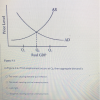 Price Level AD Real GDP Figure 9.6 In Figure 9.6, if full employment occurs at Qc then aggregate demand is Too small, causing demand-pull inflation. Too small, causing cyclical unemployment Just right Too great, causing cyclical unemployment.
Unit 3: Aggregate Demand, Aggregate Supply, and Fiscal Policy AD, AS, and LRAS Short Run vs....
 Unit 3: Aggregate Demand, Aggregate Supply, and Fiscal Policy AD, AS, and LRAS Short Run vs. Long Run Aggregate Supply Draw the economy at full employment 1. In the short run, wages and resource prices will as price levels increase 2. In the long run, wages and resource prices will as price levels increase Shifters of AD and AS Shifters of Aggregate Demand Shifters of Aggregate Supply imi Recessionary Gap Draw an economy in a recession Inflationary Gap Draw an...
Assignment Score: NaN% Resources Hint Check Answer Question 4 of 13 > The graph shows the...
 Assignment Score: NaN% Resources Hint Check Answer Question 4 of 13 > The graph shows the aggregate demand (AD) curve and the long-run aggregate supply (LRAS) curve for a hypothetical economy. Suppose that the economy experiences an increase in the human capital of workers, causing productivity to rise Show the effect of this change by shifting one of the curves in the graph. How will this change affect the price level? The price level will rise. The price level will...
1. An above-full-employment equilibrium occurs when Group of answer choices aggregate demand decreases while neither the...
1. An above-full-employment equilibrium occurs when Group of answer choices aggregate demand decreases while neither the short-run nor long-run aggregate supply changes. short-run aggregate supply decreases while neither aggregate demand nor long-run aggregate supply changes. the equilibrium level of real GDP is greater than potential GDP. the equilibrium level of real GDP is less than potential GDP. 2. Which of the following shifts the aggregate demand curve rightward? Group of answer choices a decrease in consumption an increase in investment...
In the AS-AD model, when actual GDP falls below potential real GDP in the equilibrium of...
In the AS-AD model, when actual GDP falls below potential real GDP in the equilibrium of the AD and short-run AS curves, then -aggregate supply increases. -the economy is not at a short run equilibrium in the AS-AD model. -cyclical unemployment occurs.
The graph shows an economy below full employment. To restore full employment, the government incr...
 The graph shows an economy below full employment. To restore full employment, the government increases government expenditure by $0.5 trillion. Draw a curve to show the effect of the increase if it is the only change in spending plans. Label the curve ADo AE Price level (GDP price index, 2009-100) Potential GDP The increase in government expenditure sets off a multiplier process. Draw a curve that shows the multiplier effect that returns the economy to full employment. Label it AD,...
2. Suppose the economy is in long-run equilibrium, with real GDP at $19 trillion and the unemployment rate at 5%. Now assume that the central bank unexpectedly decreases money supply by 6%. a) Illust...
 2. Suppose the economy is in long-run equilibrium, with real GDP at $19 trillion and the unemployment rate at 5%. Now assume that the central bank unexpectedly decreases money supply by 6%. a) Illustrate the short-run effects of the monetary policy by using aggregate demand-aggregate supply model. Be sure to indicate the direction of change in real GDP, the price level and the unemployment rate. b) Illustrate the long-run effects of the monetary policy by using aggregate demand-aggregate supply model....
Consider the AD/AS macro model. Suppose there is an increase in aggregate demand and, simultaneously, a...
 Consider the AD/AS macro model. Suppose there is an increase in aggregate demand and, simultaneously, a decrease in aggregate supply. The result will be a Select one: a. rise in real GDP but price level changes will be indeterminate. b. rise in real GDP and a fall in the price level. c. an indeterminate change in real GDP and a rise in the d. an indeterminate change in real GDP and a fall in the price level e. rise in...
 Price Level AD Real GDP Figure 9.6 In Figure 9.6, if full employment occurs at Qc then aggregate demand is Too small, causing demand-pull inflation. Too small, causing cyclical unemployment Just right Too great, causing cyclical unemployment.
 Unit 3: Aggregate Demand, Aggregate Supply, and Fiscal Policy AD, AS, and LRAS Short Run vs. Long Run Aggregate Supply Draw the economy at full employment 1. In the short run, wages and resource prices will as price levels increase 2. In the long run, wages and resource prices will as price levels increase Shifters of AD and AS Shifters of Aggregate Demand Shifters of Aggregate Supply imi Recessionary Gap Draw an economy in a recession Inflationary Gap Draw an...
 Assignment Score: NaN% Resources Hint Check Answer Question 4 of 13 > The graph shows the aggregate demand (AD) curve and the long-run aggregate supply (LRAS) curve for a hypothetical economy. Suppose that the economy experiences an increase in the human capital of workers, causing productivity to rise Show the effect of this change by shifting one of the curves in the graph. How will this change affect the price level? The price level will rise. The price level will...
 The graph shows an economy below full employment. To restore full employment, the government increases government expenditure by $0.5 trillion. Draw a curve to show the effect of the increase if it is the only change in spending plans. Label the curve ADo AE Price level (GDP price index, 2009-100) Potential GDP The increase in government expenditure sets off a multiplier process. Draw a curve that shows the multiplier effect that returns the economy to full employment. Label it AD,...
 2. Suppose the economy is in long-run equilibrium, with real GDP at $19 trillion and the unemployment rate at 5%. Now assume that the central bank unexpectedly decreases money supply by 6%. a) Illustrate the short-run effects of the monetary policy by using aggregate demand-aggregate supply model. Be sure to indicate the direction of change in real GDP, the price level and the unemployment rate. b) Illustrate the long-run effects of the monetary policy by using aggregate demand-aggregate supply model....
 Consider the AD/AS macro model. Suppose there is an increase in aggregate demand and, simultaneously, a decrease in aggregate supply. The result will be a Select one: a. rise in real GDP but price level changes will be indeterminate. b. rise in real GDP and a fall in the price level. c. an indeterminate change in real GDP and a rise in the d. an indeterminate change in real GDP and a fall in the price level e. rise in...
Most questions answered within 3 hours.
-
Where is the error in this code sequence?
String s1 = "Hello";
String s2 = "ello";...
asked 11 months ago -
Financial data for Joel de Paris, Inc., for last year
follow:
Joel de Paris, Inc.
Balance...
asked 11 months ago -
Consider this reaction:
Al2(SO4)3 (aq)+ BaCl3
(aq) Al2Cl6 (aq)- +
3BaSO4(s) . What is the...
asked 11 months ago -
Suppose that Savneet is considering increasing her
recent random sample from 20 car rentals to 40...
asked 11 months ago -
Trucks arrive at an unloading terminal at an average rate of 120
per hour.
Trucks arrive...
asked 11 months ago -
Why are methanol and ethanol completely soluble in water while
octanol is not very little soluble....
asked 11 months ago -
A facilities manager at a university reads in a research report
that the mean amount of...
asked 11 months ago -
When the CuSO4 is rehydrated by adding water to the anhydrous
compound, is this an endothermic...
asked 11 months ago -
A ray of sunlight is passing from diamond into crown glass; the
angle of incidence is...
asked 11 months ago -
A block of mass 0.249 kg is placed on top of a light, vertical
spring of...
asked 11 months ago -
how do the kidneys compensate in the presences of acidosis
a) trigger hyperventilate
b) reserve acid...
asked 11 months ago -
Question 501 pts
The rental rate of capital to the firm increases. Which of the
following...
asked 11 months ago