Question #5 If glucose is labeled with 14C at its C2 position, where will the label...
Question #5 If glucose is labeled with 14C at its C2 position, where will the label appear in pyruvate? DRAW pyruvate and CIRCLE the 14C.
Homework Answers
ANSWER:
If glucose is labeled with 14C at its C2 position then it will appear in c2/c5 carbon of pyruvate
(Please rate if answer is helpful thanks)
I have made this full explanation about labeling of glucose..i i ho it will help you
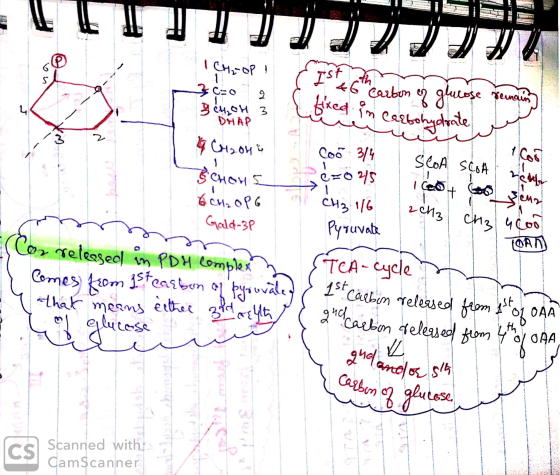
Add Answer to:
Question #5 If glucose is labeled with 14C at
its C2 position, where will the label...
Question #5 If glucose is labeled with "C at its C4 position, where will the label...
 Question #5 If glucose is labeled with "C at its C4 position, where will the label appear in pyruvate? DRAW pyruvate and CIRCLE the "C.
If a molecule of glucose is labeled with 14C at position 1 proceeds through glycolysis, where...
If a molecule of glucose is labeled with 14C at position 1 proceeds through glycolysis, where will the radioactive label end up? a) At the carboxyl carbon of all the pyruvate produced b) At the carboxyl carbon of half of the pyruvate produced. c) At the methyl carbon of half of the pyruvate produced. d) At the methyl carbon of all the pyruvate produced. e) At the carbonyl carbon of all the pyruvate produced. f) At the carbonyl carbon of...
Glucose labeled with 14C atom in position C-1 is incubated with glycolysis enzymes. what part (%) of...
Glucose labeled with 14C atom in position C-1 is incubated with glycolysis enzymes. what part (%) of pyruvate molecules will be labeled
Question 3 Glucose labeled with 14C in C-3 and C-4 is completely converted to acetyl-CoA via...
Question 3 Glucose labeled with 14C in C-3 and C-4 is completely converted to acetyl-CoA via glycolysis and the pyruvate dehydrogenase complex. What percentage of the acetyl-CoA molecules formed will be labeled with 14C, and in which position of the acetyl moiety will the 14C label be found? Select the correct answer and explain your reasoning 100% of the acetyl-CoA will be labeled at C-1 (carboxyl). 100% of the acetyl-CoA will be labeled at C-2. 50% of the acetyl-CoA will...
Question 3 Glucose labeled with 14C in C-3 and C-4 is completely converted to acetyl-CoA via...
Question 3 Glucose labeled with 14C in C-3 and C-4 is completely converted to acetyl-CoA via glycolysis and the pyruvate dehydrogenase complex. What percentage of the acetyl-CoA molecules formed will be labeled with 14C, and in which position of the acetyl moiety will the 14C label be found? Select the correct answer and explain your reasoning 100% of the acetyl-CoA will be labeled at C-1 (carboxyl). 100% of the acetyl-CoA will be labeled at C-2. 50% of the acetyl-CoA will...
Question 3 Glucose labeled with 14C in C-3 and C-4 is completely converted to acetyl-CoA via...
Question 3 Glucose labeled with 14C in C-3 and C-4 is completely converted to acetyl-CoA via glycolysis and the pyruvate dehydrogenase complex. What percentage of the acetyl-CoA molecules formed will be labeled with 14C, and in which position of the acetyl moiety will the 14C label be found? Select the correct answer and explain your reasoning 100% of the acetyl-CoA will be labeled at C-1 (carboxyl). 100% of the acetyl-CoA will be labeled at C-2. 50% of the acetyl-CoA will...
Question 3 Glucose labeled with 14C in C-3 and C-4 is completely converted to acetyl-CoA via...
Question 3 Glucose labeled with 14C in C-3 and C-4 is completely converted to acetyl-CoA via glycolysis and the pyruvate dehydrogenase complex. What percentage of the acetyl-CoA molecules formed will be labeled with 14C, and in which position of the acetyl moiety will the 14C label be found? Select the correct answer and explain your reasoning 100% of the acetyl-CoA will be labeled at C-1 (carboxyl). 100% of the acetyl-CoA will be labeled at C-2. 50% of the acetyl-CoA will...
In a "pulse chase" experiment under anaerobic conditions, 14C glucose is added to an ethanol-producing yeast...
In a "pulse chase" experiment under anaerobic conditions, 14C glucose is added to an ethanol-producing yeast cell extract just long enough that each intermediate in the ethanol fermentation is labeled with a 14C (pulse). The 14C label is then diluted so that no additional radioactivity is incorporated into the intermediates (chase). 1. What position in ethanol will be labeled with 14C if 14C-glucose labeled at position C-1 is used? 2. Where should the 14C label sit in glucose for it...
Question 7 3 pts A second biochemist also studying metabolism feeds her rats 3-[14C]-alanine (alanine labeled...
 Question 7 3 pts A second biochemist also studying metabolism feeds her rats 3-[14C]-alanine (alanine labeled at the methyl group). Alanine can provide carbons for gluconeogenesis because of the reaction catalyzed by alanine aminotransferase. alanine + a-ketoglutarate = pyruvate + glutamate After sacrificing her rats she finds considerable 14C in the glucose. Where is the 14C located in the glucose? C1 C2 C3 C4 C5 C6
21. Glucose labeled with 14C in C-1 and C-4 gives rise in glycolysis to pyruvate labeled...
 21. Glucose labeled with 14C in C-1 and C-4 gives rise in glycolysis to pyruvate labeled in: A) its methyl carbon B) all three carbons C) its carbonyl carbon D) its carboxyl carbon E) A and D
 Question #5 If glucose is labeled with "C at its C4 position, where will the label appear in pyruvate? DRAW pyruvate and CIRCLE the "C.
 Question 7 3 pts A second biochemist also studying metabolism feeds her rats 3-[14C]-alanine (alanine labeled at the methyl group). Alanine can provide carbons for gluconeogenesis because of the reaction catalyzed by alanine aminotransferase. alanine + a-ketoglutarate = pyruvate + glutamate After sacrificing her rats she finds considerable 14C in the glucose. Where is the 14C located in the glucose? C1 C2 C3 C4 C5 C6
 21. Glucose labeled with 14C in C-1 and C-4 gives rise in glycolysis to pyruvate labeled in: A) its methyl carbon B) all three carbons C) its carbonyl carbon D) its carboxyl carbon E) A and D
Most questions answered within 3 hours.
-
Where is the error in this code sequence?
String s1 = "Hello";
String s2 = "ello";...
asked 10 months ago -
Financial data for Joel de Paris, Inc., for last year
follow:
Joel de Paris, Inc.
Balance...
asked 10 months ago -
Consider this reaction:
Al2(SO4)3 (aq)+ BaCl3
(aq) Al2Cl6 (aq)- +
3BaSO4(s) . What is the...
asked 10 months ago -
Suppose that Savneet is considering increasing her
recent random sample from 20 car rentals to 40...
asked 10 months ago -
Trucks arrive at an unloading terminal at an average rate of 120
per hour.
Trucks arrive...
asked 10 months ago -
Why are methanol and ethanol completely soluble in water while
octanol is not very little soluble....
asked 10 months ago -
A facilities manager at a university reads in a research report
that the mean amount of...
asked 10 months ago -
When the CuSO4 is rehydrated by adding water to the anhydrous
compound, is this an endothermic...
asked 10 months ago -
A ray of sunlight is passing from diamond into crown glass; the
angle of incidence is...
asked 10 months ago -
A block of mass 0.249 kg is placed on top of a light, vertical
spring of...
asked 10 months ago -
how do the kidneys compensate in the presences of acidosis
a) trigger hyperventilate
b) reserve acid...
asked 10 months ago -
Question 501 pts
The rental rate of capital to the firm increases. Which of the
following...
asked 10 months ago