Frances Gumm has an opportunity to invest $3,000 in a venture that has a 0.2 chance...
Frances Gumm has an opportunity to invest $3,000 in a venture that has a 0.2 chance of making nothing, a 0.3 chance of making $2,000, a 0.2 chance of making $4,000, and a 0.3 chance of making $6,000. Her utilities for each of the outcomes are 0 for $2,000, 35 for $4,000, and 40 for making $6,000. Draw Frances’s utility curve and advise her on making the investment.
Homework Answers
His wealth = $3000
His potential return from investment:
| Return | Utility | Probability | Probabilistic utility |
| 0 | 0 | 0.2 | 0 |
| 2000 | 0 | 0.3 | 0 |
| 4000 | 35 | 0.2 | 7 |
| 6000 | 40 | 0.3 | 12 |
| Total | 19 | ||
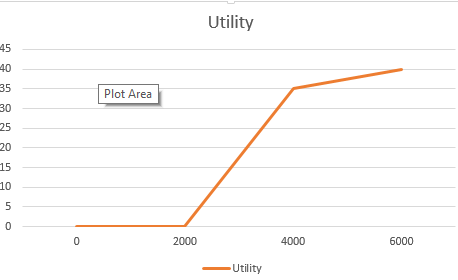
Frances Gumm should make this investment only if the utility from $3000 is less than 19 (which is probabilistic utility from different outcomes of investment)
Add Answer to:
Frances Gumm has an opportunity to invest $3,000 in a venture
that has a 0.2 chance...
A manager expresses indifference between a certain profit of $5,000 and a venture with a 70%...
A manager expresses indifference between a certain profit of $5,000 and a venture with a 70% chance of making $10,000 and a 30% chance of making nothing. If the manager's utility-scale is set at 1 utile for $0. and 100 utiles for $10,000. If the manager is indifferent between a venture that has a 60% chance of making $10,000 and a 40% chance of making $1,000, and a sure investment that yields $5,000. Find the value of $1,000 in utiles...
Suppose that a decision maker has the opportunity to invest in an oil well drilling operation...
 Suppose that a decision maker has the opportunity to invest in an oil well drilling operation that has a .3 chance of yielding a profit of $1,000,000, a. 4 chance of yielding a profit of $400,000, and a .3 chance of yielding a profit of -$100,000. Also, suppose that the decision maker's utilities for $400,000 and $0 are.9 and .7. Find the expected utility of the oil well drilling operation. Find the expected utility of not investing. What should the...
Z. An investor has the opportunity to invest $450,000 in a project that with probability p...
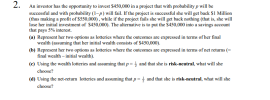 Z. An investor has the opportunity to invest $450,000 in a project that with probability p will be successful and with probability (1-p) will fail. If the project is successful she will get back S1 Million (thus making a profit of S550,000), while if the project fails she will get back nothing (that is, she will lose her initial investment of $450,000). The alternative is to put the $450,000 into a savings account that pays 5% interest. (a) Represent her...
The graph shows Dana's utiity of wealth curve. Total utaty units) Dana has an opportunity to Invast her wealth in a business venturs that has a 50 parcant chance of returning $9.000 and a 50 perc...
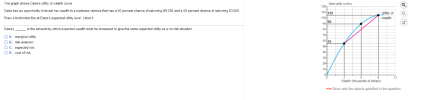 The graph shows Dana's utiity of wealth curve. Total utaty units) Dana has an opportunity to Invast her wealth in a business venturs that has a 50 parcant chance of returning $9.000 and a 50 percant chance of returning $3,000 105 ot Draw a horizontal lina at Dana's axpectad utility laval Labal it axpected utlity laval 90 Danass tha amount by which axpacted weath must ba Increased to glve tha same ampactad untility as a no-risk situation A. marginal utilin...
Firm X has the opportunity to invest $254,000 in a new venture. The projected cash flows...
Firm X has the opportunity to invest $254,000 in a new venture. The projected cash flows from the venture are as follows. Use Appendix A and Appendix B. Please show all calculations. Year 0 Year 1 Year 2 Year 3 Initial investment $ (254,000 ) Revenues $ 38,400 $ 38,400 $ 38,400 Expenses (23,040 ) (5,760 ) (5,760 ) Return of investment 254,000 Before-tax net cash flow (254,000 ) $ 15,360 $ 32,640 $ 286,640 Firm X uses an 8...
75. A venture capitalist, willing to invest $1,000,000, has three investments to choose from. The first...
 75. A venture capitalist, willing to invest $1,000,000, has three investments to choose from. The first investment, a software company, has a 10% chance of returning $5,000,000 profit, a 30% chance of returning $1,000,000 profit, and a 60% chance of losing the million dollars. The second company, a hardware company, has a 20% chance ofreturning $3,000,000 profit, a 40% chance of returning $1,000,000 profit, and a 40% chance of loging the million dollars. The third company, a biotech firm, has...
Firm X has the opportunity to invest $288,000 in a new venture. The projected cash flows...
 Firm X has the opportunity to invest $288,000 in a new venture. The projected cash flows from the venture are as follows. Use Appendix A and Appendix B. Year 1 Year 2 Year 3 Year e Initial investment $(288,000) $ 57,800 (34,680) $ 57,800 (8,670) 288,800 $337,130 $57,800 (8,670) Revenues Expenses Return of investment (288,000) $ 23,120 Before-tax net cash flow $49,130 Firm X uses an 8 percent discount rate, and its marginal tax rate over the life of the...
A venture capitalist, willing to invest $1,000,000, has three investments to choose from. The first investment,...
A venture capitalist, willing to invest $1,000,000, has three investments to choose from. The first investment, a software company, has a 10% chance of returning $5,000,000 profit, a 30% chance of returning $1,000,000 profit, and a 60% chance of losing the million dollars. The second company, a hardware company, has a 20% chance of returning $3,000,000 profit, a 40% chance of returning $1,000,000 profit, and a 40% chance of losing the million dollars. The third company, a biotech firm, has...
An investment of $10,000 in a high risk venture has a 50-50 chance over the next...
An investment of $10,000 in a high risk venture has a 50-50 chance over the next year of increasing to $14,000 or decreasing to $8000. Thus the net return can be either $4000 or -$2,000. Two investors A and B have exhibited the following indifference probabilities: Indifference Probabilities Net return ($) Investor A Investor B -2000 0.00 0.00 -1000 .70 .10 0 .80 .20 1000 .85 .30 2000 .90 .50 3000 .95 .60 4000 1.00 1.00 Graph the utility functions...
1. a. Two investors, A and B, are evaluating the same investment opportunity, which has an expected value of £100. The u...
1. a. Two investors, A and B, are evaluating the same investment opportunity, which has an expected value of £100. The utility functions of A and B are ln(x) and x2, respectively. Which investor has a certainty equivalent higher than 100? Which investor requires the higher risk premium? b. (i) Describe suitable measures of risk for ‘loss-aversion’ and ‘risk aversion’. (ii) Concisely define the term ‘risk neutral’ with respect to a utility function u (w), where w is the realisation...
 Suppose that a decision maker has the opportunity to invest in an oil well drilling operation that has a .3 chance of yielding a profit of $1,000,000, a. 4 chance of yielding a profit of $400,000, and a .3 chance of yielding a profit of -$100,000. Also, suppose that the decision maker's utilities for $400,000 and $0 are.9 and .7. Find the expected utility of the oil well drilling operation. Find the expected utility of not investing. What should the...
 Z. An investor has the opportunity to invest $450,000 in a project that with probability p will be successful and with probability (1-p) will fail. If the project is successful she will get back S1 Million (thus making a profit of S550,000), while if the project fails she will get back nothing (that is, she will lose her initial investment of $450,000). The alternative is to put the $450,000 into a savings account that pays 5% interest. (a) Represent her...
 The graph shows Dana's utiity of wealth curve. Total utaty units) Dana has an opportunity to Invast her wealth in a business venturs that has a 50 parcant chance of returning $9.000 and a 50 percant chance of returning $3,000 105 ot Draw a horizontal lina at Dana's axpectad utility laval Labal it axpected utlity laval 90 Danass tha amount by which axpacted weath must ba Increased to glve tha same ampactad untility as a no-risk situation A. marginal utilin...
 75. A venture capitalist, willing to invest $1,000,000, has three investments to choose from. The first investment, a software company, has a 10% chance of returning $5,000,000 profit, a 30% chance of returning $1,000,000 profit, and a 60% chance of losing the million dollars. The second company, a hardware company, has a 20% chance ofreturning $3,000,000 profit, a 40% chance of returning $1,000,000 profit, and a 40% chance of loging the million dollars. The third company, a biotech firm, has...
 Firm X has the opportunity to invest $288,000 in a new venture. The projected cash flows from the venture are as follows. Use Appendix A and Appendix B. Year 1 Year 2 Year 3 Year e Initial investment $(288,000) $ 57,800 (34,680) $ 57,800 (8,670) 288,800 $337,130 $57,800 (8,670) Revenues Expenses Return of investment (288,000) $ 23,120 Before-tax net cash flow $49,130 Firm X uses an 8 percent discount rate, and its marginal tax rate over the life of the...
Most questions answered within 3 hours.
-
Where is the error in this code sequence?
String s1 = "Hello";
String s2 = "ello";...
asked 11 months ago -
Financial data for Joel de Paris, Inc., for last year
follow:
Joel de Paris, Inc.
Balance...
asked 11 months ago -
Consider this reaction:
Al2(SO4)3 (aq)+ BaCl3
(aq) Al2Cl6 (aq)- +
3BaSO4(s) . What is the...
asked 11 months ago -
Suppose that Savneet is considering increasing her
recent random sample from 20 car rentals to 40...
asked 11 months ago -
Trucks arrive at an unloading terminal at an average rate of 120
per hour.
Trucks arrive...
asked 11 months ago -
Why are methanol and ethanol completely soluble in water while
octanol is not very little soluble....
asked 11 months ago -
A facilities manager at a university reads in a research report
that the mean amount of...
asked 11 months ago -
When the CuSO4 is rehydrated by adding water to the anhydrous
compound, is this an endothermic...
asked 11 months ago -
A ray of sunlight is passing from diamond into crown glass; the
angle of incidence is...
asked 11 months ago -
A block of mass 0.249 kg is placed on top of a light, vertical
spring of...
asked 11 months ago -
how do the kidneys compensate in the presences of acidosis
a) trigger hyperventilate
b) reserve acid...
asked 11 months ago -
Question 501 pts
The rental rate of capital to the firm increases. Which of the
following...
asked 11 months ago