For each of the following questions, answer how the given two functions compare asymptotically. (1) nlogn...
For each of the following questions, answer how the given two functions compare asymptotically.
(1) nlogn and n1.1logloglogn
(2) (ceil n)3 and (floor n)4
Homework Answers


Add Answer to:
For each of the following questions, answer how the given two
functions compare asymptotically.
(1) nlogn...
4. Let fín) and g(n) be asymptotically positive functions. Prove each of the following statements...
 4. Let fín) and g(n) be asymptotically positive functions. Prove each of the following statements A. fin)-O(g(n)) if and only if fin) *gn)g(n)) B. fn) - Og(n if and only if fin)2- O(g(n)?)
4. Let fín) and g(n) be asymptotically positive functions. Prove each of the following statements A. fin)-O(g(n)) if and only if fin) *gn)g(n)) B. fn) - Og(n if and only if fin)2- O(g(n)?)
4. Let fín) and g(n) be asymptotically positive functions. Prove each of the following statements A. fin)-O(g(n)) if and only if fin) *gn)g(n)) B. fn) - Og(n if and only if fin)2- O(g(n)?)
Let f1 and f2 be asymptotically positive non-decreasing functions. Prove or disprove each of the following...
Let f1 and f2 be asymptotically positive non-decreasing functions. Prove or disprove each of the following conjectures. To disprove give a counter example. If f1(n) = O(g(n)) and f2(n) = O(g(n)) then f1(n)= Θ (f2(n) ).
Let f(n) and g(n) be asymptotically positive functions. Prove or disprove each of the following conjectures....
Let f(n) and g(n) be asymptotically positive functions. Prove or disprove each of the following conjectures. f(n) = O(g(n)) implies g(n) = Ω(f(n)) . f(n) = O(g(n)) implies g(n) = O(f(n)). f(n) + g(n) = Θ(min(f(n),g(n))).
Let f1 and f2 be asymptotically positive non-decreasing functions. Prove or disprove each of the following...
Let f1 and f2 be asymptotically positive non-decreasing functions. Prove or disprove each of the following conjectures. To disprove, give a counterexample. a.If f1(n) = Theta(g(n)) and f2(n) = Theta(g(n)) then f1(n) + f2(n) = Theta(g(n)) b.If f1(n) = O(g(n)) and f2(n) = O(g(n))then f1(n) = O(f2(n))
Calculate the order of magnitude ?( ) of the following functions, assuming that T (1) =...
Calculate the order of magnitude ?( ) of the following functions, assuming that T (1) = ? (1). T(n) = 5T(n/7) + nlogn T(n) = 3T(n/4) + log3n T(n) = 4T(n/4) + nlogn T(n) = 9T(n/10) + log3n T(n) = 2T(n/3) + n/log2n T(n) = T(n-1) + 1/n
U.JUllal llclui SIVETULTUlas The recursive relationship for many functions follows a general pattern. T(n <= 1)...
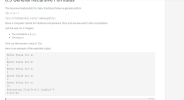 U.JUllal llclui SIVETULTUlas The recursive relationship for many functions follows a general pattern. T(n <= 1) = 1 T(n) = a*T(floor(n/b)) + (n^x) * ceil log2(n)"y) Since a computer cannot do fractional comparisons, floor and ceil are used in this computation Ask the user for 5 integers: • The constants a, b,xy • The input n Print out the numeric value of T(n). Here is an example of the expected output. Enter Value for a: Enter Value for b: Enter...
In the space provided, answer each of the given questions. Your answers should be concise; aim fo...
 In the space provided, answer each of the given questions. Your answers should be concise; aim for two or three sentences. 1. Why is choosing not to overload the assignment operator and using default memberwise copy a potentially dangerous thing to do? 2. Why are some operators overloaded as member functions while others are not? 3. Describe precisely how the overloaded addition operator for HugeInt operates. 4. What restrictions does the class have?
In the space provided, answer each of...
In the space provided, answer each of the given questions. Your answers should be concise; aim for two or three sentences. 1. Why is choosing not to overload the assignment operator and using default memberwise copy a potentially dangerous thing to do? 2. Why are some operators overloaded as member functions while others are not? 3. Describe precisely how the overloaded addition operator for HugeInt operates. 4. What restrictions does the class have?
In the space provided, answer each of...
4. Two functions are given below. For the questions below, answer a, b, neither, or both,...
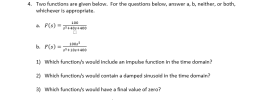 4. Two functions are given below. For the questions below, answer a, b, neither, or both, whichever is appropriate a. F(s)+40+400 b. F(s)=ー10,+400 1) Which function/s would include an impulse function in the time domain? 2) Which function/s would contain a damped sinusoid in the time domain? 3) Which function/s would have a final value of zero? s+10s+400
Part I. (30 pts) (10 pts) Let fin) and g(n) be asymptotically positive functions. Prove or...
 Part I. (30 pts) (10 pts) Let fin) and g(n) be asymptotically positive functions. Prove or disprove each of the following statements T a、 f(n) + g(n)=0(max(f(n), g(n))) 1. b. f(n) = 0(g(n)) implies g(n) = Ω(f(n)) T rc. f(n)- o F d. f(n) o(f(n)) 0(f (n)) f(n)=6((f(n))2)
1. Give an asymptotically tight bound to each of the following expressions: 3n^2 + 2n^3 3n...
1. Give an asymptotically tight bound to each of the following expressions: 3n^2 + 2n^3 3n log n + 2n^2 2^n + 3^n 2. Arrange the following asymptotic family from lower order to higher order. The first has been done for you. O(n log n) O(n^3) O(log n) O(n^2 log n) O(n) O(3^n) O(2^n) 3. At work, Peter needs to solve a problem of different sizes. He has two algorithms available to solve the problem. Algorithm A can solve the...
 4. Let fín) and g(n) be asymptotically positive functions. Prove each of the following statements A. fin)-O(g(n)) if and only if fin) *gn)g(n)) B. fn) - Og(n if and only if fin)2- O(g(n)?)
4. Let fín) and g(n) be asymptotically positive functions. Prove each of the following statements A. fin)-O(g(n)) if and only if fin) *gn)g(n)) B. fn) - Og(n if and only if fin)2- O(g(n)?)
4. Let fín) and g(n) be asymptotically positive functions. Prove each of the following statements A. fin)-O(g(n)) if and only if fin) *gn)g(n)) B. fn) - Og(n if and only if fin)2- O(g(n)?)
 U.JUllal llclui SIVETULTUlas The recursive relationship for many functions follows a general pattern. T(n <= 1) = 1 T(n) = a*T(floor(n/b)) + (n^x) * ceil log2(n)"y) Since a computer cannot do fractional comparisons, floor and ceil are used in this computation Ask the user for 5 integers: • The constants a, b,xy • The input n Print out the numeric value of T(n). Here is an example of the expected output. Enter Value for a: Enter Value for b: Enter...
 In the space provided, answer each of the given questions. Your answers should be concise; aim for two or three sentences. 1. Why is choosing not to overload the assignment operator and using default memberwise copy a potentially dangerous thing to do? 2. Why are some operators overloaded as member functions while others are not? 3. Describe precisely how the overloaded addition operator for HugeInt operates. 4. What restrictions does the class have?
In the space provided, answer each of...
In the space provided, answer each of the given questions. Your answers should be concise; aim for two or three sentences. 1. Why is choosing not to overload the assignment operator and using default memberwise copy a potentially dangerous thing to do? 2. Why are some operators overloaded as member functions while others are not? 3. Describe precisely how the overloaded addition operator for HugeInt operates. 4. What restrictions does the class have?
In the space provided, answer each of...
 4. Two functions are given below. For the questions below, answer a, b, neither, or both, whichever is appropriate a. F(s)+40+400 b. F(s)=ー10,+400 1) Which function/s would include an impulse function in the time domain? 2) Which function/s would contain a damped sinusoid in the time domain? 3) Which function/s would have a final value of zero? s+10s+400
 Part I. (30 pts) (10 pts) Let fin) and g(n) be asymptotically positive functions. Prove or disprove each of the following statements T a、 f(n) + g(n)=0(max(f(n), g(n))) 1. b. f(n) = 0(g(n)) implies g(n) = Ω(f(n)) T rc. f(n)- o F d. f(n) o(f(n)) 0(f (n)) f(n)=6((f(n))2)
Most questions answered within 3 hours.
-
Where is the error in this code sequence?
String s1 = "Hello";
String s2 = "ello";...
asked 10 months ago -
Financial data for Joel de Paris, Inc., for last year
follow:
Joel de Paris, Inc.
Balance...
asked 10 months ago -
Consider this reaction:
Al2(SO4)3 (aq)+ BaCl3
(aq) Al2Cl6 (aq)- +
3BaSO4(s) . What is the...
asked 10 months ago -
Suppose that Savneet is considering increasing her
recent random sample from 20 car rentals to 40...
asked 10 months ago -
Trucks arrive at an unloading terminal at an average rate of 120
per hour.
Trucks arrive...
asked 10 months ago -
Why are methanol and ethanol completely soluble in water while
octanol is not very little soluble....
asked 10 months ago -
A facilities manager at a university reads in a research report
that the mean amount of...
asked 10 months ago -
When the CuSO4 is rehydrated by adding water to the anhydrous
compound, is this an endothermic...
asked 10 months ago -
A ray of sunlight is passing from diamond into crown glass; the
angle of incidence is...
asked 10 months ago -
A block of mass 0.249 kg is placed on top of a light, vertical
spring of...
asked 10 months ago -
how do the kidneys compensate in the presences of acidosis
a) trigger hyperventilate
b) reserve acid...
asked 10 months ago -
Question 501 pts
The rental rate of capital to the firm increases. Which of the
following...
asked 10 months ago