The function below takes a single parameter, a list of numbers called number_list. Complete the function...
The function below takes a single parameter, a list of numbers called number_list. Complete the function to return a string of the provided numbers as a series of comma separate values (CSV). For example, if the function was provided the argument [22, 33, 44], the function should return '22,33,44'. Hint: in order to use the join function you need to first convert the numbers into strings, which you can do by looping over the number list to create a new list (via append) of strings of each number. (python)
def convert_to_csv(number_list):
Homework Answers
Here is the answer..
CODE:
def convert_to_csv(number_list):
return ','.join([str(i) for i in number_list])
l=[22,33,44]
print("before list :",l)
print("csv : ",convert_to_csv(l))
OUTPUT:

If you have any doubts please COMMENT...
If you understand the answer please give THUMBS UP....
Add Answer to:
The function below takes a single parameter, a list of numbers
called number_list. Complete the function...
HW7.26. Return a CSV string from a list of numbers The function below takes a single...
HW7.26. Return a CSV string from a list of numbers The function below takes a single parameter, a list of numbers called number_list. Complete the function to return a string of the provided numbers as a series of comma separate values (CSV). For example, if the function was provided the argument [22, 33, 44], the function should return '22,33,44'. Hint: in order to use the join function you need to first convert the numbers into strings, which you can do...
urgent Help needed in python program ! Thanx # This is a function definition. You can...
urgent Help needed in python program ! Thanx # This is a function definition. You can ignore this for now. def parse_integer_list_from_string(string): """ Returns a list of integers from a string containing integers separated by spaces. """ # Split the line into a list of strings, each containing a number. number_string_list = string.split() # Create an empty list to store the numbers as integers. numbers = [] # Convert each string to an integer and add it to the list...
The function below takes a single argument: data_list, a list containing a mix of strings and...
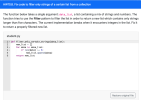 The function below takes a single argument: data_list, a list
containing a mix of strings and numbers. The function tries to use
the Filter pattern to filter the list in order to
return a new list which contains only strings longer than five
characters. The current implementation breaks when it encounters
integers in the list. Fix it to return a properly filtered new
list.
HW10.8. Fix code to filter only strings of a certain list from a collection The function...
The function below takes a single argument: data_list, a list
containing a mix of strings and numbers. The function tries to use
the Filter pattern to filter the list in order to
return a new list which contains only strings longer than five
characters. The current implementation breaks when it encounters
integers in the list. Fix it to return a properly filtered new
list.
HW10.8. Fix code to filter only strings of a certain list from a collection The function...
Python Question? Write a function called reverse(user_list, num = -1) that takes a list and a...
Python Question? Write a function called reverse(user_list, num = -1) that takes a list and a number as parameters. The function returns a copy of the list with the first number of items reversed. Conditions: The number parameter must be a default argument. - If the default argument for number is given in the function call, only the first number of items are reversed. - If the default argument for number is not provided in the function call, then the...
PYTHON The function longest that returns the longest of two strings. The function count_over that takes...
PYTHON The function longest that returns the longest of two strings. The function count_over that takes a list of numbers and an integer nand returns the count of the numbers that are over n. The function bmi that takes two parameters height and weight and returns the value of the body mass index: a person's weight in kg divided by the square of their height in meters. def longest(string1, string2): """Return the longest string from the two arguments, if the...
28Write a Python function from scratch called has_5_or_more_elements that takes a single list parameter. Your function...
28Write a Python function from scratch called has_5_or_more_elements that takes a single list parameter. Your function should return a Boolean. The return value should be True if the list parameter has 5 or more elements and False otherwise.
Write a function called most_consonants(words) that takes a list of strings called words and returns the...
Write a function called most_consonants(words) that takes a list of strings called words and returns the string in the list with the most consonants (i.e., the most letters that are not vowels). You may assume that the strings only contain lowercase letters. For example: >>> most_consonants(['python', 'is', 'such', 'fun']) result: 'python' >>> most_consonants(['oooooooh', 'i', 'see', 'now']) result: 'now' The function that you write must use a helper function (either the num_vowels function from lecture, or a similar function that you...
[Python] I have the following function that removes all non-numerical characters from a string: d...
[Python] I have the following function that removes all non-numerical characters from a string: def remove_non_numeric(s): seq_type= type(s) return seq_type().join(filter(seq_type.isdigit, s)) And I need help implementing it into this function: def list_only_numbers( a_list ) : # Create a new empty list. # Using a loop (or a list comprehension) # 1) call remove_non_numeric with a list element # 2) if the return value is not the empty string, convert # the string to either int or float (if it contains...
Python: Write a function named "sort_by_length" that takes a list/array of strings as a parameter and...
Python: Write a function named "sort_by_length" that takes a list/array of strings as a parameter and sorts the strings by their length
Python 3.7.3 ''' Problem 3 Write a function called names, which takes a list of strings...
Python 3.7.3 ''' Problem 3 Write a function called names, which takes a list of strings as a parameter. The strings are intended to represent a person's first and last name (with a blank in between). Assume the last names are unique. The function should return a dictionary (dict) whose keys are the people's last names, and whose values are their first names. For example: >>> dictionary = names([ 'Ljubomir Perkovic', \ 'Amber Settle', 'Steve Jost']) >>> dictionary['Settle'] 'Amber' >>>...
 The function below takes a single argument: data_list, a list
containing a mix of strings and numbers. The function tries to use
the Filter pattern to filter the list in order to
return a new list which contains only strings longer than five
characters. The current implementation breaks when it encounters
integers in the list. Fix it to return a properly filtered new
list.
HW10.8. Fix code to filter only strings of a certain list from a collection The function...
The function below takes a single argument: data_list, a list
containing a mix of strings and numbers. The function tries to use
the Filter pattern to filter the list in order to
return a new list which contains only strings longer than five
characters. The current implementation breaks when it encounters
integers in the list. Fix it to return a properly filtered new
list.
HW10.8. Fix code to filter only strings of a certain list from a collection The function...
Most questions answered within 3 hours.
-
Where is the error in this code sequence?
String s1 = "Hello";
String s2 = "ello";...
asked 11 months ago -
Financial data for Joel de Paris, Inc., for last year
follow:
Joel de Paris, Inc.
Balance...
asked 11 months ago -
Consider this reaction:
Al2(SO4)3 (aq)+ BaCl3
(aq) Al2Cl6 (aq)- +
3BaSO4(s) . What is the...
asked 11 months ago -
Suppose that Savneet is considering increasing her
recent random sample from 20 car rentals to 40...
asked 11 months ago -
Trucks arrive at an unloading terminal at an average rate of 120
per hour.
Trucks arrive...
asked 11 months ago -
Why are methanol and ethanol completely soluble in water while
octanol is not very little soluble....
asked 11 months ago -
A facilities manager at a university reads in a research report
that the mean amount of...
asked 11 months ago -
When the CuSO4 is rehydrated by adding water to the anhydrous
compound, is this an endothermic...
asked 11 months ago -
A ray of sunlight is passing from diamond into crown glass; the
angle of incidence is...
asked 11 months ago -
A block of mass 0.249 kg is placed on top of a light, vertical
spring of...
asked 11 months ago -
how do the kidneys compensate in the presences of acidosis
a) trigger hyperventilate
b) reserve acid...
asked 11 months ago -
Question 501 pts
The rental rate of capital to the firm increases. Which of the
following...
asked 11 months ago