Wirh the following price and dividend information, calculate the sample variance for the returns. (Round to...
Wirh the following price and dividend information, calculate the sample variance for the returns. (Round to 4 decimals)
|
Year |
Price |
Dividend |
|
0 |
49.72 |
|
|
1 |
53.54 |
1.00 |
|
2 |
59.22 |
1.10 |
|
3 |
51.3 |
1.20 |
|
4 |
53.45 |
1.30 |
|
5 |
56.35 |
1.40 |
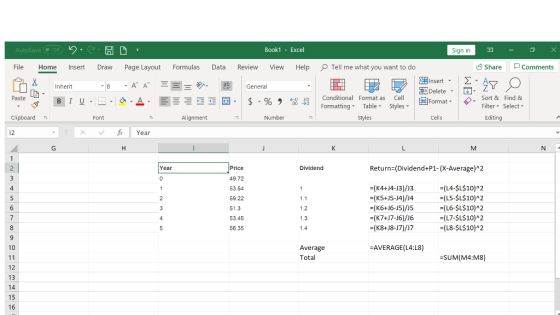
Homework Answers
| Variance | 0.9003% |
| Year | Price | Dividend | Return=(Dividend+P1-P0)/P0 | (X-Average)^2 |
| 0 | 49.72 | |||
| 1 | 53.54 | 1 | 9.69% | 0.00206 |
| 2 | 59.22 | 1.1 | 12.66% | 0.005636 |
| 3 | 51.3 | 1.2 | -11.35% | 0.027237 |
| 4 | 53.45 | 1.3 | 6.73% | 0.000246 |
| 5 | 56.35 | 1.4 | 8.04% | 0.000835 |
| Average | 5.1560% | |||
| Total | 0.036013 |
Variance = Total (X-Average)^2 / (n-1) = 0.036013/(5-1) =
0.9003%
Add Answer to:
Wirh the following price and dividend information, calculate the
sample variance for the returns. (Round to...
Given the following price and dividend information, calculate the $1 invested equivalent. (Round to 4 decimals)...
Given the following price and dividend information, calculate the $1 invested equivalent. (Round to 4 decimals) Year Price Dividend 0 50.72 1 43.54 1.75 2 49.22 2.10 3 51.30 2.20 4 52.45 2.50 5 56.35 2.75
6. Use the following set of period-specific discount rates to price the following four annual coupon...
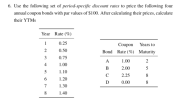 6. Use the following set of period-specific discount rates to price the following four annual coupon bonds with par values of $100. After calculating their prices, calculate their YTMs Year Rate (%) 0.25 0.50 0.75 Coupon Years to Bond Rate(%) Maturity 1.00 1.00 2.00 1.10 1.20 2.25 0.00 1.30 1.40
Following is information on the price per share and the dividend for a sample of 30...
Following is information on the price per share and the dividend for a sample of 30 companies. Obs Price Dividend 1 20.21 3.14 2 22.22 3.36 3 31.60 0.46 4 33.78 7.99 5 36.07 0.77 6 36.33 8.46 7 36.37 7.62 8 38.20 8.03 9 39.06 6.33 10 39.86 7.96 11 43.65 8.95 12 49.29 9.61 13 53.94 11.11 14 54.62 13.28 15 55.31 10.22 16 57.27 9.53 17 57.61 12.60 18 58.51 10.43 19 59.72 7.97 20 60.81 9.19...
Calculate the pooled variance (as in an independent-Measures t test for the following sample. Round to...
 Calculate the pooled variance (as in an independent-Measures t test for the following sample. Round to two decimal places. Treatment Treatment A B 12 8 8 9 12 15 16 17 4 5 17 18 17 13 6 3
Calculate the range, variance, and standard deviation for the following sample. 0,1.0.0 -4, 4, -3, 4,...
Calculate the range, variance, and standard deviation for the following sample. 0,1.0.0 -4, 4, -3, 4, 0, -4, 4, -4, 0, -1, -3, -4, 0, 4 Range Sample variance, s square = (Round to two decimal places as needed.) Sample standard deviation, ss= (Round to two decimal places as needed.)
Given the following information calculate the price of the stock. The first dividend of $2.50 is...
Given the following information calculate the price of the stock. The first dividend of $2.50 is expected to be paid in 5 years time. Dividends are then expected to gow by 12% p.a. for the next 3 years. After this initial growth stage, it is assumed that dividends will grow by 4% p.a. into the foreseeable future. The required rate of return is 12% p.a. $15.69 $22.05 $24.12 $41.43 Cannot be determined, insuffiecient information.
Using the following returns, calculate the average returns, the variances, and the standard deviations for X...
 Using the following returns, calculate the average returns, the variances, and the standard deviations for X and Y. (Note that the book covers both the "arithmetic" and the "geometric" averages. Here, calculate the regular "arithmetic" average returns. These are the average returns covered in the course lecture. Year 1 2 3 4 5 Returns X Y 10% 20% 28 41 17 -11 -18 -25 1949 Requirement 1: (a)Calculate the average return for X. (Click to select) (b)Calculate the average return...
ABC’s stock is expected to distribute a dividend of € 1.00 next year with dividends increasing...
ABC’s stock is expected to distribute a dividend of € 1.00 next year with dividends increasing for years 2, 3 and 4 by 5% per year. Thereafter dividends are expected to grow by a fixed rate every year. The ROE and plowback (retention) rate after year 4 are expected to be 5% and 25% respectively. Based on the information above answer questions 1 and 3 1. What is the expected growth rate of dividends from year 5 onwards? a. 5%...
ABC’s stock is expected to distribute a dividend of € 1.00 next year with dividends increasing...
ABC’s stock is expected to distribute a dividend of € 1.00 next year with dividends increasing for years 2, 3 and 4 by 5% per year. Thereafter dividends are expected to grow by a fixed rate every year. The ROE and plowback (retention) rate after year 4 are expected to be 5% and 25% respectively. Based on the information above answer questions 1 and 3 1. What is the expected growth rate of dividends from year 5 onwards? a. 5%...
A stock has had the following year-end prices and dividends: Year Price Dividend $64.10 1 $1.10...
 A stock has had the following year-end prices and dividends: Year Price Dividend $64.10 1 $1.10 2 74.05 3 67.61 1.25 76.25 1.45 5 82.70 1.60 6 93.15 175 What are the arithmetic and geometric returns for the stock? (Do not round intermediate calculations and enter your answer as a percent rounded to 2 decimal places, e.g., 32.16.) Arithmetic average return Geometric average return %
 6. Use the following set of period-specific discount rates to price the following four annual coupon bonds with par values of $100. After calculating their prices, calculate their YTMs Year Rate (%) 0.25 0.50 0.75 Coupon Years to Bond Rate(%) Maturity 1.00 1.00 2.00 1.10 1.20 2.25 0.00 1.30 1.40
 Calculate the pooled variance (as in an independent-Measures t test for the following sample. Round to two decimal places. Treatment Treatment A B 12 8 8 9 12 15 16 17 4 5 17 18 17 13 6 3
 Using the following returns, calculate the average returns, the variances, and the standard deviations for X and Y. (Note that the book covers both the "arithmetic" and the "geometric" averages. Here, calculate the regular "arithmetic" average returns. These are the average returns covered in the course lecture. Year 1 2 3 4 5 Returns X Y 10% 20% 28 41 17 -11 -18 -25 1949 Requirement 1: (a)Calculate the average return for X. (Click to select) (b)Calculate the average return...
 A stock has had the following year-end prices and dividends: Year Price Dividend $64.10 1 $1.10 2 74.05 3 67.61 1.25 76.25 1.45 5 82.70 1.60 6 93.15 175 What are the arithmetic and geometric returns for the stock? (Do not round intermediate calculations and enter your answer as a percent rounded to 2 decimal places, e.g., 32.16.) Arithmetic average return Geometric average return %
Most questions answered within 3 hours.
-
Where is the error in this code sequence?
String s1 = "Hello";
String s2 = "ello";...
asked 11 months ago -
Financial data for Joel de Paris, Inc., for last year
follow:
Joel de Paris, Inc.
Balance...
asked 11 months ago -
Consider this reaction:
Al2(SO4)3 (aq)+ BaCl3
(aq) Al2Cl6 (aq)- +
3BaSO4(s) . What is the...
asked 11 months ago -
Suppose that Savneet is considering increasing her
recent random sample from 20 car rentals to 40...
asked 11 months ago -
Trucks arrive at an unloading terminal at an average rate of 120
per hour.
Trucks arrive...
asked 11 months ago -
Why are methanol and ethanol completely soluble in water while
octanol is not very little soluble....
asked 11 months ago -
A facilities manager at a university reads in a research report
that the mean amount of...
asked 11 months ago -
When the CuSO4 is rehydrated by adding water to the anhydrous
compound, is this an endothermic...
asked 11 months ago -
A ray of sunlight is passing from diamond into crown glass; the
angle of incidence is...
asked 11 months ago -
A block of mass 0.249 kg is placed on top of a light, vertical
spring of...
asked 11 months ago -
how do the kidneys compensate in the presences of acidosis
a) trigger hyperventilate
b) reserve acid...
asked 11 months ago -
Question 501 pts
The rental rate of capital to the firm increases. Which of the
following...
asked 11 months ago