The reaction H2(g) + I2(g) <=> 2HI(g) has Kc = 50.2 at 718K. If a flask...
The reaction H2(g) + I2(g) <=> 2HI(g) has Kc = 50.2 at 718K. If a flask is charged with 4.25M HI, what are the equilibrium concentrations of H2 and I2? at equilibrium, [H^2}+[I^2]= ?????
Homework Answers
ICE Table:
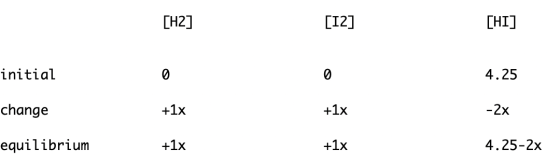
Equilibrium constant expression is
Kc = [HI]^2/[H2]*[I2]
50.2 = (4.25-2*x)^2/(1*x)^2
sqrt(50.2) = (4.25-2*x)/(1*x)
7.085 = (4.25-2*x)/(1*x)
7.085*x = 4.25-2*x
-4.25 + 9.085*x = 0
x = 0.468
At equilibrium:
[H2] = x = 0.468 M
[I2] = x = 0.468 M
Answer:
[H2] = 0.468 M
[I2] = 0.468 M
Add Answer to:
The reaction H2(g) + I2(g) <=> 2HI(g) has Kc = 50.2 at
718K. If a flask...
H2(g)+I2(g)⇌2HI(g) For the above reaction, Kc=55.3 at 700 K. In a 2.00-L flask containing an equilibrium...
H2(g)+I2(g)⇌2HI(g) For the above reaction, Kc=55.3 at 700 K. In a 2.00-L flask containing an equilibrium mixture of the three gases, there are 0.053 g of H2 and 4.39 g of I2. What is the mass of HI in the flask?
Consider this reaction: H 2 (g)+ I 2 (g)⇌2HI(g) H2(g)+I2(g)⇌2HI(g) A rxn mixture in a 3.73...
Consider this reaction: H 2 (g)+ I 2 (g)⇌2HI(g) H2(g)+I2(g)⇌2HI(g) A rxn mixture in a 3.73 L flask at a certain temperature initially contains 0.766 g H2 and 96.7 g I 2 I2 . At equilibrium, the flask holds 90.3 g HI . Calculate the equilibrium constant (Kc)(Kc) for the reaction at this temperature. Record your answer using two significant figures.
For the reaction H2(g)+I2(g)⇌2HI(g), Kc= 55.3 at 700 K. In a 2.00-L flask containing an equilibrium...
For the reaction H2(g)+I2(g)⇌2HI(g), Kc= 55.3 at 700 K. In a 2.00-L flask containing an equilibrium mixture of the three gases, there are 0.053 g H2 and 4.38 g I2. What is the mass of HI in the flask? Express your answer to two significant figures and include the appropriate units.
Consider the following reaction: H2(g)+I2(g)⇌2HI(g) A reaction mixture in a 3.70 L flask at a certain...
Consider the following reaction: H2(g)+I2(g)⇌2HI(g) A reaction mixture in a 3.70 L flask at a certain temperature initially contains 0.766 g H2 and 97.0 g I2 At equilibrium, the flask contains 90.2 g HI. Calculate the equilibrium constant (Kc) for the reaction at this temperature. I keep getting 700 as the answer but it's not right.
For the reaction 2HI (g) <--> H2 (g) + I2 (g) Kc = 1.0 x 10⁻⁴...
For the reaction 2HI (g) <--> H2 (g) + I2 (g) Kc = 1.0 x 10⁻⁴ if [H2] = [I2] = 0.50M at equilibrium, what is the [HI] ? (2 sig figs)
At a certain temperature, the equilibrium constant, Kc, for this reaction is 53.3. H2(g)+I2(g)−⇀↽−2HI(g)Kc=53.3 At this...
At a certain temperature, the equilibrium constant, Kc, for this reaction is 53.3. H2(g)+I2(g)−⇀↽−2HI(g)Kc=53.3 At this temperature, 0.600 mol H2 and 0.600 mol I2 were placed in a 1.00 L container to react. What concentration of HI is present at equilibrium?
For the reaction H2 (g) + I2 (g) = 2HI (g); Kc =50.0. Calculate the concentration...
For the reaction H2 (g) + I2 (g) = 2HI (g); Kc =50.0. Calculate the concentration of HI (g) at equilibrium if the initial concentration of each substance is 0.0600 M and the reaction mixture is allowed to come to equilibrium. (Hint: ICE Table)
Kc for the reaction of hydrogen and iodine to produce hydrogen iodide, H2(g) + I2(g) ⇌...
Kc for the reaction of hydrogen and iodine to produce hydrogen iodide, H2(g) + I2(g) ⇌ 2HI(g) is 54.3 at 430°C. Determine the initial and equilibrium concentration of HI if initial concentrations of H2 and I2 are both 0.10 M and their equilibrium concentrations are both 0.052 M at 430°C
Consider the reaction: H2(g)+I2(g)⇌2HI(g) A reaction mixture in a 3.69 −L flask at 500 K initially...
Consider the reaction: H2(g)+I2(g)⇌2HI(g) A reaction mixture in a 3.69 −L flask at 500 K initially contains 0.377 g H2 and 17.93 g I2. At equilibrium, the flask contains 17.72 g HI. Calculate the equilibrium constant at this temperature.
Consider the following reaction where Kc = 55.6 at 698 K: H2(g) + I2(g) <------>2HI(g) A...
Consider the following reaction where Kc = 55.6 at 698 K: H2(g) + I2(g) <------>2HI(g) A reaction mixture was found to contain 4.14×10⁻² moles of H2(g), 3.91×10⁻² moles of I2(g) and 0.258 moles of HI(g), in a 1.00 Liter container. Indicate True (T) or False (F)for each of the following: ___TF 1. In order to reach equilibrium HI(g) must be consumed. ___TF 2. In order to reach equilibrium Kc must decrease. ___TF 3. In order to reach equilibrium H2 must...
Most questions answered within 3 hours.
-
Where is the error in this code sequence?
String s1 = "Hello";
String s2 = "ello";...
asked 11 months ago -
Financial data for Joel de Paris, Inc., for last year
follow:
Joel de Paris, Inc.
Balance...
asked 11 months ago -
Consider this reaction:
Al2(SO4)3 (aq)+ BaCl3
(aq) Al2Cl6 (aq)- +
3BaSO4(s) . What is the...
asked 11 months ago -
Suppose that Savneet is considering increasing her
recent random sample from 20 car rentals to 40...
asked 11 months ago -
Trucks arrive at an unloading terminal at an average rate of 120
per hour.
Trucks arrive...
asked 11 months ago -
Why are methanol and ethanol completely soluble in water while
octanol is not very little soluble....
asked 11 months ago -
A facilities manager at a university reads in a research report
that the mean amount of...
asked 11 months ago -
When the CuSO4 is rehydrated by adding water to the anhydrous
compound, is this an endothermic...
asked 11 months ago -
A ray of sunlight is passing from diamond into crown glass; the
angle of incidence is...
asked 11 months ago -
A block of mass 0.249 kg is placed on top of a light, vertical
spring of...
asked 11 months ago -
how do the kidneys compensate in the presences of acidosis
a) trigger hyperventilate
b) reserve acid...
asked 11 months ago -
Question 501 pts
The rental rate of capital to the firm increases. Which of the
following...
asked 11 months ago