Avery, MacLeod and McCarthy’s experiment first determined that DNA was the “transforming principle” present in the...
Avery, MacLeod and McCarthy’s experiment first determined that DNA was the “transforming principle” present in the cell extract of a pathogenic strain of bacteria. Describe the experiment and explain how the results demonstrated the presence of a “transforming principle” as well as identifying it as DNA.
Homework Answers
Avery-MacLeod-McCarty Experiment
There are two strains of bacteria R- rough
S- smooth.
S are virulent or able to cause disease.
R are avirulent. They are unable to cause disease.
R are unable to cause disease but when injected with heat killed
smooth bacteria, they were able to cause the disease.
Now it is need to be tested that which is the transforming
element.
So, lipids, carbohydrates and proteins all are tested.
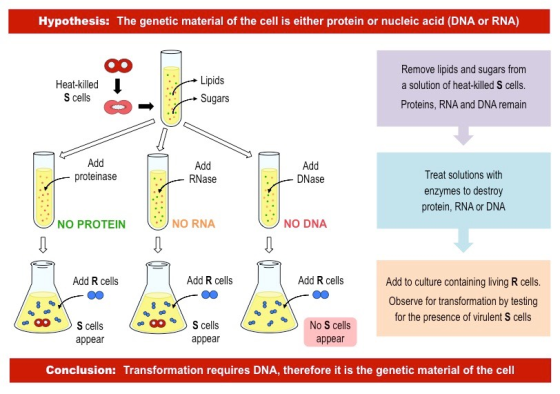
They prepared cultures containing the heat-killed S strain of the
bacteria and then removed lipids and carbohydrates from the
solution.
they treated the solutions with different digestive enzymes (DNase, RNase or protease) to destroy the targeted compound.
Finally, they introduced living R strain cells to the culture to see which cultures would develop transformed S strain bacteria
Only in the culture treated with DNase did the S strain bacteria fail to grow (i.e. no DNA = no transformation). This means that DNA was the transforming agent.
This indicated that DNA was the genetic component that was being transferred between cells.
Add Answer to:
Avery, MacLeod and McCarthy’s experiment first determined that
DNA was the “transforming principle” present in the...
D 18) How did Avery, MacLeod, and McCarty demonstrate that Griffith's transforming principle was DNA? A)...
 D 18) How did Avery, MacLeod, and McCarty demonstrate that Griffith's transforming principle was DNA? A) Injecting live S-strain bacteria alone could not kill a mouse. B) Injecting heat-killed S-strain bacterial alone could not kill a mouse. C) Heat-killed S-strain bacterial transformed live R-strain bacteria into live S-strain bacteria. D) DNase, an enzyme that destroys DNA, eliminated the biological activity of the transforming material. E) RNase, an enzyme that destroys RNA, had no effect on the transforming principle.
Is my reasoning correct? Will leave rate and comment. 1. Griffiths (1928) mixed heat-killed 'THIS' bacteria...
 Is
my reasoning correct? Will leave rate and comment.
1. Griffiths (1928) mixed heat-killed 'THIS' bacteria with 'IIR' bacteria and injected a mouse with both types of bacteria. As a result, the mouse died and Griffiths obtained living 's bacteria from the dead mouse. How can you explain this phenomenon? When 'R' and 'strains were mixed, the DNA from 'IS' bacteria with the gene responsible for forming capsules transferred to the 'R' bacteria. The gene cause 'R' to transform into...
Is
my reasoning correct? Will leave rate and comment.
1. Griffiths (1928) mixed heat-killed 'THIS' bacteria with 'IIR' bacteria and injected a mouse with both types of bacteria. As a result, the mouse died and Griffiths obtained living 's bacteria from the dead mouse. How can you explain this phenomenon? When 'R' and 'strains were mixed, the DNA from 'IS' bacteria with the gene responsible for forming capsules transferred to the 'R' bacteria. The gene cause 'R' to transform into...
1. Read through the INTRODUCTION. Answer the questions in between each historical section. PRE-LAB: LAB EXERCISE...
 1. Read through the INTRODUCTION. Answer the questions in
between each historical section.
PRE-LAB: LAB EXERCISE 7 Directions: Use the lab manual to answer the following questions in COMPLETE SENTENCES AND IN YOUR OWN WORDS. Use your own handwriting, do NOT type! 1. Read through the INTRODUCTION. Answer the questions in between each historical section: . . . . m . N m - N The Evidence : 1869-1924 1869: DNA, first called nuclein, is identified in cell nuclei of...
1. Read through the INTRODUCTION. Answer the questions in
between each historical section.
PRE-LAB: LAB EXERCISE 7 Directions: Use the lab manual to answer the following questions in COMPLETE SENTENCES AND IN YOUR OWN WORDS. Use your own handwriting, do NOT type! 1. Read through the INTRODUCTION. Answer the questions in between each historical section: . . . . m . N m - N The Evidence : 1869-1924 1869: DNA, first called nuclein, is identified in cell nuclei of...
1. Describe one experiment that can test the hypothesis that DNA replication is semi conservative. Describe...
1. Describe one experiment that can test the hypothesis that DNA replication is semi conservative. Describe the results of this experiment if replication was conservative. And if it was distributive? 2. What type of chemical bond contributes to the specificity of base paring in the DNA? Are there any other chemical or physical factors in the structure o f the DNA molecule contributing to the thermodynamic stability of the DNA? 3. List the m ajor differences between DNA and RNA....
and Lab Exer n this experiment you will evaluate effect of UV light on bacterial growth. UV light affects growth by interfering with DNA, resulting in thymine dimer formation. The dimerization...
 and Lab Exer n this experiment you will evaluate effect of UV light on bacterial growth. UV light affects growth by interfering with DNA, resulting in thymine dimer formation. The dimerization is confined within adjacent thymine residues on same strand (intrastrand ). These dimmer lesions have consequence on DNA functions including interference in DNA replication, transcription etc, so UV exposure of cells can lead to lethal effects for bacterial multiplications. This forms the basis for UV method to control bacterial...
25. Mendel's factors undergo segregation and independent assortment. How is this illustrated in the chromosomes during...
 25. Mendel's factors undergo segregation and independent assortment. How is this illustrated in the chromosomes during Meiosis I? 26. Explain how these inheritance patterns are considered non-Mendelian. Incomplete Dominance . Multiple Alleles • Codominance X-linked Linkage . Pedigrees - Genetic Disorders 27. What is non-disjunction and how does it affect the chromosome distribution during meiosis? 28. What is a karyotype and what does it allow you to do? 29. Fill in the circles and squares to illustrate the following inheritance...
This is what we did in the experiment .First of all,1 µl of plasmid DNA was...
 This is what we did in the experiment .First of all,1 µl of
plasmid DNA was added into the tube which contains competent cells
and the tube was tapped gently to mix DNA and the competent
bacteria. After that it was placed on ice for 30 minutes. Then, the
tube with the competent bacteria and plasmid were transferred to
heating block at 42 °C and the tube was leaved in there exactly 90
seconds. 0.25 ml of LB broth was...
This is what we did in the experiment .First of all,1 µl of
plasmid DNA was added into the tube which contains competent cells
and the tube was tapped gently to mix DNA and the competent
bacteria. After that it was placed on ice for 30 minutes. Then, the
tube with the competent bacteria and plasmid were transferred to
heating block at 42 °C and the tube was leaved in there exactly 90
seconds. 0.25 ml of LB broth was...
You have found a strain of microorganism, Schizosaccharomyces spp that is very sensitive to mutagenic compounds....
You have found a strain of microorganism, Schizosaccharomyces spp that is very sensitive to mutagenic compounds. When grown in the presence of known mutagens this organism produces many mutant progeny. This microbe, initially isolated from beer-stained carpeting from Zach’s apartment, is obviously deficient in repairing damage to DNA. You perform a series of experiments to determine which repair system is defective. A. You first take two identical cultures and expose them to 30 minutes of irradiation. You place one of...
Name: Date: Section: Biology 190: Introduction to Cdl and Molecular Biolog Reading guide # 16 Ch.-DNA...
 Name: Date: Section: Biology 190: Introduction to Cdl and Molecular Biolog Reading guide # 16 Ch.-DNA Structure & Replication Read p. 257-273 from Cha dar the following question Prior to Watson and Crick's deduction of DNA structure, the parad that protein and not DNA was the molecule that was the likely genetic mate candidate at the time? on of DNA structure, the paradigm among the scientific community was Necule that was the likely genetic material. Why was protein a stronger...
This is what we did in the experiment .First of all,1 µl of plasmid DNA was...
 This is what we did in the experiment .First of all,1 µl of
plasmid DNA was added into the tube which contains competent cells
and the tube was tapped gently to mix DNA and the competent
bacteria. After that it was placed on ice for 30 minutes. Then, the
tube with the competent bacteria and plasmid were transferred to
heating block at 42 °C and the tube was leaved in there exactly 90
seconds. 0.25 ml of LB broth was...
This is what we did in the experiment .First of all,1 µl of
plasmid DNA was added into the tube which contains competent cells
and the tube was tapped gently to mix DNA and the competent
bacteria. After that it was placed on ice for 30 minutes. Then, the
tube with the competent bacteria and plasmid were transferred to
heating block at 42 °C and the tube was leaved in there exactly 90
seconds. 0.25 ml of LB broth was...
 D 18) How did Avery, MacLeod, and McCarty demonstrate that Griffith's transforming principle was DNA? A) Injecting live S-strain bacteria alone could not kill a mouse. B) Injecting heat-killed S-strain bacterial alone could not kill a mouse. C) Heat-killed S-strain bacterial transformed live R-strain bacteria into live S-strain bacteria. D) DNase, an enzyme that destroys DNA, eliminated the biological activity of the transforming material. E) RNase, an enzyme that destroys RNA, had no effect on the transforming principle.
 Is
my reasoning correct? Will leave rate and comment.
1. Griffiths (1928) mixed heat-killed 'THIS' bacteria with 'IIR' bacteria and injected a mouse with both types of bacteria. As a result, the mouse died and Griffiths obtained living 's bacteria from the dead mouse. How can you explain this phenomenon? When 'R' and 'strains were mixed, the DNA from 'IS' bacteria with the gene responsible for forming capsules transferred to the 'R' bacteria. The gene cause 'R' to transform into...
Is
my reasoning correct? Will leave rate and comment.
1. Griffiths (1928) mixed heat-killed 'THIS' bacteria with 'IIR' bacteria and injected a mouse with both types of bacteria. As a result, the mouse died and Griffiths obtained living 's bacteria from the dead mouse. How can you explain this phenomenon? When 'R' and 'strains were mixed, the DNA from 'IS' bacteria with the gene responsible for forming capsules transferred to the 'R' bacteria. The gene cause 'R' to transform into...
 1. Read through the INTRODUCTION. Answer the questions in
between each historical section.
PRE-LAB: LAB EXERCISE 7 Directions: Use the lab manual to answer the following questions in COMPLETE SENTENCES AND IN YOUR OWN WORDS. Use your own handwriting, do NOT type! 1. Read through the INTRODUCTION. Answer the questions in between each historical section: . . . . m . N m - N The Evidence : 1869-1924 1869: DNA, first called nuclein, is identified in cell nuclei of...
1. Read through the INTRODUCTION. Answer the questions in
between each historical section.
PRE-LAB: LAB EXERCISE 7 Directions: Use the lab manual to answer the following questions in COMPLETE SENTENCES AND IN YOUR OWN WORDS. Use your own handwriting, do NOT type! 1. Read through the INTRODUCTION. Answer the questions in between each historical section: . . . . m . N m - N The Evidence : 1869-1924 1869: DNA, first called nuclein, is identified in cell nuclei of...
 and Lab Exer n this experiment you will evaluate effect of UV light on bacterial growth. UV light affects growth by interfering with DNA, resulting in thymine dimer formation. The dimerization is confined within adjacent thymine residues on same strand (intrastrand ). These dimmer lesions have consequence on DNA functions including interference in DNA replication, transcription etc, so UV exposure of cells can lead to lethal effects for bacterial multiplications. This forms the basis for UV method to control bacterial...
 25. Mendel's factors undergo segregation and independent assortment. How is this illustrated in the chromosomes during Meiosis I? 26. Explain how these inheritance patterns are considered non-Mendelian. Incomplete Dominance . Multiple Alleles • Codominance X-linked Linkage . Pedigrees - Genetic Disorders 27. What is non-disjunction and how does it affect the chromosome distribution during meiosis? 28. What is a karyotype and what does it allow you to do? 29. Fill in the circles and squares to illustrate the following inheritance...
 This is what we did in the experiment .First of all,1 µl of
plasmid DNA was added into the tube which contains competent cells
and the tube was tapped gently to mix DNA and the competent
bacteria. After that it was placed on ice for 30 minutes. Then, the
tube with the competent bacteria and plasmid were transferred to
heating block at 42 °C and the tube was leaved in there exactly 90
seconds. 0.25 ml of LB broth was...
This is what we did in the experiment .First of all,1 µl of
plasmid DNA was added into the tube which contains competent cells
and the tube was tapped gently to mix DNA and the competent
bacteria. After that it was placed on ice for 30 minutes. Then, the
tube with the competent bacteria and plasmid were transferred to
heating block at 42 °C and the tube was leaved in there exactly 90
seconds. 0.25 ml of LB broth was...
 Name: Date: Section: Biology 190: Introduction to Cdl and Molecular Biolog Reading guide # 16 Ch.-DNA Structure & Replication Read p. 257-273 from Cha dar the following question Prior to Watson and Crick's deduction of DNA structure, the parad that protein and not DNA was the molecule that was the likely genetic mate candidate at the time? on of DNA structure, the paradigm among the scientific community was Necule that was the likely genetic material. Why was protein a stronger...
 This is what we did in the experiment .First of all,1 µl of
plasmid DNA was added into the tube which contains competent cells
and the tube was tapped gently to mix DNA and the competent
bacteria. After that it was placed on ice for 30 minutes. Then, the
tube with the competent bacteria and plasmid were transferred to
heating block at 42 °C and the tube was leaved in there exactly 90
seconds. 0.25 ml of LB broth was...
This is what we did in the experiment .First of all,1 µl of
plasmid DNA was added into the tube which contains competent cells
and the tube was tapped gently to mix DNA and the competent
bacteria. After that it was placed on ice for 30 minutes. Then, the
tube with the competent bacteria and plasmid were transferred to
heating block at 42 °C and the tube was leaved in there exactly 90
seconds. 0.25 ml of LB broth was...
Most questions answered within 3 hours.
-
Where is the error in this code sequence?
String s1 = "Hello";
String s2 = "ello";...
asked 10 months ago -
Financial data for Joel de Paris, Inc., for last year
follow:
Joel de Paris, Inc.
Balance...
asked 10 months ago -
Consider this reaction:
Al2(SO4)3 (aq)+ BaCl3
(aq) Al2Cl6 (aq)- +
3BaSO4(s) . What is the...
asked 10 months ago -
Suppose that Savneet is considering increasing her
recent random sample from 20 car rentals to 40...
asked 10 months ago -
Trucks arrive at an unloading terminal at an average rate of 120
per hour.
Trucks arrive...
asked 10 months ago -
Why are methanol and ethanol completely soluble in water while
octanol is not very little soluble....
asked 10 months ago -
A facilities manager at a university reads in a research report
that the mean amount of...
asked 10 months ago -
When the CuSO4 is rehydrated by adding water to the anhydrous
compound, is this an endothermic...
asked 10 months ago -
A ray of sunlight is passing from diamond into crown glass; the
angle of incidence is...
asked 10 months ago -
A block of mass 0.249 kg is placed on top of a light, vertical
spring of...
asked 10 months ago -
how do the kidneys compensate in the presences of acidosis
a) trigger hyperventilate
b) reserve acid...
asked 10 months ago -
Question 501 pts
The rental rate of capital to the firm increases. Which of the
following...
asked 10 months ago