A 1.389 g sample containing some iron(II) in it was dissolved in 1 M H2SO4, then...
A 1.389 g sample containing some iron(II) in it was dissolved in 1 M H2SO4, then titrated with 0.0292 permanganate until the reaction solution was a pale yellow. 6.8 mL of 7.9 M H3PO4 were added to the reaction solution to form a colorless complex with the Fe3+ reaction product. The titration was finished when the pale pink of excess permanganate was visible in the reaction flask. The initial buret reading was 2.4 mL. The final buret reading was 40.1 mL. Question: What is the mass % iron in the sample?
Homework Answers
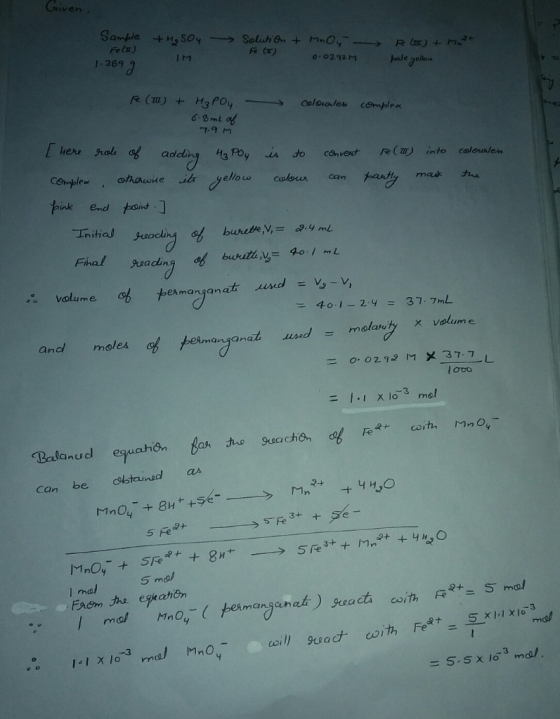
To solve this problem use the following steps
1.calculate volume of permanganate used from burette readings.
2.Calculate moles of permanganate used by multiplying it's molarity with volume used.
3.Write balanced equation between iron II and permanganate ion.
4.Use unitary method to determine the moles of iron II reacting with moles of permanganate used(calculated in step 2)
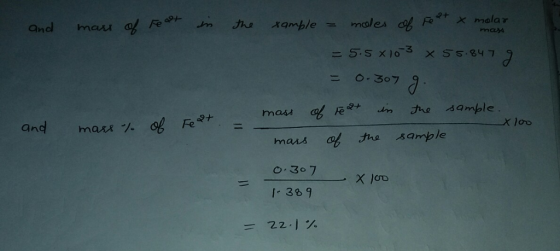
5.convert moles of Fe II into mass by multiplying with its molar mass.
6.Calculate mass % by dividing mass of iron × 100 by mass of sample.
The solution is as follows
Add Answer to:
A 1.389 g sample containing some iron(II) in it was dissolved in
1 M H2SO4, then...
A sample containing some iron (II) was titrated with 0.0241 M permanganate solution. The net volume...
A sample containing some iron (II) was titrated with 0.0241 M permanganate solution. The net volume of titrant required to complete the reaction was 11.2 mL. Question: How many moles of iron were in the sample?
1. (4p) In an acidic aqueous solution, Fe2+ ions are oxidized to Fe3+ ions by MnO4": 5Fe2+(aq) + MnO4 (aq) + 8H(aq) → 5...
 1. (4p) In an acidic aqueous solution, Fe2+ ions are oxidized to Fe3+ ions by MnO4": 5Fe2+(aq) + MnO4 (aq) + 8H(aq) → 5Fe3+ (aq) + Mn2(aq) + 4H2O(1) In part A of the experiment, suppose that 1.067 g of Fe(NH4)2(SO4)2.6H2O(s) are placed in a 250 ml Erlenmeyer flask to which 20 mL of water and 8 mL of 3 M H2SO4(aq) are added. The solution was titrated to the end point by adding 26.89 mL of KMnO4(aq) from the...
A 0.495 g sample of iron containing salt required 20.22 mL of 0.0194 M permanganate solution...
A 0.495 g sample of iron containing salt required 20.22 mL of 0.0194 M permanganate solution to reach the endpointof a titration. What is the percent of iron (55.845 g/mol) in the salt? Work shown please
Is the calculated concentration for IO3- in the data table correct, and if not, how do I calculat...
 Is the calculated concentration for IO3-
in the data table correct, and if not, how do I calculate it. Also,
the questions below the data table in the second picture. How are
they calculated?
2. The molar solubility of Cal(IO3)2 in pure water Temperature of the saturated solution of calcium iodate: Volume (or mass) of saturated calcium iodate solution titrated:O -24 °C ted:1 Q mL (or g) Data Trial 1 Trial 2 Trial 3 Volume of Na2S203 titrant Final buret...
Is the calculated concentration for IO3-
in the data table correct, and if not, how do I calculate it. Also,
the questions below the data table in the second picture. How are
they calculated?
2. The molar solubility of Cal(IO3)2 in pure water Temperature of the saturated solution of calcium iodate: Volume (or mass) of saturated calcium iodate solution titrated:O -24 °C ted:1 Q mL (or g) Data Trial 1 Trial 2 Trial 3 Volume of Na2S203 titrant Final buret...
In this experiment you will use an oxidation - reduction titration to determine the percent of...
 In this experiment you will use an oxidation - reduction titration to determine the percent of oxalate ion, CO2 in an unknown sample containing oxalate ion. Potassium permanganate (KMnO.) will be titrated against the oxalic acid (C2H:08) as shown by the following oxidation-reduction reaction: +3 +7 5C,044 2MnO4 + 16H* → 10CO, 8H0 + 2Mn2 +4 + + Mno. Mn? is the reduction process C2042 → CO2 is the oxidation process The underlying principle behind a titration is that an...
used to titrate a solution of iron(II) ions., with which it reacts according to Cerium(IV) sulfate...
 used to titrate a solution of iron(II) ions., with which it reacts according to Cerium(IV) sulfate Ce4(aq)Fe2 (aq)>Ce3*(aq) + Fe3 (aq) A cerium(IV) sulfate solution is prepared by dissolving 40.47 g of Ce(SO42 in water and diluting to a total volume of 1.000 L. A total of 19.41 mL of this solution is required to reach the endpoint in a titration of a 100.0-mL sample containing Fe(aq). Determine the concentration of Fe2 in the original solution It is desired precipitate,...
Chromel is an alloy composed of nickel, iron, and chromium. A 0.6445-g sample was dissolved and...
Chromel is an alloy composed of nickel, iron, and chromium. A 0.6445-g sample was dissolved and diluted to 250.0 mL. When a 50.00-mL aliquot of 0.05173 M EDTA was mixed with an equal volume of the diluted sample, all three ions were chelated, and a 5.23-mL back-titration with 0.06139 M copper(II) was required. The chromium in a second 50.0-mL aliquot was masked through the addition of hexamethylenetetramine; titration of the Fe and Ni required 38.95 mL of 0.05173 M EDTA....
The Fe2+ (55.845 g/mol) content of a 2.264 g steel sample dissolved in 50.00 mL of...
 The Fe2+ (55.845 g/mol) content of a 2.264 g steel sample dissolved in 50.00 mL of an acidic solution was determined by tiration with a standardized 0.120 M potassium permanganate (KMnO4, 158.034 g/mol) solution. The titration required 44.82 mL to reach the end point. What is the concentration of iron in the steel sample? Express your answer as grams of Fe per gram of steel Mn2+5 Fe34 H20 + 5 Fe2+ MnO8 H concentration g Fe/g steel A 1.969 g...
1. A solid sample containing some Fe2+ weighs 2.360 g. It required 36.44 mL 0.0244 M...
 1. A solid sample containing some Fe2+ weighs 2.360 g. It required 36.44 mL 0.0244 M KMnO, to titrate the Fe- in the dissolved sample to a pink end point. The balanced redox reaction is shown below. 8 H + MnO4 + 5 Fe2+ + Mn2+ + 5 Fe3+ + 4H20 Calculate each of the following quantities. 2. (2 points) Calculate the percentage of Fe in pure iron(II) ammonium sulfate hexahydrate: (NH4)2[Fe(SO4)2]• 6 H20.
BACKGROUND: Synthesis of Potassium Iron (III) Oxalate Hydrate Salt The iron(II) ions from Fe(NH4)2(SO4)2•6H2O will be precipitated as iron(II) oxalate. Fe^2+(aq) + C2O4^2-(aq) --> FeC2O4 (s) The su...
 BACKGROUND: Synthesis of Potassium Iron
(III) Oxalate Hydrate Salt
The iron(II) ions from
Fe(NH4)2(SO4)2•6H2O
will be precipitated as iron(II) oxalate.
Fe^2+(aq) + C2O4^2-(aq) --> FeC2O4 (s)
The supernatant liquid, containing the ammonium and sulfate
ions, as well as excess oxalate ions and oxalic acid will be
decanted and discarded. The solid will then be re-dissolved and the
iron(II) ions will be oxidized to iron(III) ions by reaction with
hydrogen peroxide.
2Fe^2+(aq) + H2O2(aq) --> 2Fe^3+(aq) +2 OH^ - (aq)
The...
BACKGROUND: Synthesis of Potassium Iron
(III) Oxalate Hydrate Salt
The iron(II) ions from
Fe(NH4)2(SO4)2•6H2O
will be precipitated as iron(II) oxalate.
Fe^2+(aq) + C2O4^2-(aq) --> FeC2O4 (s)
The supernatant liquid, containing the ammonium and sulfate
ions, as well as excess oxalate ions and oxalic acid will be
decanted and discarded. The solid will then be re-dissolved and the
iron(II) ions will be oxidized to iron(III) ions by reaction with
hydrogen peroxide.
2Fe^2+(aq) + H2O2(aq) --> 2Fe^3+(aq) +2 OH^ - (aq)
The...
 1. (4p) In an acidic aqueous solution, Fe2+ ions are oxidized to Fe3+ ions by MnO4": 5Fe2+(aq) + MnO4 (aq) + 8H(aq) → 5Fe3+ (aq) + Mn2(aq) + 4H2O(1) In part A of the experiment, suppose that 1.067 g of Fe(NH4)2(SO4)2.6H2O(s) are placed in a 250 ml Erlenmeyer flask to which 20 mL of water and 8 mL of 3 M H2SO4(aq) are added. The solution was titrated to the end point by adding 26.89 mL of KMnO4(aq) from the...
 Is the calculated concentration for IO3-
in the data table correct, and if not, how do I calculate it. Also,
the questions below the data table in the second picture. How are
they calculated?
2. The molar solubility of Cal(IO3)2 in pure water Temperature of the saturated solution of calcium iodate: Volume (or mass) of saturated calcium iodate solution titrated:O -24 °C ted:1 Q mL (or g) Data Trial 1 Trial 2 Trial 3 Volume of Na2S203 titrant Final buret...
Is the calculated concentration for IO3-
in the data table correct, and if not, how do I calculate it. Also,
the questions below the data table in the second picture. How are
they calculated?
2. The molar solubility of Cal(IO3)2 in pure water Temperature of the saturated solution of calcium iodate: Volume (or mass) of saturated calcium iodate solution titrated:O -24 °C ted:1 Q mL (or g) Data Trial 1 Trial 2 Trial 3 Volume of Na2S203 titrant Final buret...
 In this experiment you will use an oxidation - reduction titration to determine the percent of oxalate ion, CO2 in an unknown sample containing oxalate ion. Potassium permanganate (KMnO.) will be titrated against the oxalic acid (C2H:08) as shown by the following oxidation-reduction reaction: +3 +7 5C,044 2MnO4 + 16H* → 10CO, 8H0 + 2Mn2 +4 + + Mno. Mn? is the reduction process C2042 → CO2 is the oxidation process The underlying principle behind a titration is that an...
 used to titrate a solution of iron(II) ions., with which it reacts according to Cerium(IV) sulfate Ce4(aq)Fe2 (aq)>Ce3*(aq) + Fe3 (aq) A cerium(IV) sulfate solution is prepared by dissolving 40.47 g of Ce(SO42 in water and diluting to a total volume of 1.000 L. A total of 19.41 mL of this solution is required to reach the endpoint in a titration of a 100.0-mL sample containing Fe(aq). Determine the concentration of Fe2 in the original solution It is desired precipitate,...
 The Fe2+ (55.845 g/mol) content of a 2.264 g steel sample dissolved in 50.00 mL of an acidic solution was determined by tiration with a standardized 0.120 M potassium permanganate (KMnO4, 158.034 g/mol) solution. The titration required 44.82 mL to reach the end point. What is the concentration of iron in the steel sample? Express your answer as grams of Fe per gram of steel Mn2+5 Fe34 H20 + 5 Fe2+ MnO8 H concentration g Fe/g steel A 1.969 g...
 1. A solid sample containing some Fe2+ weighs 2.360 g. It required 36.44 mL 0.0244 M KMnO, to titrate the Fe- in the dissolved sample to a pink end point. The balanced redox reaction is shown below. 8 H + MnO4 + 5 Fe2+ + Mn2+ + 5 Fe3+ + 4H20 Calculate each of the following quantities. 2. (2 points) Calculate the percentage of Fe in pure iron(II) ammonium sulfate hexahydrate: (NH4)2[Fe(SO4)2]• 6 H20.
 BACKGROUND: Synthesis of Potassium Iron
(III) Oxalate Hydrate Salt
The iron(II) ions from
Fe(NH4)2(SO4)2•6H2O
will be precipitated as iron(II) oxalate.
Fe^2+(aq) + C2O4^2-(aq) --> FeC2O4 (s)
The supernatant liquid, containing the ammonium and sulfate
ions, as well as excess oxalate ions and oxalic acid will be
decanted and discarded. The solid will then be re-dissolved and the
iron(II) ions will be oxidized to iron(III) ions by reaction with
hydrogen peroxide.
2Fe^2+(aq) + H2O2(aq) --> 2Fe^3+(aq) +2 OH^ - (aq)
The...
BACKGROUND: Synthesis of Potassium Iron
(III) Oxalate Hydrate Salt
The iron(II) ions from
Fe(NH4)2(SO4)2•6H2O
will be precipitated as iron(II) oxalate.
Fe^2+(aq) + C2O4^2-(aq) --> FeC2O4 (s)
The supernatant liquid, containing the ammonium and sulfate
ions, as well as excess oxalate ions and oxalic acid will be
decanted and discarded. The solid will then be re-dissolved and the
iron(II) ions will be oxidized to iron(III) ions by reaction with
hydrogen peroxide.
2Fe^2+(aq) + H2O2(aq) --> 2Fe^3+(aq) +2 OH^ - (aq)
The...
Most questions answered within 3 hours.
-
Where is the error in this code sequence?
String s1 = "Hello";
String s2 = "ello";...
asked 10 months ago -
Financial data for Joel de Paris, Inc., for last year
follow:
Joel de Paris, Inc.
Balance...
asked 10 months ago -
Consider this reaction:
Al2(SO4)3 (aq)+ BaCl3
(aq) Al2Cl6 (aq)- +
3BaSO4(s) . What is the...
asked 10 months ago -
Suppose that Savneet is considering increasing her
recent random sample from 20 car rentals to 40...
asked 10 months ago -
Trucks arrive at an unloading terminal at an average rate of 120
per hour.
Trucks arrive...
asked 10 months ago -
Why are methanol and ethanol completely soluble in water while
octanol is not very little soluble....
asked 10 months ago -
A facilities manager at a university reads in a research report
that the mean amount of...
asked 10 months ago -
When the CuSO4 is rehydrated by adding water to the anhydrous
compound, is this an endothermic...
asked 10 months ago -
A ray of sunlight is passing from diamond into crown glass; the
angle of incidence is...
asked 10 months ago -
A block of mass 0.249 kg is placed on top of a light, vertical
spring of...
asked 10 months ago -
how do the kidneys compensate in the presences of acidosis
a) trigger hyperventilate
b) reserve acid...
asked 10 months ago -
Question 501 pts
The rental rate of capital to the firm increases. Which of the
following...
asked 10 months ago