The following conversion equivalents are given: 1 kg = 1000 g, 1 l = 1000 cm^3....
The following conversion equivalents are given:
1 kg = 1000 g, 1 l = 1000 cm^3. The density of a liquid is 0.83
g/cm3. What is the density of the liquid, in kg/ft3,
Answer is 23.5, can someone show me the dimensional analysis to get there?
Homework Answers
Given the density of liquid = 0.83 g/cm^3
First of all, convert 'g' into 'kg'.
0.83 g = 0.83 / 1000 = 0.00083 kg
So, density of liquid = 0.00083 kg/cm^3
Now, convert 'cm' into 'ft'.
1 cm = 0.0328 ft
So, density of liquid = 0.00083 kg/ (0.0328 ft)^3
= 23.5 kg/ft^3 (Answer)
I hope, you understand the solution.
Add Answer to:
The following conversion equivalents are given:
1 kg = 1000 g, 1 l = 1000 cm^3....
Ift=12in lin=2.54 cm Igal = 0.1337 ft3 1 L 1000 cm3 Water leaks out of a...
 Ift=12in lin=2.54 cm Igal = 0.1337 ft3 1 L 1000 cm3 Water leaks out of a hole in the side ofa water tank at a rate of 13.79 ga/min. Convert this to liters/s and give your answer to four significant figures. Do not use any metric-English conversion factors not given above. Show
Given that 1 inch = 2.54 cm, the following conversion of a volume of 464 ft...
 Given that 1 inch = 2.54 cm, the following conversion of a volume of 464 ft of gas to liters is correct. 464 ft3 x x12 in3/1 ft3 x 2.54 cm3/1 in3 x 1 ml/1 cm3 x 10-3 V1 ml True False
Consider the following problem: An object has a density of 3.85 pounds / ft3. Express this...
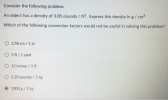 Consider the following problem: An object has a density of 3.85 pounds / ft3. Express this density in g/cm3 Which of the following conversion factors would not be useful in solving this problem? O 2.54 cm/1 in O 3ft/1 yard O 12 inches /1 ft O 2.20 pounds/1 kg O 1000 g/1kg
Conversion to Perform Answer 32 cm to m 53.5 kg to g 96.3 mL to L...
Conversion to Perform Answer 32 cm to m 53.5 kg to g 96.3 mL to L 4.00 miles to km 0.25 oz to mL Please show work
Part C Iron has a density of 7.86 g/cm (1 cm = 1 mL). Calculate the...
 Part C Iron has a density of 7.86 g/cm (1 cm = 1 mL). Calculate the volume (in dL) of a piece of iron having a mass of 4.25 kg . Note that the density is provided in different units of volume and mass than the desired units of volume (dL) and the given units of mass (kg). You will need to express the density in kg/dL (1 cm = 1 mL) before calculating the volume for the piece of...
The density of water is given as 1 g/cm3. Determine the specific volume in ft3/lbm. I...
The density of water is given as 1 g/cm3. Determine the specific volume in ft3/lbm. I got 0.077 ft^3/lbm, and it's wrong, I can tell. I'm using the specific volume equation, sv = 1/rho, by the way. Can someone provide insight into this?
A 150 g sample of polyisoprene with a molecular weight of 1000 kg/mol is reacted with...
A 150 g sample of polyisoprene with a molecular weight of 1000 kg/mol is reacted with 0.75 g of sulfur to produce a rubber network. The product is a 70 cm long strip with a 0.93 g/cm3 density. If you suspend a 10 kg weight from one end of the strip, hung vertically, to what final length will the material stretch? Note that the area to which the force is attached is not given but can be determined by (volume)/(length).
? 6. Conversion of Pressure to Head of a Fluid Given the pressure of 1 standard...
 ?
6. Conversion of Pressure to Head of a Fluid Given the pressure of 1 standard atnm as to 1.325 kN/m2. Do as follows. (a) Convert this pressure to head in m water at 4°C, the density of water at 4°C is 1.000 g/cm*, a density of 1.000 g/cm equals 1000 kg/m
?
6. Conversion of Pressure to Head of a Fluid Given the pressure of 1 standard atnm as to 1.325 kN/m2. Do as follows. (a) Convert this pressure to head in m water at 4°C, the density of water at 4°C is 1.000 g/cm*, a density of 1.000 g/cm equals 1000 kg/m
Using the following unit conversions: 1.00 fluid ounce = 29.573 ml, 1.00 L = 1000 cm^3...
 Using the following unit conversions: 1.00 fluid ounce = 29.573 ml, 1.00 L = 1000 cm^3 density of water = 1.00 gm/cm^3, the number of fluid ounces in a kg of water is
The answer to part 1 is NOT 1.09 g/cm^3 This problem involves concepts of materials engineering....
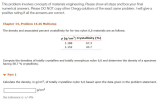 The answer to part 1 is NOT 1.09 g/cm^3
This problem involves concepts of materials engineering. Please show all steps and box your final numerical answers. Please DO NOT copy other Chegg solutions of the exact same problem. I will give a positive rating if all the answers are correct. Chapter 14, Problem 14.26 Multistep The density and associated percent cryitfor f to nylon 6,6 materials are as followes (g/cm3) Crystallinity (%) 1.188 1.152 67.3 43.7 Compute the densities of...
The answer to part 1 is NOT 1.09 g/cm^3
This problem involves concepts of materials engineering. Please show all steps and box your final numerical answers. Please DO NOT copy other Chegg solutions of the exact same problem. I will give a positive rating if all the answers are correct. Chapter 14, Problem 14.26 Multistep The density and associated percent cryitfor f to nylon 6,6 materials are as followes (g/cm3) Crystallinity (%) 1.188 1.152 67.3 43.7 Compute the densities of...
 Ift=12in lin=2.54 cm Igal = 0.1337 ft3 1 L 1000 cm3 Water leaks out of a hole in the side ofa water tank at a rate of 13.79 ga/min. Convert this to liters/s and give your answer to four significant figures. Do not use any metric-English conversion factors not given above. Show
 Given that 1 inch = 2.54 cm, the following conversion of a volume of 464 ft of gas to liters is correct. 464 ft3 x x12 in3/1 ft3 x 2.54 cm3/1 in3 x 1 ml/1 cm3 x 10-3 V1 ml True False
 Consider the following problem: An object has a density of 3.85 pounds / ft3. Express this density in g/cm3 Which of the following conversion factors would not be useful in solving this problem? O 2.54 cm/1 in O 3ft/1 yard O 12 inches /1 ft O 2.20 pounds/1 kg O 1000 g/1kg
 Part C Iron has a density of 7.86 g/cm (1 cm = 1 mL). Calculate the volume (in dL) of a piece of iron having a mass of 4.25 kg . Note that the density is provided in different units of volume and mass than the desired units of volume (dL) and the given units of mass (kg). You will need to express the density in kg/dL (1 cm = 1 mL) before calculating the volume for the piece of...
 ?
6. Conversion of Pressure to Head of a Fluid Given the pressure of 1 standard atnm as to 1.325 kN/m2. Do as follows. (a) Convert this pressure to head in m water at 4°C, the density of water at 4°C is 1.000 g/cm*, a density of 1.000 g/cm equals 1000 kg/m
?
6. Conversion of Pressure to Head of a Fluid Given the pressure of 1 standard atnm as to 1.325 kN/m2. Do as follows. (a) Convert this pressure to head in m water at 4°C, the density of water at 4°C is 1.000 g/cm*, a density of 1.000 g/cm equals 1000 kg/m
 Using the following unit conversions: 1.00 fluid ounce = 29.573 ml, 1.00 L = 1000 cm^3 density of water = 1.00 gm/cm^3, the number of fluid ounces in a kg of water is
 The answer to part 1 is NOT 1.09 g/cm^3
This problem involves concepts of materials engineering. Please show all steps and box your final numerical answers. Please DO NOT copy other Chegg solutions of the exact same problem. I will give a positive rating if all the answers are correct. Chapter 14, Problem 14.26 Multistep The density and associated percent cryitfor f to nylon 6,6 materials are as followes (g/cm3) Crystallinity (%) 1.188 1.152 67.3 43.7 Compute the densities of...
The answer to part 1 is NOT 1.09 g/cm^3
This problem involves concepts of materials engineering. Please show all steps and box your final numerical answers. Please DO NOT copy other Chegg solutions of the exact same problem. I will give a positive rating if all the answers are correct. Chapter 14, Problem 14.26 Multistep The density and associated percent cryitfor f to nylon 6,6 materials are as followes (g/cm3) Crystallinity (%) 1.188 1.152 67.3 43.7 Compute the densities of...
Most questions answered within 3 hours.
-
Where is the error in this code sequence?
String s1 = "Hello";
String s2 = "ello";...
asked 10 months ago -
Financial data for Joel de Paris, Inc., for last year
follow:
Joel de Paris, Inc.
Balance...
asked 10 months ago -
Consider this reaction:
Al2(SO4)3 (aq)+ BaCl3
(aq) Al2Cl6 (aq)- +
3BaSO4(s) . What is the...
asked 10 months ago -
Suppose that Savneet is considering increasing her
recent random sample from 20 car rentals to 40...
asked 10 months ago -
Trucks arrive at an unloading terminal at an average rate of 120
per hour.
Trucks arrive...
asked 10 months ago -
Why are methanol and ethanol completely soluble in water while
octanol is not very little soluble....
asked 10 months ago -
A facilities manager at a university reads in a research report
that the mean amount of...
asked 10 months ago -
When the CuSO4 is rehydrated by adding water to the anhydrous
compound, is this an endothermic...
asked 10 months ago -
A ray of sunlight is passing from diamond into crown glass; the
angle of incidence is...
asked 10 months ago -
A block of mass 0.249 kg is placed on top of a light, vertical
spring of...
asked 10 months ago -
how do the kidneys compensate in the presences of acidosis
a) trigger hyperventilate
b) reserve acid...
asked 10 months ago -
Question 501 pts
The rental rate of capital to the firm increases. Which of the
following...
asked 10 months ago