Identify other targets of proteins originating from the ER besides the cis-Golgi network.
Identify other targets of proteins originating from the ER besides the cis-Golgi network.
Homework Answers
The proteins which are synthesized by the ribosomes in the rough ER are the part of endomemdrane system. The synthesis of protein begins in the cytosol which is later brought to the rough ER. Once the synthesis of protein is done in the rough ER lumen the protein undergo post translational modification in the ER itself. From the ER proteins are packed into vesicle and sorted to cis-Golgi network. From cis Golgi network via the medial Golgi the protein sorted to trans Golgi network. Now from trans Golgi network protein can be delivered to the plasma membrane, can be delivered to the outside the cell (secretory protein ), to the lysosome depending on the signal sequence present in the protein
So apart from cis Golgi network the protein synthesized in the ER can be targeted to outside the cells, to the lysosome, in the plasma membrane.
Add Answer to:
Identify other targets of proteins originating from the ER
besides the cis-Golgi network.
Compared to the proteins in the trans Golgi compartment, those proteins in the cis Golgi compartment:...
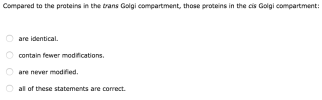 Compared to the proteins in the trans Golgi compartment, those proteins in the cis Golgi compartment: are identical. contain fewer modifications. are never modified. all of these statements are correct.
Clathrin-coated vesicles are destined to be delivered to which endomembrane compartment? A) Rough ER B) cis-Golgi...
Clathrin-coated vesicles are destined to be delivered to which endomembrane compartment? A) Rough ER B) cis-Golgi C) trans-Golgi network D) late endosome
FILL IN THE BLANK Soluble resident ER proteins that reach the Golgi are returned to the...
FILL IN THE BLANK Soluble resident ER proteins that reach the Golgi are returned to the ER via ( ) -coated vesicles. The ER retention/retrieval signal, ( ), binds to a receptor in the Golgi lumen but falls off in the ER lumen due to a change in (. ), which affects the properties of the retention signal. Transmembrane proteins that are returned from Golgi to ER have a different signal,( ) , at the ( ) -terminal end of...
Question 6 options: Cop II coated vesicles move cargo from the ER to the Golgi. Start...
Question 6 options: Cop II coated vesicles move cargo from the ER to the Golgi. Starting nearest the nucleus and moving toward the plasma membrane, the order of the Golgi network is: cis-Golgi, cis cisternae, medial cisternae, trans cisternae, and the trans Golgi. Cop I coated vesicles move cargo from the Golgi to the ER. Cisternal maturation models posit that each layer of the Golgi is a stable entity distinct from the preceding layer and that materials are moved to...
Secretory proteins move from the cis to the medial to the trans Golgi which are discrete...
Secretory proteins move from the cis to the medial to the trans Golgi which are discrete compartments or cisternae flanked by smaller vesicles. Which model for Golgi trafficking takes into account the observation that secretory proteins are not observed in the flanking vesicles? A. Orthogonal compartment model. B. Transverse secretory model. C. Cisternal maturation model. D. Vesicle transport model. E. ERGIC model.
Proteins that are produced in rough ER to be secreted to the outside must first enter...
 Proteins that are produced in rough ER to be secreted to the outside must first enter into tehlumen of rough ER, and then travel through ER and Golgi apparatus. Evely, those proteins are enclosed inside transport vosicles originate from Golgi Drag and drop the steps of the path taken by secretory proteins from their sites of synthesis to their destination. Not all labels will be used View Available Hint(s) Reset Help endoplasmic reticulum lysosome plasma membrane trans Gold cisternae cis...
Once proteins have been sorted by the Golgi apparatus they are released from the Golgi apparatus...
Once proteins have been sorted by the Golgi apparatus they are released from the Golgi apparatus in vesicles to be transported to its target membrane. How is a vesicle able to identify its target membrane and what happens to the vesicle once it finds its target membrane?
home / study / science / biology / biology questions and answers / v-snare proteins are...
home / study / science / biology / biology questions and answers / v-snare proteins are membrane proteins that are integrated into the membrane of the er during ... Your question has been answered Let us know if you got a helpful answer. Rate this answer v-SNARE proteins are membrane proteins that are integrated into the membrane of the ER during their biosynthesis and are then transported by transport vesicles to their destination. Thus, transport vesicles budding from the ER...
Reset Help Vesicle from Vesicle from Rough ERV Golgi apparatus membrane Plasma ER Golgi Processing Transport...
 Reset Help Vesicle from Vesicle from Rough ERV Golgi apparatus membrane Plasma ER Golgi Processing Transport Secretion Manufacturing Transport
A) Transport vesicles fuse one side of the Golgi and leave from the opposite side. B)...
 A) Transport vesicles fuse one side of the Golgi and leave from the opposite side. B) Proteins in the membrane of the Golgi may be sorted and modified as they move from one side of the Golgi to the other. C) Lipids in the membrane of the Golgi may be sorted and modified as they move from one side of the Golgi to the D) Soluble proteins in the cisternae (interior) of the Golgi may be sorted and modified as...
 Compared to the proteins in the trans Golgi compartment, those proteins in the cis Golgi compartment: are identical. contain fewer modifications. are never modified. all of these statements are correct.
 Proteins that are produced in rough ER to be secreted to the outside must first enter into tehlumen of rough ER, and then travel through ER and Golgi apparatus. Evely, those proteins are enclosed inside transport vosicles originate from Golgi Drag and drop the steps of the path taken by secretory proteins from their sites of synthesis to their destination. Not all labels will be used View Available Hint(s) Reset Help endoplasmic reticulum lysosome plasma membrane trans Gold cisternae cis...
 Reset Help Vesicle from Vesicle from Rough ERV Golgi apparatus membrane Plasma ER Golgi Processing Transport Secretion Manufacturing Transport
 A) Transport vesicles fuse one side of the Golgi and leave from the opposite side. B) Proteins in the membrane of the Golgi may be sorted and modified as they move from one side of the Golgi to the other. C) Lipids in the membrane of the Golgi may be sorted and modified as they move from one side of the Golgi to the D) Soluble proteins in the cisternae (interior) of the Golgi may be sorted and modified as...
Most questions answered within 3 hours.
-
Where is the error in this code sequence?
String s1 = "Hello";
String s2 = "ello";...
asked 10 months ago -
Financial data for Joel de Paris, Inc., for last year
follow:
Joel de Paris, Inc.
Balance...
asked 10 months ago -
Consider this reaction:
Al2(SO4)3 (aq)+ BaCl3
(aq) Al2Cl6 (aq)- +
3BaSO4(s) . What is the...
asked 10 months ago -
Suppose that Savneet is considering increasing her
recent random sample from 20 car rentals to 40...
asked 10 months ago -
Trucks arrive at an unloading terminal at an average rate of 120
per hour.
Trucks arrive...
asked 10 months ago -
Why are methanol and ethanol completely soluble in water while
octanol is not very little soluble....
asked 10 months ago -
A facilities manager at a university reads in a research report
that the mean amount of...
asked 10 months ago -
When the CuSO4 is rehydrated by adding water to the anhydrous
compound, is this an endothermic...
asked 10 months ago -
A ray of sunlight is passing from diamond into crown glass; the
angle of incidence is...
asked 10 months ago -
A block of mass 0.249 kg is placed on top of a light, vertical
spring of...
asked 10 months ago -
how do the kidneys compensate in the presences of acidosis
a) trigger hyperventilate
b) reserve acid...
asked 10 months ago -
Question 501 pts
The rental rate of capital to the firm increases. Which of the
following...
asked 10 months ago