Kinetics Question: a) Explain why the rate of reaction must be defined in a manner that...
Kinetics Question:
a) Explain why the rate of reaction must be defined in a manner that is not dependent on which reactant or product is used to measure it.
b) Explain why rate laws must be determined experimentally.
c) Explain how the rate limiting step in a mechanism determines the overall reaction rate.
Homework Answers

Add Answer to:
Kinetics Question:
a) Explain why the rate of reaction must be defined in a manner
that...
Which statement is false concerning elementary steps in a reaction mechanism? the rate law can be...
Which statement is false concerning elementary steps in a reaction mechanism? the rate law can be deduced from the stoichiometry of reactants for an elementary step the overall molecularity for an elementary step is the sum of the stoichiometric coefficients for all reactants in that step the rate law for an elementary step must be determined experimentally the rate law for the overall reaction is always the same as the rate law for the slowest elementary step both (c) and...
Unit 2: Chemical Kinetics Assignment 1. Explain why the rate of a chemical reaction increases as...
 Unit 2: Chemical Kinetics Assignment 1. Explain why the rate of a chemical reaction increases as the concentration of the reactants increases 2. Consider two gases A and B in a container at room temperature. What effect will the following changes have on the reaction rate between these gases (increase, decrease, no a) The pressure is increased. b) The number of molecules of gas A is doubled c) The temperature is decreased 3. Which of the following reactions will have...
Answer the following questions about the reaction depicted in the diagram: Is the overall reaction spontaneous...
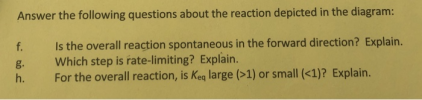 Answer the following questions about the reaction depicted in the diagram: Is the overall reaction spontaneous in the forward direction? Explain. Which step is rate-limiting? Explain. For the overall reaction, is Keq large (>1) or small (<1)? Explain. -intermideates - a Ear Eaz labi Reactant (reageuts) product Reaction Coordinate
Question 1: When creating the calibration curve during week 1, it was determined that [KSCN] = [...
Question 1: When creating the calibration curve during week 1, it was determined that [KSCN] = [FeSCN2+] at equilibrium. Explain why these two concentrations were equal in terms of the relative concentrations of each reactant, the limiting reactant, and the direction in which the reaction proceeded Question 2: Describe the process by which equilibrium concentrations of the reactants and product were determined. Include in your discussion, how the equilibrium (final) concentration of FeSCN2+ was determined using a calibration curve, mole-to-mole...
Most reactions occur by a series of steps. The energy profile for a certain reaction that...
 Most reactions occur by a series of steps. The energy profile for a certain reaction that proceeds by a two-step mechanism is shown below. 2 1 Reaction coordinate In regard to the energy profile, identify the following. (a) The positions of reactants and products reaction coordinate for reactants 1 reaction coordinate for products 3 (b) The activation energy for the overall reaction. (Enter your answers in increasing numerical order.) the energy difference between reaction coordinatesSelect and-Select (c) AE for the...
A reaction mechanism is defined as the sequence of reaction steps that define the pathway from...
A reaction mechanism is defined as the sequence of reaction steps that define the pathway from reactants to products. Each step in a mechanism is an elementary reaction, which describes a single molecular event of usually one or two molecules interacting. The rate law for an overall reaction is the rate law for the slowest step in the mechanism, which is directly related to the stoichiometric coefficients of the reactants. The exception to this rule occurs when the slowest step...
A2. Chemical Kinetics (20 marks) MBr2 Br Br M k1 |(1) k2. Br H2 HBr H k2,r (2) k3,f HBr2 HBr Br (3) + Experimentally me...
 A2. Chemical Kinetics (20 marks) MBr2 Br Br M k1 |(1) k2. Br H2 HBr H k2,r (2) k3,f HBr2 HBr Br (3) + Experimentally measured rate expression for [HBr] given as below: d [HBr] A1exp[H2] [Br2]1/2 HBr 1+ A2exp TBr2 dt Consider the above elementary reactions mechanism proposed by Bodenstein to explain their experimental findings of the reaction rate of HBr. Reactions 1 and 2 are bi-directional (forward and reverse) while reaction 3 is uni-directional (forward only) as written....
= - KINETICS AND EQUILIBRIUM Calculating the reaction rate of one reactant from that of another...
 = - KINETICS AND EQUILIBRIUM Calculating the reaction rate of one reactant from that of another Nitric acid is a key industrial chemical, largely used to make fertilizers and explosives. The first step in its synthesis is the oxidation of ammonia. In this reaction, gaseous ammonia reacts with dioxygen gas to produce nitrogen monoxide gas and water. Suppose a chemical engineer studying a new catalyst for the oxidation of ammonia reaction finds that 510. liters per second of dioxygen are...
Overall rate In the question below the correct answer is B, how does that show agreement...
 Overall rate
In the question below the correct answer is B, how does that
show agreement with the overall reaction which does not have any
concentration of CL present?
Questions 42-44 refer to the following information. When free Cl(g) atoms encounter O(8) molecules in the upper atmosphere, the following reaction mechanism is proposed to occur. Cl(g) +03(g) → C10(g) +02(g) CIO(g) + 03(g) → Cl(g) + 2 O2(g) 203(g) → 302(g) slow step fast step overall reaction AH-285 kJ/mol 42....
Overall rate
In the question below the correct answer is B, how does that
show agreement with the overall reaction which does not have any
concentration of CL present?
Questions 42-44 refer to the following information. When free Cl(g) atoms encounter O(8) molecules in the upper atmosphere, the following reaction mechanism is proposed to occur. Cl(g) +03(g) → C10(g) +02(g) CIO(g) + 03(g) → Cl(g) + 2 O2(g) 203(g) → 302(g) slow step fast step overall reaction AH-285 kJ/mol 42....
Please answer each part with work shown. Thank you. 6. The following three mechanisms have been proposed for a particular reaction. Mechanism II Mechanism III Mechanisml H2 +NO-H2O+N (slow) N +...
 Please answer each part with work shown. Thank you.
6. The following three mechanisms have been proposed for a particular reaction. Mechanism II Mechanism III Mechanisml H2 +NO-H2O+N (slow) N +NON2+0 (fast) O+H2-> H2O (fast) 2 NO-N202 (fast equilibrium) H2-N202-H20+ N3O (slow) H2+N20-H2O+N2 (fast) H2 + 2 NO- H2O+N2O (slow) N20+ H2N2+ H2O (fast) a) What is the overall reaction that each proposed mechanism supports? b) Calculate the ΔΗ'm for the overall reaction. c) For each mechanism, draw an energy...
Please answer each part with work shown. Thank you.
6. The following three mechanisms have been proposed for a particular reaction. Mechanism II Mechanism III Mechanisml H2 +NO-H2O+N (slow) N +NON2+0 (fast) O+H2-> H2O (fast) 2 NO-N202 (fast equilibrium) H2-N202-H20+ N3O (slow) H2+N20-H2O+N2 (fast) H2 + 2 NO- H2O+N2O (slow) N20+ H2N2+ H2O (fast) a) What is the overall reaction that each proposed mechanism supports? b) Calculate the ΔΗ'm for the overall reaction. c) For each mechanism, draw an energy...
 Unit 2: Chemical Kinetics Assignment 1. Explain why the rate of a chemical reaction increases as the concentration of the reactants increases 2. Consider two gases A and B in a container at room temperature. What effect will the following changes have on the reaction rate between these gases (increase, decrease, no a) The pressure is increased. b) The number of molecules of gas A is doubled c) The temperature is decreased 3. Which of the following reactions will have...
 Answer the following questions about the reaction depicted in the diagram: Is the overall reaction spontaneous in the forward direction? Explain. Which step is rate-limiting? Explain. For the overall reaction, is Keq large (>1) or small (<1)? Explain. -intermideates - a Ear Eaz labi Reactant (reageuts) product Reaction Coordinate
 Most reactions occur by a series of steps. The energy profile for a certain reaction that proceeds by a two-step mechanism is shown below. 2 1 Reaction coordinate In regard to the energy profile, identify the following. (a) The positions of reactants and products reaction coordinate for reactants 1 reaction coordinate for products 3 (b) The activation energy for the overall reaction. (Enter your answers in increasing numerical order.) the energy difference between reaction coordinatesSelect and-Select (c) AE for the...
 A2. Chemical Kinetics (20 marks) MBr2 Br Br M k1 |(1) k2. Br H2 HBr H k2,r (2) k3,f HBr2 HBr Br (3) + Experimentally measured rate expression for [HBr] given as below: d [HBr] A1exp[H2] [Br2]1/2 HBr 1+ A2exp TBr2 dt Consider the above elementary reactions mechanism proposed by Bodenstein to explain their experimental findings of the reaction rate of HBr. Reactions 1 and 2 are bi-directional (forward and reverse) while reaction 3 is uni-directional (forward only) as written....
 = - KINETICS AND EQUILIBRIUM Calculating the reaction rate of one reactant from that of another Nitric acid is a key industrial chemical, largely used to make fertilizers and explosives. The first step in its synthesis is the oxidation of ammonia. In this reaction, gaseous ammonia reacts with dioxygen gas to produce nitrogen monoxide gas and water. Suppose a chemical engineer studying a new catalyst for the oxidation of ammonia reaction finds that 510. liters per second of dioxygen are...
 Overall rate
In the question below the correct answer is B, how does that
show agreement with the overall reaction which does not have any
concentration of CL present?
Questions 42-44 refer to the following information. When free Cl(g) atoms encounter O(8) molecules in the upper atmosphere, the following reaction mechanism is proposed to occur. Cl(g) +03(g) → C10(g) +02(g) CIO(g) + 03(g) → Cl(g) + 2 O2(g) 203(g) → 302(g) slow step fast step overall reaction AH-285 kJ/mol 42....
Overall rate
In the question below the correct answer is B, how does that
show agreement with the overall reaction which does not have any
concentration of CL present?
Questions 42-44 refer to the following information. When free Cl(g) atoms encounter O(8) molecules in the upper atmosphere, the following reaction mechanism is proposed to occur. Cl(g) +03(g) → C10(g) +02(g) CIO(g) + 03(g) → Cl(g) + 2 O2(g) 203(g) → 302(g) slow step fast step overall reaction AH-285 kJ/mol 42....
 Please answer each part with work shown. Thank you.
6. The following three mechanisms have been proposed for a particular reaction. Mechanism II Mechanism III Mechanisml H2 +NO-H2O+N (slow) N +NON2+0 (fast) O+H2-> H2O (fast) 2 NO-N202 (fast equilibrium) H2-N202-H20+ N3O (slow) H2+N20-H2O+N2 (fast) H2 + 2 NO- H2O+N2O (slow) N20+ H2N2+ H2O (fast) a) What is the overall reaction that each proposed mechanism supports? b) Calculate the ΔΗ'm for the overall reaction. c) For each mechanism, draw an energy...
Please answer each part with work shown. Thank you.
6. The following three mechanisms have been proposed for a particular reaction. Mechanism II Mechanism III Mechanisml H2 +NO-H2O+N (slow) N +NON2+0 (fast) O+H2-> H2O (fast) 2 NO-N202 (fast equilibrium) H2-N202-H20+ N3O (slow) H2+N20-H2O+N2 (fast) H2 + 2 NO- H2O+N2O (slow) N20+ H2N2+ H2O (fast) a) What is the overall reaction that each proposed mechanism supports? b) Calculate the ΔΗ'm for the overall reaction. c) For each mechanism, draw an energy...
Most questions answered within 3 hours.
-
Where is the error in this code sequence?
String s1 = "Hello";
String s2 = "ello";...
asked 10 months ago -
Financial data for Joel de Paris, Inc., for last year
follow:
Joel de Paris, Inc.
Balance...
asked 10 months ago -
Consider this reaction:
Al2(SO4)3 (aq)+ BaCl3
(aq) Al2Cl6 (aq)- +
3BaSO4(s) . What is the...
asked 10 months ago -
Suppose that Savneet is considering increasing her
recent random sample from 20 car rentals to 40...
asked 10 months ago -
Trucks arrive at an unloading terminal at an average rate of 120
per hour.
Trucks arrive...
asked 10 months ago -
Why are methanol and ethanol completely soluble in water while
octanol is not very little soluble....
asked 10 months ago -
A facilities manager at a university reads in a research report
that the mean amount of...
asked 10 months ago -
When the CuSO4 is rehydrated by adding water to the anhydrous
compound, is this an endothermic...
asked 10 months ago -
A ray of sunlight is passing from diamond into crown glass; the
angle of incidence is...
asked 10 months ago -
A block of mass 0.249 kg is placed on top of a light, vertical
spring of...
asked 10 months ago -
how do the kidneys compensate in the presences of acidosis
a) trigger hyperventilate
b) reserve acid...
asked 10 months ago -
Question 501 pts
The rental rate of capital to the firm increases. Which of the
following...
asked 10 months ago