In R! Write a function named prime_factor(x) that will find the prime factorization of an integer...
In R!
Write a function named prime_factor(x) that will find the prime factorization of an integer x. The function will output a numeric vector. All of the values in the output vector will be prime. The product of the numeric vector will be the original value x. There should be a check to make sure that the input value is a number greater than 2 with no decimal values with appropriate error messages. If you’re stuck on getting started with this, I suggest doing some prime factorizations yourself. For example, try to find the prime factors of 171 or 364. Note the steps you go through to find these prime factors and see if you can create code to do it. (The point of the exercise is to give you practice writing code. Yes, I am aware that solutions to this problem already exist on the Internet. Don’t search for them. While the problem is simple, it is complex enough that it is incredibly unlikely for students to create identical code solutions. You are free to talk about your approach and I fully expect many students to take identical approaches, but students writing identical code is an entirely different matter.)
Homework Answers
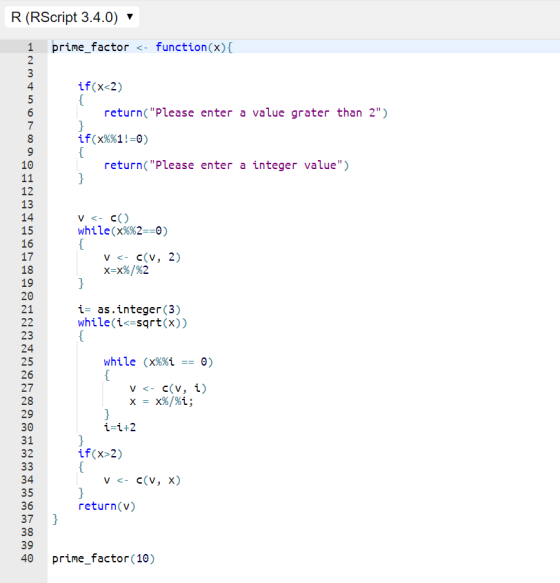
prime_factor <- function(x){
if(x<2)
{
return("Please enter a value grater than 2")
}
if(x%%1!=0)
{
return("Please enter a integer value")
}
v <- c()
while(x%%2==0)
{
v <- c(v, 2)
x=x%/%2
}
i= as.integer(3)
while(i<=sqrt(x))
{
while (x%%i == 0)
{
v <- c(v, i)
x = x%/%i;
}
i=i+2
}
if(x>2)
{
v <- c(v, x)
}
return(v)
}
prime_factor(364)
Add Answer to:
In R!
Write a function named prime_factor(x) that will find the prime
factorization of an integer...
The prime factorization of a number is the unique list of prime numbers that, when multiplied,...
The prime factorization of a number is the unique list of prime numbers that, when multiplied, gives the number. For example, the prime factorization of 60 is 2 ∗ 2 ∗ 3 ∗ 5. In this problem you must write code to recursively find and return the prime factorization of the given number. You must print these in ascending sorted order with spaces in between. For example, if your input is: 120 then you should print the following output: 2...
The prime factorization of a number is the unique list of prime numbers that, when multiplied,...
The prime factorization of a number is the unique list of prime numbers that, when multiplied, gives the number. For example, the prime factorization of 60 is 2 ∗ 2 ∗ 3 ∗ 5. In this problem you must write code to recursively find and return the prime factorization of the given number. You must print these in ascending sorted order with spaces in between. For example, if your input is: 120 then you should print the following output: 2...
IN PYHTON CODE Question #3 Produce a function prime_factors.dict that has one integer variable n that...
 IN PYHTON CODE
Question #3 Produce a function prime_factors.dict that has one integer variable n that is assumed to be greater than 1. The function will return a dictionary with keys the integers from 2 to n, inclusive, and with values the set of prime factors of each key. So, the command prime_factors.dict (8) will return the dictionary 2 123,3: 3),4 2),5 (53,6 2,3),7:7),8 {2)) Note that even though the prime number 2 appears twice in the prime fac- torization...
IN PYHTON CODE
Question #3 Produce a function prime_factors.dict that has one integer variable n that is assumed to be greater than 1. The function will return a dictionary with keys the integers from 2 to n, inclusive, and with values the set of prime factors of each key. So, the command prime_factors.dict (8) will return the dictionary 2 123,3: 3),4 2),5 (53,6 2,3),7:7),8 {2)) Note that even though the prime number 2 appears twice in the prime fac- torization...
In this exercise you will work with LU factorization of an matrix A. Theory: Any matrix A can be ...
In this exercise you will work with LU factorization of an matrix A. Theory: Any matrix A can be reduced to an echelon form by using only row replacement and row interchanging operations. Row interchanging is almost always necessary for a computer realization because it reduces the round off errors in calculations - this strategy in computer calculation is called partial pivoting, which refers to selecting for a pivot the largest by absolute value entry in a column. The MATLAB...
In this exercise, you will work with a QR factorization of an mxn matrix. We will proceed in the ...
 In this exercise, you will work with a QR factorization of an mxn matrix. We will proceed in the way that is chosen by MATLAB, which is different from the textbook presentation. An mxn matrix A can be presented as a product of a unitary (or orthogonal) mxm matrix Q and an upper-triangular m × n matrix R, that is, A = Q * R . Theory: a square mxm matrix Q is called unitary (or orthogona) if -,or equivalently,...
Please write the code using matlab 1) i. Create an anonymous function named optimist, that accepts...
 Please write the code using matlab
1) i. Create an anonymous function named optimist, that accepts a single variable as input i Create a row vector Tthat represents the number of seconds in two minutes, starting ii. Call the function optimist on the vector T, store the result in variable R1 and returns the double of that variable from one and ending at a hundred and twenty v. Create an anonymous function named pessimist, that accepts a single variable as...
Please write the code using matlab
1) i. Create an anonymous function named optimist, that accepts a single variable as input i Create a row vector Tthat represents the number of seconds in two minutes, starting ii. Call the function optimist on the vector T, store the result in variable R1 and returns the double of that variable from one and ending at a hundred and twenty v. Create an anonymous function named pessimist, that accepts a single variable as...
Function LUfac_solver.m is provided here: function [x] = LUfac_solver(LU,b,piv) % % function [x] = LUfac_solver(lu,b) %...
 Function LUfac_solver.m is provided here:
function [x] = LUfac_solver(LU,b,piv)
%
% function [x] = LUfac_solver(lu,b)
%
% This program employs the LU factorization to solve the linear
system Ax=b.
%
% Input
% LU: lu matrix from GEpivot_new function
% b: right side column vector (ordered corresponding to original
vector
% sent to GEpivot_new)
% piv: vector indicating the pivoting (row interchanges that
took place
% during GE
%
% Output
% x: solution vector
%
% Written by Steve...
Function LUfac_solver.m is provided here:
function [x] = LUfac_solver(LU,b,piv)
%
% function [x] = LUfac_solver(lu,b)
%
% This program employs the LU factorization to solve the linear
system Ax=b.
%
% Input
% LU: lu matrix from GEpivot_new function
% b: right side column vector (ordered corresponding to original
vector
% sent to GEpivot_new)
% piv: vector indicating the pivoting (row interchanges that
took place
% during GE
%
% Output
% x: solution vector
%
% Written by Steve...
Write MATLAB code g(x)=x+a*f(x) f(x)=(e^x)+(x^2)-x-4 function f(x) is stored in fogp1.m (c) (1) Create a file...
 Write MATLAB code
g(x)=x+a*f(x)
f(x)=(e^x)+(x^2)-x-4
function f(x) is stored in fogp1.m
(c) (1) Create a file gopgi.m to calculate the function glir, a) (see Preparation, ex. 7c) function [y] =gopg1(x,a) % input: x, a % output: y y= .....; (2) Create a file sucsub1.m and write a program that calculates the solution using the method of successive substitution. Calculate the values of g(x, a) by making multiple calls to the function gopg1(x, a). Take xo = 1.3 as starting value...
Write MATLAB code
g(x)=x+a*f(x)
f(x)=(e^x)+(x^2)-x-4
function f(x) is stored in fogp1.m
(c) (1) Create a file gopgi.m to calculate the function glir, a) (see Preparation, ex. 7c) function [y] =gopg1(x,a) % input: x, a % output: y y= .....; (2) Create a file sucsub1.m and write a program that calculates the solution using the method of successive substitution. Calculate the values of g(x, a) by making multiple calls to the function gopg1(x, a). Take xo = 1.3 as starting value...
1) a) Write MATLAB function that accepts a positive integer parameter n and returns a vector...
 1)
a) Write MATLAB function that accepts a positive integer
parameter n and returns a vector containing the values of the
integral (A) for n= 1,2,3,..., n. The function must use the
relation (B) and the value of y(1). Your function must preallocate
the array that it returns. Use for loop when writing your code.
b) Write MATLAB script that uses your function to calculate the
values of the integral (A) using the recurrence relation (B), y(n)
for n=1,2,... 19...
1)
a) Write MATLAB function that accepts a positive integer
parameter n and returns a vector containing the values of the
integral (A) for n= 1,2,3,..., n. The function must use the
relation (B) and the value of y(1). Your function must preallocate
the array that it returns. Use for loop when writing your code.
b) Write MATLAB script that uses your function to calculate the
values of the integral (A) using the recurrence relation (B), y(n)
for n=1,2,... 19...
Question 2 If you read in a csv file using read.csv() function into R, what is the resulting datastructure in which R st...
Question 2 If you read in a csv file using read.csv() function into R, what is the resulting datastructure in which R stores the read-in data? A. numeric B. matrix C. data.frame D. vector Question 3 Suppose you have 4 integers, 4 characters, and 4 logical values. Which datastructure can you use to store all 12 values? Choose one or more options. A. a vector B. a matrix C. a list D. a data frame Question 4 Suppose you have...
 IN PYHTON CODE
Question #3 Produce a function prime_factors.dict that has one integer variable n that is assumed to be greater than 1. The function will return a dictionary with keys the integers from 2 to n, inclusive, and with values the set of prime factors of each key. So, the command prime_factors.dict (8) will return the dictionary 2 123,3: 3),4 2),5 (53,6 2,3),7:7),8 {2)) Note that even though the prime number 2 appears twice in the prime fac- torization...
IN PYHTON CODE
Question #3 Produce a function prime_factors.dict that has one integer variable n that is assumed to be greater than 1. The function will return a dictionary with keys the integers from 2 to n, inclusive, and with values the set of prime factors of each key. So, the command prime_factors.dict (8) will return the dictionary 2 123,3: 3),4 2),5 (53,6 2,3),7:7),8 {2)) Note that even though the prime number 2 appears twice in the prime fac- torization...
 In this exercise, you will work with a QR factorization of an mxn matrix. We will proceed in the way that is chosen by MATLAB, which is different from the textbook presentation. An mxn matrix A can be presented as a product of a unitary (or orthogonal) mxm matrix Q and an upper-triangular m × n matrix R, that is, A = Q * R . Theory: a square mxm matrix Q is called unitary (or orthogona) if -,or equivalently,...
 Please write the code using matlab
1) i. Create an anonymous function named optimist, that accepts a single variable as input i Create a row vector Tthat represents the number of seconds in two minutes, starting ii. Call the function optimist on the vector T, store the result in variable R1 and returns the double of that variable from one and ending at a hundred and twenty v. Create an anonymous function named pessimist, that accepts a single variable as...
Please write the code using matlab
1) i. Create an anonymous function named optimist, that accepts a single variable as input i Create a row vector Tthat represents the number of seconds in two minutes, starting ii. Call the function optimist on the vector T, store the result in variable R1 and returns the double of that variable from one and ending at a hundred and twenty v. Create an anonymous function named pessimist, that accepts a single variable as...
 Function LUfac_solver.m is provided here:
function [x] = LUfac_solver(LU,b,piv)
%
% function [x] = LUfac_solver(lu,b)
%
% This program employs the LU factorization to solve the linear
system Ax=b.
%
% Input
% LU: lu matrix from GEpivot_new function
% b: right side column vector (ordered corresponding to original
vector
% sent to GEpivot_new)
% piv: vector indicating the pivoting (row interchanges that
took place
% during GE
%
% Output
% x: solution vector
%
% Written by Steve...
Function LUfac_solver.m is provided here:
function [x] = LUfac_solver(LU,b,piv)
%
% function [x] = LUfac_solver(lu,b)
%
% This program employs the LU factorization to solve the linear
system Ax=b.
%
% Input
% LU: lu matrix from GEpivot_new function
% b: right side column vector (ordered corresponding to original
vector
% sent to GEpivot_new)
% piv: vector indicating the pivoting (row interchanges that
took place
% during GE
%
% Output
% x: solution vector
%
% Written by Steve...
 Write MATLAB code
g(x)=x+a*f(x)
f(x)=(e^x)+(x^2)-x-4
function f(x) is stored in fogp1.m
(c) (1) Create a file gopgi.m to calculate the function glir, a) (see Preparation, ex. 7c) function [y] =gopg1(x,a) % input: x, a % output: y y= .....; (2) Create a file sucsub1.m and write a program that calculates the solution using the method of successive substitution. Calculate the values of g(x, a) by making multiple calls to the function gopg1(x, a). Take xo = 1.3 as starting value...
Write MATLAB code
g(x)=x+a*f(x)
f(x)=(e^x)+(x^2)-x-4
function f(x) is stored in fogp1.m
(c) (1) Create a file gopgi.m to calculate the function glir, a) (see Preparation, ex. 7c) function [y] =gopg1(x,a) % input: x, a % output: y y= .....; (2) Create a file sucsub1.m and write a program that calculates the solution using the method of successive substitution. Calculate the values of g(x, a) by making multiple calls to the function gopg1(x, a). Take xo = 1.3 as starting value...
 1)
a) Write MATLAB function that accepts a positive integer
parameter n and returns a vector containing the values of the
integral (A) for n= 1,2,3,..., n. The function must use the
relation (B) and the value of y(1). Your function must preallocate
the array that it returns. Use for loop when writing your code.
b) Write MATLAB script that uses your function to calculate the
values of the integral (A) using the recurrence relation (B), y(n)
for n=1,2,... 19...
1)
a) Write MATLAB function that accepts a positive integer
parameter n and returns a vector containing the values of the
integral (A) for n= 1,2,3,..., n. The function must use the
relation (B) and the value of y(1). Your function must preallocate
the array that it returns. Use for loop when writing your code.
b) Write MATLAB script that uses your function to calculate the
values of the integral (A) using the recurrence relation (B), y(n)
for n=1,2,... 19...
Most questions answered within 3 hours.
-
Where is the error in this code sequence?
String s1 = "Hello";
String s2 = "ello";...
asked 11 months ago -
Financial data for Joel de Paris, Inc., for last year
follow:
Joel de Paris, Inc.
Balance...
asked 11 months ago -
Consider this reaction:
Al2(SO4)3 (aq)+ BaCl3
(aq) Al2Cl6 (aq)- +
3BaSO4(s) . What is the...
asked 11 months ago -
Suppose that Savneet is considering increasing her
recent random sample from 20 car rentals to 40...
asked 11 months ago -
Trucks arrive at an unloading terminal at an average rate of 120
per hour.
Trucks arrive...
asked 11 months ago -
Why are methanol and ethanol completely soluble in water while
octanol is not very little soluble....
asked 11 months ago -
A facilities manager at a university reads in a research report
that the mean amount of...
asked 11 months ago -
When the CuSO4 is rehydrated by adding water to the anhydrous
compound, is this an endothermic...
asked 11 months ago -
A ray of sunlight is passing from diamond into crown glass; the
angle of incidence is...
asked 11 months ago -
A block of mass 0.249 kg is placed on top of a light, vertical
spring of...
asked 11 months ago -
how do the kidneys compensate in the presences of acidosis
a) trigger hyperventilate
b) reserve acid...
asked 11 months ago -
Question 501 pts
The rental rate of capital to the firm increases. Which of the
following...
asked 11 months ago