Using the Booth’s Multiplication multiply the following: 0110 x 1011 using M as 101
Homework Answers

Add Answer to:
Using the Booth’s Multiplication multiply the following:
0110 x 1011 using M as 101
Consider the following 8-bit multiplication problem: 0110 1100 x 0011 1001 For count the number of...
 Consider the following 8-bit multiplication problem: 0110 1100 x
0011 1001
For count the number of additions (and/or subtractions) for the
basic binary multiplication show in figure 10.9 and for Booth's
algorithm shown in figure 10.12. What is the 16 bit product?
START C,A-0 M-Multiplicand Multiplier Count- Flowchart for Unsigned Binary Multiplication No C,A-A+M Shift right C,A, Q Count Count- No Yes_ END Product in A,Q Figure 10.9 Flowchart for Unsigned Binary Multiplication
Consider the following 8-bit multiplication problem: 0110 1100 x
0011 1001
For count the number of additions (and/or subtractions) for the
basic binary multiplication show in figure 10.9 and for Booth's
algorithm shown in figure 10.12. What is the 16 bit product?
START C,A-0 M-Multiplicand Multiplier Count- Flowchart for Unsigned Binary Multiplication No C,A-A+M Shift right C,A, Q Count Count- No Yes_ END Product in A,Q Figure 10.9 Flowchart for Unsigned Binary Multiplication
a. Multiply the following numbers using signed by unsigned multiplication and write output Qn.m format. (101111)...
a. Multiply the following numbers using signed by unsigned multiplication and write output Qn.m format. (101111) signed Q3.3 x (111101) Unsigned Q2.4
a. Multiply the following numbers using signed by unsigned multiplication and write output On.m format (101111)...
 a. Multiply the following numbers using signed by unsigned multiplication and write output On.m format (101111) signed Q3.3 x (111101) Unsigned Q2.4
multiply 9 by 6 using fast binary multiplication
multiply 9 by 6 using fast binary multiplication
C++ Recursion Practice! 1)Multiplication #include <iostream.h> int Multiply(int M, int N) //Performs multiplication using the +...
C++ Recursion Practice! 1)Multiplication #include <iostream.h> int Multiply(int M, int N) //Performs multiplication using the + operator. //Pre : M and N are defined and N > 0. //Post: Returns M x N { int Prod; if (N == 1) Prod = M; //base case else Prod = M + Multiply(M, N - 1); //recursive step return Prod; } 2) Reverse #include <iostream.h> void Reverse(int N) //Displays string of length N in the reverse order //Pre : N...
The Russian Multiplication problem can be defined as follows: Say you want to multiply x with...
The Russian Multiplication problem can be defined as follows: Say you want to multiply x with y giving z. The problem is solved using the following iterative loop: With each iteration, x gets the value x/2 and y gets the value y*2. If x is even, the y-entry is ignored. If x is odd, y is added to a running total. The loop terminates when x = 0. For example: Calculate z = 24 * 52. Write a Prolog program...
Solve using loops in MATLAB provide screenshots id. Matrix Multiplication Matrix Multiplication of an M x...
 Solve using loops in MATLAB provide screenshots
id. Matrix Multiplication Matrix Multiplication of an M x P matrix (A) with a P x N matrix (B) yields an M x N matrix (C) with the Matlab command: C=A*B Replicate this result by using three nested loops. Your code should work for any compatible matrices A, B.
Solve using loops in MATLAB provide screenshots
id. Matrix Multiplication Matrix Multiplication of an M x P matrix (A) with a P x N matrix (B) yields an M x N matrix (C) with the Matlab command: C=A*B Replicate this result by using three nested loops. Your code should work for any compatible matrices A, B.
Compare and contrast the third multiplication algorithm with Booth’s Algorithm for the following 8-bit numbers. Use...
Compare and contrast the third multiplication algorithm with Booth’s Algorithm for the following 8-bit numbers. Use A = (0001 1110)2 for the multiplier and B = (0010 0010)2 for the multiplicand. Determine AxB using each algorithm. Which algorithm uses more arithmetic operations? Which algorithm is more efficient for AxB? Recall that shifts are more efficient than adds. Please read the question carefully, and show the step for both third multiplication algorithm and Booth’s Algorithm. Please show all the steps and...
5.1. Attempt the following questions. [CL0-3] [5] a. Multiply the following numbers using signed by unsigned...
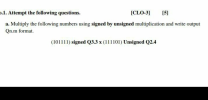 5.1. Attempt the following questions. [CL0-3] [5] a. Multiply the following numbers using signed by unsigned multiplication and write output Qn.m format. (101111) signed Q3.3 x (111101) Unsigned Q2.4
Multiply the following 2 numbers- assume multiply hardware is un available and that you can 4. on...
 Will rate immediately
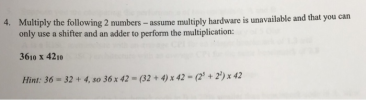
Multiply the following 2 numbers- assume multiply hardware is un available and that you can 4. only use a shifter and an adder to perform the multiplication: 3610 x 4210 Hint: 36 32+ 4, so 36x 42-(324) x 42 (2) x 42
Multiply the following 2 numbers- assume multiply hardware is un available and that you can 4. only use a shifter and an adder to perform the multiplication: 3610 x 4210 Hint: 36 32+ 4, so...
Will rate immediately
Multiply the following 2 numbers- assume multiply hardware is un available and that you can 4. only use a shifter and an adder to perform the multiplication: 3610 x 4210 Hint: 36 32+ 4, so 36x 42-(324) x 42 (2) x 42
Multiply the following 2 numbers- assume multiply hardware is un available and that you can 4. only use a shifter and an adder to perform the multiplication: 3610 x 4210 Hint: 36 32+ 4, so...
 Consider the following 8-bit multiplication problem: 0110 1100 x
0011 1001
For count the number of additions (and/or subtractions) for the
basic binary multiplication show in figure 10.9 and for Booth's
algorithm shown in figure 10.12. What is the 16 bit product?
START C,A-0 M-Multiplicand Multiplier Count- Flowchart for Unsigned Binary Multiplication No C,A-A+M Shift right C,A, Q Count Count- No Yes_ END Product in A,Q Figure 10.9 Flowchart for Unsigned Binary Multiplication
Consider the following 8-bit multiplication problem: 0110 1100 x
0011 1001
For count the number of additions (and/or subtractions) for the
basic binary multiplication show in figure 10.9 and for Booth's
algorithm shown in figure 10.12. What is the 16 bit product?
START C,A-0 M-Multiplicand Multiplier Count- Flowchart for Unsigned Binary Multiplication No C,A-A+M Shift right C,A, Q Count Count- No Yes_ END Product in A,Q Figure 10.9 Flowchart for Unsigned Binary Multiplication
 a. Multiply the following numbers using signed by unsigned multiplication and write output On.m format (101111) signed Q3.3 x (111101) Unsigned Q2.4
 Solve using loops in MATLAB provide screenshots
id. Matrix Multiplication Matrix Multiplication of an M x P matrix (A) with a P x N matrix (B) yields an M x N matrix (C) with the Matlab command: C=A*B Replicate this result by using three nested loops. Your code should work for any compatible matrices A, B.
Solve using loops in MATLAB provide screenshots
id. Matrix Multiplication Matrix Multiplication of an M x P matrix (A) with a P x N matrix (B) yields an M x N matrix (C) with the Matlab command: C=A*B Replicate this result by using three nested loops. Your code should work for any compatible matrices A, B.
 5.1. Attempt the following questions. [CL0-3] [5] a. Multiply the following numbers using signed by unsigned multiplication and write output Qn.m format. (101111) signed Q3.3 x (111101) Unsigned Q2.4
 Will rate immediately
Multiply the following 2 numbers- assume multiply hardware is un available and that you can 4. only use a shifter and an adder to perform the multiplication: 3610 x 4210 Hint: 36 32+ 4, so 36x 42-(324) x 42 (2) x 42
Multiply the following 2 numbers- assume multiply hardware is un available and that you can 4. only use a shifter and an adder to perform the multiplication: 3610 x 4210 Hint: 36 32+ 4, so...
Will rate immediately
Multiply the following 2 numbers- assume multiply hardware is un available and that you can 4. only use a shifter and an adder to perform the multiplication: 3610 x 4210 Hint: 36 32+ 4, so 36x 42-(324) x 42 (2) x 42
Multiply the following 2 numbers- assume multiply hardware is un available and that you can 4. only use a shifter and an adder to perform the multiplication: 3610 x 4210 Hint: 36 32+ 4, so...
Most questions answered within 3 hours.
-
Where is the error in this code sequence?
String s1 = "Hello";
String s2 = "ello";...
asked 10 months ago -
Financial data for Joel de Paris, Inc., for last year
follow:
Joel de Paris, Inc.
Balance...
asked 10 months ago -
Consider this reaction:
Al2(SO4)3 (aq)+ BaCl3
(aq) Al2Cl6 (aq)- +
3BaSO4(s) . What is the...
asked 10 months ago -
Suppose that Savneet is considering increasing her
recent random sample from 20 car rentals to 40...
asked 10 months ago -
Trucks arrive at an unloading terminal at an average rate of 120
per hour.
Trucks arrive...
asked 10 months ago -
Why are methanol and ethanol completely soluble in water while
octanol is not very little soluble....
asked 10 months ago -
A facilities manager at a university reads in a research report
that the mean amount of...
asked 10 months ago -
When the CuSO4 is rehydrated by adding water to the anhydrous
compound, is this an endothermic...
asked 10 months ago -
A ray of sunlight is passing from diamond into crown glass; the
angle of incidence is...
asked 10 months ago -
A block of mass 0.249 kg is placed on top of a light, vertical
spring of...
asked 10 months ago -
how do the kidneys compensate in the presences of acidosis
a) trigger hyperventilate
b) reserve acid...
asked 10 months ago -
Question 501 pts
The rental rate of capital to the firm increases. Which of the
following...
asked 10 months ago