Why is Stoke's law applicable at low Reynolds number but not at high Reynolds numbers?
Why is Stoke's law applicable at low Reynolds number but not at high Reynolds numbers?
Homework Answers
Stokes's law is applicable at low Reynold's number because it is derived from Navier Stokes's law with assumptions that in the flow viscous force dominates and tiny particles follow the streamline of such creeping flow flow but when the flow because turbulent at high Reynold's number then flow becomes chaotic and in that case inertial force starts dominating an particles moves in random motion and so we cannot apply Stoke's law to such flow.
Add Answer to:
Why is Stoke's law applicable at low Reynolds number but not at
high Reynolds numbers?
Laws and Numbers Reynolds Number, Re Mach Number, M Knudsen Number, Kn Torricelli's Law Archimedes' Principle
 Laws and Numbers Reynolds Number, Re Mach Number, M Knudsen Number, Kn Torricelli's Law Archimedes' Principle
Question 2 2A. Define Reynolds number. 2B. What is the range of Reynolds number where the...
 Question 2 2A. Define Reynolds number. 2B. What is the range of Reynolds number where the Darcy's Law is applicable? 2C. How should you ensure you are in the valid range of Reynolds number to apply the Darcy's Law correctly? 2D. Consider a porous medium with the following rock properties • Porosity, Ø = 20% • Permeability, k = 200 mD The fluid being injected into the medium at a Darcian velocity, u = 5 cm/s, has the following properties...
The aerodynamic drag acting on a cylinder at a very low Reynolds number (Stokes flow or...
 The aerodynamic drag acting on a cylinder at a very low Reynolds number (Stokes flow or creeping motion) is a function of dynamic viscosity of fluid (u), diameter of cylinder (D) and freestream velocity (U). Find a non-dimensional parameter using dimensional analysis.
The aerodynamic drag acting on a cylinder at a very low Reynolds number (Stokes flow or...
 The aerodynamic drag acting on a cylinder at a very low Reynolds number (Stokes flow or creeping motion) is a function of dynamic viscosity of fluid (u), diameter of cylinder (D) and freestream velocity (U). Find a non-dimensional parameter using dimensional analysis.
The aerodynamic drag acting on a cylinder at a very low Reynolds number (Stokes flow or...
The aerodynamic drag acting on a cylinder at a very low Reynolds number (Stokes flow or creeping motion) is a function of dynamic viscosity of fluid (µ), diameter of cylinder (D) and freestream velocity (U). Find a non-dimensional parameter using dimensional analysis.
Problem #3 At very low Reynolds numbers a ball viscometer can be used to measure fluid...
 Problem #3 At very low Reynolds numbers a ball viscometer can be used to measure fluid viscosity by dropping a spherical ball in the fluid and measuring its terminal velocity. Consider a solid ball of radius a = 1cm and density Ps = 2,500 kg/m falling in liquid glycerin with density P = 1,250 kg/m3. The measured terminal velocity of the ball is U = 0.15 m/s. Calculate the viscosity of the liquid.
6.1 (A) Stokes's flow (low-Reynolds-number incompress- ible flow) over a sphere has velocity components Compute all...
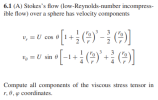 6.1 (A) Stokes's flow (low-Reynolds-number incompress- ible flow) over a sphere has velocity components Compute all components of the viscous stress tensor in r, coordinates.
6a. The aerodynamic drag acting on a cylinder at a very low Reynolds number (Stokes flow...
 6a. The aerodynamic drag acting on a cylinder at a very low Reynolds number (Stokes flow or creeping motion) is a function of dynamic viscosity of fluid (u), diameter of cylinder (D) and freestream velocity (U). Find a non-dimensional parameter using dimensional analysis. 6b. A model test is to be conducted in a water tunnel using a 1: 20 model of a submarine, which is to travel at a speed of 12 km/h deep under sea surface. The water temperature...
85. Show that the Reynolds number is unitless by substituting units for all the quantities in...
 85. Show that the Reynolds number is unitless by substituting units for all the quantities in its definition and cancelling. 86. Calculate the Reynolds numbers for the flow of water through (a) a nozzle with a radius of 0.250 cm and (b) a garden hose with a radius of 0.900 cm, when the nozzle is attached to the hose. The flow rate through hose and nozzle is 0.500 L/s. Can the flow in either possibly be laminar?
please show all work The aerodynamic drag acting on a cylinder at a very low Reynolds...
 please show all work
The aerodynamic drag acting on a cylinder at a very low Reynolds number (Stokes flow or creeping motion) is a function of dynamic viscosity of fluid (u), diameter of cylinder (D) and freestream velocity (U). Find a non-dimensional parameter using dimensional analysis.
please show all work
The aerodynamic drag acting on a cylinder at a very low Reynolds number (Stokes flow or creeping motion) is a function of dynamic viscosity of fluid (u), diameter of cylinder (D) and freestream velocity (U). Find a non-dimensional parameter using dimensional analysis.
 Laws and Numbers Reynolds Number, Re Mach Number, M Knudsen Number, Kn Torricelli's Law Archimedes' Principle
 Question 2 2A. Define Reynolds number. 2B. What is the range of Reynolds number where the Darcy's Law is applicable? 2C. How should you ensure you are in the valid range of Reynolds number to apply the Darcy's Law correctly? 2D. Consider a porous medium with the following rock properties • Porosity, Ø = 20% • Permeability, k = 200 mD The fluid being injected into the medium at a Darcian velocity, u = 5 cm/s, has the following properties...
 The aerodynamic drag acting on a cylinder at a very low Reynolds number (Stokes flow or creeping motion) is a function of dynamic viscosity of fluid (u), diameter of cylinder (D) and freestream velocity (U). Find a non-dimensional parameter using dimensional analysis.
 The aerodynamic drag acting on a cylinder at a very low Reynolds number (Stokes flow or creeping motion) is a function of dynamic viscosity of fluid (u), diameter of cylinder (D) and freestream velocity (U). Find a non-dimensional parameter using dimensional analysis.
 Problem #3 At very low Reynolds numbers a ball viscometer can be used to measure fluid viscosity by dropping a spherical ball in the fluid and measuring its terminal velocity. Consider a solid ball of radius a = 1cm and density Ps = 2,500 kg/m falling in liquid glycerin with density P = 1,250 kg/m3. The measured terminal velocity of the ball is U = 0.15 m/s. Calculate the viscosity of the liquid.
 6.1 (A) Stokes's flow (low-Reynolds-number incompress- ible flow) over a sphere has velocity components Compute all components of the viscous stress tensor in r, coordinates.
 6a. The aerodynamic drag acting on a cylinder at a very low Reynolds number (Stokes flow or creeping motion) is a function of dynamic viscosity of fluid (u), diameter of cylinder (D) and freestream velocity (U). Find a non-dimensional parameter using dimensional analysis. 6b. A model test is to be conducted in a water tunnel using a 1: 20 model of a submarine, which is to travel at a speed of 12 km/h deep under sea surface. The water temperature...
 85. Show that the Reynolds number is unitless by substituting units for all the quantities in its definition and cancelling. 86. Calculate the Reynolds numbers for the flow of water through (a) a nozzle with a radius of 0.250 cm and (b) a garden hose with a radius of 0.900 cm, when the nozzle is attached to the hose. The flow rate through hose and nozzle is 0.500 L/s. Can the flow in either possibly be laminar?
 please show all work
The aerodynamic drag acting on a cylinder at a very low Reynolds number (Stokes flow or creeping motion) is a function of dynamic viscosity of fluid (u), diameter of cylinder (D) and freestream velocity (U). Find a non-dimensional parameter using dimensional analysis.
please show all work
The aerodynamic drag acting on a cylinder at a very low Reynolds number (Stokes flow or creeping motion) is a function of dynamic viscosity of fluid (u), diameter of cylinder (D) and freestream velocity (U). Find a non-dimensional parameter using dimensional analysis.
Most questions answered within 3 hours.
-
Where is the error in this code sequence?
String s1 = "Hello";
String s2 = "ello";...
asked 10 months ago -
Financial data for Joel de Paris, Inc., for last year
follow:
Joel de Paris, Inc.
Balance...
asked 10 months ago -
Consider this reaction:
Al2(SO4)3 (aq)+ BaCl3
(aq) Al2Cl6 (aq)- +
3BaSO4(s) . What is the...
asked 10 months ago -
Suppose that Savneet is considering increasing her
recent random sample from 20 car rentals to 40...
asked 10 months ago -
Trucks arrive at an unloading terminal at an average rate of 120
per hour.
Trucks arrive...
asked 10 months ago -
Why are methanol and ethanol completely soluble in water while
octanol is not very little soluble....
asked 10 months ago -
A facilities manager at a university reads in a research report
that the mean amount of...
asked 10 months ago -
When the CuSO4 is rehydrated by adding water to the anhydrous
compound, is this an endothermic...
asked 10 months ago -
A ray of sunlight is passing from diamond into crown glass; the
angle of incidence is...
asked 10 months ago -
A block of mass 0.249 kg is placed on top of a light, vertical
spring of...
asked 10 months ago -
how do the kidneys compensate in the presences of acidosis
a) trigger hyperventilate
b) reserve acid...
asked 10 months ago -
Question 501 pts
The rental rate of capital to the firm increases. Which of the
following...
asked 10 months ago