A battleship has a gun that fires shells with muzzle velocity u, and the gunner wants...
A battleship has a gun that fires shells with muzzle velocity u, and the gunner wants to hit an enemy ship at range L. The gun is to be fired at some angle θ above the horizontal. Find the two possible values of θ that are possible under normal conditions. Under what conditions are there one solution or no solutions at all? To what extent is the form of the solution determined by units?
Homework Answers
If bullet will hit for any angle theta obtained by the relation
shown in picture then bullet will also hit for the angle 90-theta .
And for the angle 90 degree there will no possibility to hit the
enemy ship by bullet.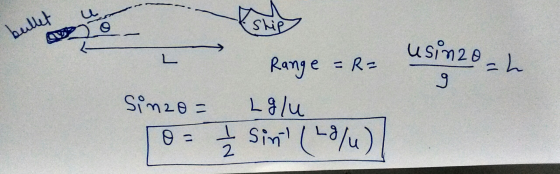
Add Answer to:
A battleship has a gun that fires shells with muzzle velocity
u, and the gunner wants...
A battleship simultaneously fires two shells toward two identical enemy ships. One shell hits ship A,...
A battleship simultaneously fires two shells toward two identical enemy ships. One shell hits ship A, which is close by, and the other hits ship B, which is farther away. The two shells are fired at the same speed. Assume that air resistance is negligible and that the magnitude of the acceleration due to gravity is g. * What shape is the trajectory (graph of y vs. x) of the shells? a.straight line b.parabola c.hyperbola d. The shape cannot be...
A cannon fires a cannonball with muzzle velocity vo (muzzle velocity is the velocity at which...
 A cannon fires a cannonball with muzzle velocity vo (muzzle velocity is the velocity at which the projectile leaves the cannon). The maximum range of the cannon is 17.6 km (a) What is the muzzle velocity v? (b) A target is a horizontal distance of 5.50 km away fronm the cannon-The cannon can hit this target by firing at two different angles, a low angle 6, and a high angle 0. Calculate these two angles. (c) Find the times, t...
A cannon fires a cannonball with muzzle velocity vo (muzzle velocity is the velocity at which...
 A cannon fires a cannonball with muzzle velocity vo (muzzle velocity is the velocity at which the projectile leaves the cannon). The maximum range of the cannon is 17.6 km (a) What is the muzzle velocity v? (b) A target is a horizontal distance of 5.50 km away fronm the cannon-The cannon can hit this target by firing at two different angles, a low angle 6, and a high angle 0. Calculate these two angles. (c) Find the times, t...
The shells fired from an artillery piece have a muzzle speed of 195 m/s, and the...
The shells fired from an artillery piece have a muzzle speed of 195 m/s, and the target is at a horizontal distance of 2.00 km. Two possible angles can be used to hit the target. Find the smallest angle relative to the horizontal at which the gun should be aimed? (Hint: sin2θ = 2sinθcosθ)
A warship has a gun that fires a projectile at an initial speed of 400 m/s....
A warship has a gun that fires a projectile at an initial speed of 400 m/s. It fires at an enemy ship that is 10.0 km away. At what angle from the horizontal should the gun be fired in order to hit the enemy, assuming that the enemy’s location does not change? (Hint: you can write two equations involving time, one for the horizontal motion, and one for the vertical motion. Solve one equation for time and substitute into the...
A modern 5-inch 62-calibre naval gun can fire a 32 kg shell at a muzzle velocity...
A modern 5-inch 62-calibre naval gun can fire a 32 kg shell at a muzzle velocity of 800 m/s to a range of 37 km at 20 rounds/min. Suppose such a gun fires a projectile eastward at a nearly horizontal trajectory to a target 12 km away. The ship is at 60° geographic latitude. Find the deflection of the projectile due to the Coriolis force in both the northern and southern hemispheres (ignore air resistance).
9.28« Use the result (9,73) of Problem 9.26 to do the following: A naval gun shoots...
 9.28« Use the result (9,73) of Problem 9.26 to do the following: A naval gun shoots a shell at colatitude θ in a direction that is α above the horizontal and due east, with muzzle speed u . (a) Ignoring the earth's rotation (and air resistance), find how long (t) the shell would be in the air and how far away (R) it would land. If v 500 m/s anda 20°, what are t and R? (b) A naval gunner...
You have an internship working for the National Park Service. They start you off in the laborator...
 You have an internship working for the National Park Service. They start you off in the laboratory which tests possible new equipment. Your first job is to test a small cannon used to prevent avalanches in populated areas by shooting down the velocity of the projectile as it leaves the cannon (muzzle speed) so that the range and trajectory of the cannon can be determined. heavy snow concentrations. You want to find out Lab, Initial Lab, Final The cannon you...
 A cannon fires a cannonball with muzzle velocity vo (muzzle velocity is the velocity at which the projectile leaves the cannon). The maximum range of the cannon is 17.6 km (a) What is the muzzle velocity v? (b) A target is a horizontal distance of 5.50 km away fronm the cannon-The cannon can hit this target by firing at two different angles, a low angle 6, and a high angle 0. Calculate these two angles. (c) Find the times, t...
 A cannon fires a cannonball with muzzle velocity vo (muzzle velocity is the velocity at which the projectile leaves the cannon). The maximum range of the cannon is 17.6 km (a) What is the muzzle velocity v? (b) A target is a horizontal distance of 5.50 km away fronm the cannon-The cannon can hit this target by firing at two different angles, a low angle 6, and a high angle 0. Calculate these two angles. (c) Find the times, t...
 9.28« Use the result (9,73) of Problem 9.26 to do the following: A naval gun shoots a shell at colatitude θ in a direction that is α above the horizontal and due east, with muzzle speed u . (a) Ignoring the earth's rotation (and air resistance), find how long (t) the shell would be in the air and how far away (R) it would land. If v 500 m/s anda 20°, what are t and R? (b) A naval gunner...
 You have an internship working for the National Park Service. They start you off in the laboratory which tests possible new equipment. Your first job is to test a small cannon used to prevent avalanches in populated areas by shooting down the velocity of the projectile as it leaves the cannon (muzzle speed) so that the range and trajectory of the cannon can be determined. heavy snow concentrations. You want to find out Lab, Initial Lab, Final The cannon you...
Most questions answered within 3 hours.
-
Where is the error in this code sequence?
String s1 = "Hello";
String s2 = "ello";...
asked 10 months ago -
Financial data for Joel de Paris, Inc., for last year
follow:
Joel de Paris, Inc.
Balance...
asked 10 months ago -
Consider this reaction:
Al2(SO4)3 (aq)+ BaCl3
(aq) Al2Cl6 (aq)- +
3BaSO4(s) . What is the...
asked 10 months ago -
Suppose that Savneet is considering increasing her
recent random sample from 20 car rentals to 40...
asked 10 months ago -
Trucks arrive at an unloading terminal at an average rate of 120
per hour.
Trucks arrive...
asked 10 months ago -
Why are methanol and ethanol completely soluble in water while
octanol is not very little soluble....
asked 10 months ago -
A facilities manager at a university reads in a research report
that the mean amount of...
asked 10 months ago -
When the CuSO4 is rehydrated by adding water to the anhydrous
compound, is this an endothermic...
asked 10 months ago -
A ray of sunlight is passing from diamond into crown glass; the
angle of incidence is...
asked 10 months ago -
A block of mass 0.249 kg is placed on top of a light, vertical
spring of...
asked 10 months ago -
how do the kidneys compensate in the presences of acidosis
a) trigger hyperventilate
b) reserve acid...
asked 10 months ago -
Question 501 pts
The rental rate of capital to the firm increases. Which of the
following...
asked 10 months ago