explain why acetic acid is unlikely to be a contaminant in your solid aspirin
Homework Answers

Add Answer to:
explain why acetic acid is unlikely to be a contaminant in your
solid aspirin
H3PO4 OH + OH OH salicylic acid acetic anhydride acetic acid acetylsalicylic acid (aspirin) 1. Why...
 H3PO4 OH + OH OH salicylic acid acetic anhydride acetic acid acetylsalicylic acid (aspirin) 1. Why is it better to perform acetylation with acetic anhydride rather than using a Fischer esterification with acetic acid? 2. Draw a complete arrow-pushing mechanism for the reaction. 3. When an old sample of aspirin is left in moist conditions, it will begin to smell like vinegar. Draw a reaction scheme and briefly explain what happened.
Why? K_a for acetic acid, CH_3COOH, is 1.80 times l0^-5. K_a for acetylsalicylic acid (aspirin), HC_9H_7O_4,...
 Why?
K_a for acetic acid, CH_3COOH, is 1.80 times l0^-5. K_a for acetylsalicylic acid (aspirin), HC_9H_7O_4, is 3.00 times l0^-4. K_a for formic acid, HCOOH, is 1.80 times l0-4. What is the formula for the strongest conjugate base?
Why?
K_a for acetic acid, CH_3COOH, is 1.80 times l0^-5. K_a for acetylsalicylic acid (aspirin), HC_9H_7O_4, is 3.00 times l0^-4. K_a for formic acid, HCOOH, is 1.80 times l0-4. What is the formula for the strongest conjugate base?
Aspirin can be synthesized in the lab by combining salicylic acid (C7H6O3) and acetic anhydride (C4H6O3)...
Aspirin can be synthesized in the lab by combining salicylic acid (C7H6O3) and acetic anhydride (C4H6O3) to form aspirin (C9H8O4) and acetic acid (C2H4O2).C2H4O2). The balanced equation for this reaction is C7H6O3+C4H6O3⟶C9H8O4+C2H4O2 A student started with 4.00 mL acetic anhydride (density=1.08 g/mL) and 2.07 g salicylic acid. The student synthesized 2.00 g of aspirin. Select the limiting reactant. acetic acid (C2H4O2) salicylic acid (C7H6O3) aspirin (C9H8O4) acetic anhydride (C4H6O3) Calculate the theoretical yield of aspirin (C9H8O4). theoretical yield: Calculate the...
Aspirin can be made by reacting acetic anhydride (C4H6O3) with salicylic acid (C7H6O3) to form aspirin...
Aspirin can be made by reacting acetic anhydride (C4H6O3) with salicylic acid (C7H6O3) to form aspirin (C9H8O4). C4H6O3 + C7H6O3 --> C2H4O2 + C9H8O4 When synthesizing aspirin, a student began with 3.05 mL of acetic anhydride (density = 1.08 g/mL) and 1.85 g of salicylic acid. The reaction was allowed to run its course and 1.84 grams of aspirin was collected by the student. Determine the limiting reactant, theoretical yield of aspirin, and percent yield for the reaction.
Aspirin can be sunthesized in the lab by combining salicylic acid (C7H6O3) and acetic anhydride (C4H6O3)...
Aspirin can be sunthesized in the lab by combining salicylic acid (C7H6O3) and acetic anhydride (C4H6O3) to form aspirin (C9H8O4) and acetic acid (C2H4O2). The balanced equation for this reaction is C7H6O3+C4H6O3⟶C9H8O4+C2H4O2 A student started with 4.45 mL acetic anhydride (density=1.08 g/mL) and 2.34 g salicylic acid. The student synthesized 2.47 g of aspirin. Calculate the theoretical yield of aspirin (C9H8O4) in grams Calculate the percent yield for aspirin (C9H8O4)
What are the starting materials for the experiment? a- Salicylic acid b-Acetic anhydride C-Acetic acid d-Aspirin...
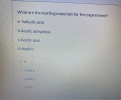 What are the starting materials for the experiment? a- Salicylic acid b-Acetic anhydride C-Acetic acid d-Aspirin o cand d a and b band
Aspirin can be made in the laboratory by reacting acetic anhydride (C4H6O3) with salicylic acid (C7H6O3)...
Aspirin can be made in the laboratory by reacting acetic anhydride (C4H6O3) with salicylic acid (C7H6O3) to form aspirin (C9H8O4) and acetic acid (C2H4O2). The balanced equation is C4H6O3+C7H6O3→C9H8O4+C2H4O2.In a laboratory synthesis, a student begins with 2.90 mL of acetic anhydride (density=1.08g/ml) and 1.26 g of salicylic acid. Once the reaction is complete, the student collects 1.22 g of aspirin. Determine the theoretical yield of aspirin for the reaction. Determine the percent yield of aspirin for the reaction.
Aspirin can be made in the laboratory by reacting acetic anhydride (C4H6O3) with salicylic acid (C7H6O3)...
Aspirin can be made in the laboratory by reacting acetic anhydride (C4H6O3) with salicylic acid (C7H6O3) to form aspirin (C9H8O4) and acetic acid (C2H4O2). The balanced equation is C4H6O3+C7H6O3→C9H8O4+C2H4O2 In a laboratory synthesis, a student begins with 3.10 mL of acetic anhydride (density=1.08g/ml) and 1.24 g of salicylic acid. Once the reaction is complete, the student collects 1.21 g of aspirin. Determine the theoretical yield of aspirin for the reaction. And determine the percent yield of aspirin for the reaction.
Lab Section Nume Preparation and Examination of a Drug: Aspirin EXPERIMENT 25 OBSERVATIONS AND RESULTS 1....
 Lab Section Nume Preparation and Examination of a Drug: Aspirin EXPERIMENT 25 OBSERVATIONS AND RESULTS 1. The Synthesis of Aspirin Record the weight of your aspirin, and calculate the percentage yield. Base the yield on salicylic acid since we acetic anhydride was used. Show all calculations. Weight of aspirin d. 08035 Yield of aspirin 2. Contaminants in Aspirin What was the color of the salicylic acid-ferric chloride test solution? On the basis of color is either your aspirin or commercial...
Aspirin (acetylsalicylic acid) may be formed from salicylic acid and acetic acid as follows: 13a How...
Aspirin (acetylsalicylic acid) may be formed from salicylic acid and acetic acid as follows: 13a How many g of aspirin may be produced from 6.94 × 10² mol salicylic acid
 H3PO4 OH + OH OH salicylic acid acetic anhydride acetic acid acetylsalicylic acid (aspirin) 1. Why is it better to perform acetylation with acetic anhydride rather than using a Fischer esterification with acetic acid? 2. Draw a complete arrow-pushing mechanism for the reaction. 3. When an old sample of aspirin is left in moist conditions, it will begin to smell like vinegar. Draw a reaction scheme and briefly explain what happened.
 Why?
K_a for acetic acid, CH_3COOH, is 1.80 times l0^-5. K_a for acetylsalicylic acid (aspirin), HC_9H_7O_4, is 3.00 times l0^-4. K_a for formic acid, HCOOH, is 1.80 times l0-4. What is the formula for the strongest conjugate base?
Why?
K_a for acetic acid, CH_3COOH, is 1.80 times l0^-5. K_a for acetylsalicylic acid (aspirin), HC_9H_7O_4, is 3.00 times l0^-4. K_a for formic acid, HCOOH, is 1.80 times l0-4. What is the formula for the strongest conjugate base?
 What are the starting materials for the experiment? a- Salicylic acid b-Acetic anhydride C-Acetic acid d-Aspirin o cand d a and b band
 Lab Section Nume Preparation and Examination of a Drug: Aspirin EXPERIMENT 25 OBSERVATIONS AND RESULTS 1. The Synthesis of Aspirin Record the weight of your aspirin, and calculate the percentage yield. Base the yield on salicylic acid since we acetic anhydride was used. Show all calculations. Weight of aspirin d. 08035 Yield of aspirin 2. Contaminants in Aspirin What was the color of the salicylic acid-ferric chloride test solution? On the basis of color is either your aspirin or commercial...
Most questions answered within 3 hours.
-
Where is the error in this code sequence?
String s1 = "Hello";
String s2 = "ello";...
asked 10 months ago -
Financial data for Joel de Paris, Inc., for last year
follow:
Joel de Paris, Inc.
Balance...
asked 10 months ago -
Consider this reaction:
Al2(SO4)3 (aq)+ BaCl3
(aq) Al2Cl6 (aq)- +
3BaSO4(s) . What is the...
asked 10 months ago -
Suppose that Savneet is considering increasing her
recent random sample from 20 car rentals to 40...
asked 10 months ago -
Trucks arrive at an unloading terminal at an average rate of 120
per hour.
Trucks arrive...
asked 10 months ago -
Why are methanol and ethanol completely soluble in water while
octanol is not very little soluble....
asked 10 months ago -
A facilities manager at a university reads in a research report
that the mean amount of...
asked 10 months ago -
When the CuSO4 is rehydrated by adding water to the anhydrous
compound, is this an endothermic...
asked 10 months ago -
A ray of sunlight is passing from diamond into crown glass; the
angle of incidence is...
asked 10 months ago -
A block of mass 0.249 kg is placed on top of a light, vertical
spring of...
asked 10 months ago -
how do the kidneys compensate in the presences of acidosis
a) trigger hyperventilate
b) reserve acid...
asked 10 months ago -
Question 501 pts
The rental rate of capital to the firm increases. Which of the
following...
asked 10 months ago