cellulose is produced through the formation of beta 1,4 linkahes between glucose molecules . this is...
Homework Answers
Dehydration
cellulose is produced through formation of beta 1,4 linkages between glucose molecules
Add Answer to:
cellulose is produced through the formation of beta 1,4 linkahes
between glucose molecules . this is...
How many molecules of FADH_2 are produced by the complete catabolism of one molecule of glucose?...
 How many molecules of FADH_2 are produced by the complete catabolism of one molecule of glucose? 1 2 4 8 16 The majority of ATP produced during the catabolism of glucose is formed during? oxidative phosphorylation glycolysis the citric acid cycle lipogenesis acetly-CoA formation
Draw the following monosaccharides in the chain form (not ring form): Write the chemical formula for...
 Draw the following monosaccharides in the chain form (not ring form): Write the chemical formula for both glucose and fructose: What molecular similarities, in structure, are there between the glucose and fructose molecules? What are the differences? What are these two molecules called in relation to one another? , Draw the formation of a-glucose and a P-glucose starting from the chain form using your book (page 73) as a guide, (use chemical symbols) alpha-glucose beta-glucose In equation format, draw formation...
Her er stor How many FADH2 molecules are produced through complete beta oxidation of a 14...
 Her er stor How many FADH2 molecules are produced through complete beta oxidation of a 14 carbon fatty acid? releases and restore through complete bere O 6 O O O
Question 31 Amylopectin is a form of starch which has O only 8-1,4-bonds between glucose units...
 Question 31 Amylopectin is a form of starch which has O only 8-1,4-bonds between glucose units only a-1,4-links bonds glucose units both a-1,4-and a-1,6-bonds between glucose units hemiacetal links joining glucose units carbon-carbon bonds joining glucose units
Draw the following molecules (two dimensional representations; stereochemical view not required): Three glucose (Haworth projection) disaccharides...
Draw the following molecules (two dimensional representations; stereochemical view not required): Three glucose (Haworth projection) disaccharides linked as follows: (i) alpha-1,4-glycosidic bond; (ii) alpha-1,6-glycosidic bond; (iii) beta-1,4-glycosidic bond.
n 6. The glucose molecules in cellulose are linked together by what type of glycosidic bond...
 n 6. The glucose molecules in cellulose are linked together by what type of glycosidic bond (or linkage)? 1. Convert the following D-sugars (shown their chair conformations) into their Haworth formulations & Fischer projections. Н % ОН НО CH2OH но. ОН НО ОН Н Н — НО НО H Haworth МАСА Fischer Н Н HO CH2OH Lo -ОН Н -OH НО НО — H НО он Н Haworth CHCH Fischer
Part A d-Glucose units joined by beta-1,4-glycosidic linkages are not digestible by humans because o humans...
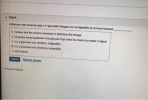 Part A d-Glucose units joined by beta-1,4-glycosidic linkages are not digestible by humans because o humans lack the enzyme necessary to hydrolyze this linkage O all groups being equatorial in the glucose rings make the chains too stable to digest o it is a glycoside and therefore, indigestible . It is unbranched and therefore, Indigestible O all the above Submit Request Answer Provide Feedback
how many G3P molecules is needed for the formation of 1 glucose molecule in the calvin...
how many G3P molecules is needed for the formation of 1 glucose molecule in the calvin cycle? A. 4 B. 3 C. 2 or D. 1
All of the following are true about cellulose EXCEPT: (select all that apply, must have all...
All of the following are true about cellulose EXCEPT: (select all that apply, must have all correct for credit) a) it contains a microfibril structure due to hydrogen bonding between sugar residues in adjacent cellulose chains b) It consists of many glucose units connected by beta (1-6) linkages c) It is the main component of plant cell walls d) It is well fermented by colonic bacteria I think it is just B and D but not sure about the others.
2. Suppose 7 glucose molecules enter glycolysis. Calculate the number of inorganic phosphate molecules required as...
 2. Suppose 7 glucose molecules
enter glycolysis. Calculate the number of inorganic phosphate
molecules required as well as the number of pyruvate molecules
produced.
Pi=
In yeast, ethanol is produced from glucose under anaerobic conditions. A cell-free yeast extract is placed in a solution that contains 2.50 x 10 mmol glucose, 0.35 mmol ADP, 0.35 mmol Pi, 0.70 mmol ATP, 0.20 mmol NAD', and 0.20 mmol NADH. It is kept under anaerobic conditions. What is the maximum amount of ethanol...
2. Suppose 7 glucose molecules
enter glycolysis. Calculate the number of inorganic phosphate
molecules required as well as the number of pyruvate molecules
produced.
Pi=
In yeast, ethanol is produced from glucose under anaerobic conditions. A cell-free yeast extract is placed in a solution that contains 2.50 x 10 mmol glucose, 0.35 mmol ADP, 0.35 mmol Pi, 0.70 mmol ATP, 0.20 mmol NAD', and 0.20 mmol NADH. It is kept under anaerobic conditions. What is the maximum amount of ethanol...
 How many molecules of FADH_2 are produced by the complete catabolism of one molecule of glucose? 1 2 4 8 16 The majority of ATP produced during the catabolism of glucose is formed during? oxidative phosphorylation glycolysis the citric acid cycle lipogenesis acetly-CoA formation
 Draw the following monosaccharides in the chain form (not ring form): Write the chemical formula for both glucose and fructose: What molecular similarities, in structure, are there between the glucose and fructose molecules? What are the differences? What are these two molecules called in relation to one another? , Draw the formation of a-glucose and a P-glucose starting from the chain form using your book (page 73) as a guide, (use chemical symbols) alpha-glucose beta-glucose In equation format, draw formation...
 Her er stor How many FADH2 molecules are produced through complete beta oxidation of a 14 carbon fatty acid? releases and restore through complete bere O 6 O O O
 Question 31 Amylopectin is a form of starch which has O only 8-1,4-bonds between glucose units only a-1,4-links bonds glucose units both a-1,4-and a-1,6-bonds between glucose units hemiacetal links joining glucose units carbon-carbon bonds joining glucose units
 n 6. The glucose molecules in cellulose are linked together by what type of glycosidic bond (or linkage)? 1. Convert the following D-sugars (shown their chair conformations) into their Haworth formulations & Fischer projections. Н % ОН НО CH2OH но. ОН НО ОН Н Н — НО НО H Haworth МАСА Fischer Н Н HO CH2OH Lo -ОН Н -OH НО НО — H НО он Н Haworth CHCH Fischer
 Part A d-Glucose units joined by beta-1,4-glycosidic linkages are not digestible by humans because o humans lack the enzyme necessary to hydrolyze this linkage O all groups being equatorial in the glucose rings make the chains too stable to digest o it is a glycoside and therefore, indigestible . It is unbranched and therefore, Indigestible O all the above Submit Request Answer Provide Feedback
 2. Suppose 7 glucose molecules
enter glycolysis. Calculate the number of inorganic phosphate
molecules required as well as the number of pyruvate molecules
produced.
Pi=
In yeast, ethanol is produced from glucose under anaerobic conditions. A cell-free yeast extract is placed in a solution that contains 2.50 x 10 mmol glucose, 0.35 mmol ADP, 0.35 mmol Pi, 0.70 mmol ATP, 0.20 mmol NAD', and 0.20 mmol NADH. It is kept under anaerobic conditions. What is the maximum amount of ethanol...
2. Suppose 7 glucose molecules
enter glycolysis. Calculate the number of inorganic phosphate
molecules required as well as the number of pyruvate molecules
produced.
Pi=
In yeast, ethanol is produced from glucose under anaerobic conditions. A cell-free yeast extract is placed in a solution that contains 2.50 x 10 mmol glucose, 0.35 mmol ADP, 0.35 mmol Pi, 0.70 mmol ATP, 0.20 mmol NAD', and 0.20 mmol NADH. It is kept under anaerobic conditions. What is the maximum amount of ethanol...
Most questions answered within 3 hours.
-
Where is the error in this code sequence?
String s1 = "Hello";
String s2 = "ello";...
asked 10 months ago -
Financial data for Joel de Paris, Inc., for last year
follow:
Joel de Paris, Inc.
Balance...
asked 10 months ago -
Consider this reaction:
Al2(SO4)3 (aq)+ BaCl3
(aq) Al2Cl6 (aq)- +
3BaSO4(s) . What is the...
asked 10 months ago -
Suppose that Savneet is considering increasing her
recent random sample from 20 car rentals to 40...
asked 10 months ago -
Trucks arrive at an unloading terminal at an average rate of 120
per hour.
Trucks arrive...
asked 10 months ago -
Why are methanol and ethanol completely soluble in water while
octanol is not very little soluble....
asked 10 months ago -
A facilities manager at a university reads in a research report
that the mean amount of...
asked 10 months ago -
When the CuSO4 is rehydrated by adding water to the anhydrous
compound, is this an endothermic...
asked 10 months ago -
A ray of sunlight is passing from diamond into crown glass; the
angle of incidence is...
asked 10 months ago -
A block of mass 0.249 kg is placed on top of a light, vertical
spring of...
asked 10 months ago -
how do the kidneys compensate in the presences of acidosis
a) trigger hyperventilate
b) reserve acid...
asked 10 months ago -
Question 501 pts
The rental rate of capital to the firm increases. Which of the
following...
asked 10 months ago