T or F -- Switching yeast cells from glucose medium to medium without glucose does alter...
T or F -- Switching yeast cells from glucose medium to medium without glucose does alter gene expression.
Homework Answers


Add Answer to:
T or F -- Switching yeast cells from glucose medium to medium
without glucose does alter...
To study the function of the essential cytosolic Hsc70 genes in yeast, researchers constructed a shuttle...
To study the function of the essential cytosolic Hsc70 genes in yeast, researchers constructed a shuttle vector in which a copy of the Hsc70 gene was ligated to the GAL1 promoter. The vector was then introduced into haploid yeast cells in which all four copies of the Hsc70 genes had been disrupted. Following introduction of the vector, you would expect that: the yeast cells would grow on galactose but not glucose medium. the yeast cells would grow on glucose but...
A suspension of yeast cells is being grown under anaerobic conditions such that glucose is degraded...
A suspension of yeast cells is being grown under anaerobic conditions such that glucose is degraded to ethanol and carbon dioxide. Adding an inhibitor of alcohol dehydrogenase to the yeast cell suspension results in rapid cell death. Why? a.) Without alcohol dehydrogenase, the acetaldehyde concentration increases to levels that are toxic to the yeast cells. b.) NADH generated during glycolysis cannot be recycled back to NAD+, thus anaerobic ATP production through glycolysis cannot be maintained. c.) Pyruvate is no longer...
You are conducting a microarray experiment with yeast cells and have labeled the cDNAs generated from...
 You are conducting a microarray experiment with yeast cells and have labeled the cDNAs generated from cells grown under normal condition (N) with a red dye and the cDNAs generated from the same cell line after the cells were subjected to a stress (S) with a green dye. For gene spot 15, you observe that the color was red, what does that mean? A. The number of chromosomes per cell with gene 15 was higher after stress (S) B. The...
(1 point) A culture of yeast grows at a rate proportional to its size. If the initial population is 8000 cells and it doubles after 3 hours, answer the following questions. 1. Write an expression for the number of yeast cells after t hours. Answer: P(t)=
(1 point) A culture of yeast grows at a rate proportional to its size. If the initial population is 80008000 cells and it doubles after 33 hours, answer the following questions.1. Write an expression for the number of yeast cells after tt hours.Answer: P(t)=P(t)= 2. Find the number of yeast cells after 77 hours.Answer: 3. Find the rate at which the population of yeast cells is increasing at 77 hours.Answer (in cells per hour):
Louis Pasteur observed that when oxygen is introduced to cells consuming glucose at a high rate...
 Louis Pasteur observed that when oxygen is introduced to cells consuming glucose at a high rate in an anaerobic environment, fermentation ceases and the rate of glucose consumption decreases. This phenomenon is called the Pasteur effect. The basis of this effect is the shift from fermentation to oxidative phosphorylation to regenerate NAD*. Additionally, the cells also synthesize ATP through oxidative phosphorylation. In respiration-deficient yeast mutants that lack cytochrome oxidase, the Pasteur effect is not seen. Select the reasons why the...
A complex signaling pathway in yeast allows the cells to accumulate high concentrations of glycer...
A complex signaling pathway in yeast allows the cells to accumulate high concentrations of glycerol if they are exposed to high extracellular concentration of salt or glucose. The increased osmolarity of the extracellular medium activates Ras, which in turn activates adenylate cyclase. A second pathway, the HOG (high osmolarity glycerol) pathway activates the MAP kinase pathway. The target protein is the enzyme PFK2, which is activated by phosphorylation. (PFK2 produces an allosteric regulator that activates glycolysis, which ultimately produces glycerol.)...
Two CRISPR experiments (A and B) have been conducted in yeast cells to understand the effect...
 Two CRISPR experiments (A and B) have been conducted in
yeast cells to understand the effect of inducible promoters. The
yeast cells used in both experiments contain 2 plasmids: one
plasmid that has the Cas9 gene and one plasmid that has the CAN1.Y
gRNA sequence. However, the two experiments differ in the promoter
used in one of the plasmid.
The graph below shows the colony count from the
canavanine selection plates (YNB + met + his + canavanine) that use...
Two CRISPR experiments (A and B) have been conducted in
yeast cells to understand the effect of inducible promoters. The
yeast cells used in both experiments contain 2 plasmids: one
plasmid that has the Cas9 gene and one plasmid that has the CAN1.Y
gRNA sequence. However, the two experiments differ in the promoter
used in one of the plasmid.
The graph below shows the colony count from the
canavanine selection plates (YNB + met + his + canavanine) that use...
Like humans, yeast (Saccharomyces cerevisiae) can store sugar in the form of glycogen. Thus when glucose...
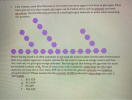 Like humans, yeast (Saccharomyces cerevisiae) can store sugar in the form of glycogen. Thus when glucose is in short supply, glycogen can be broken down and its subunits can enter glycolysis. Use the following picture of a small glycogen molecule to assist when answering this question. Before baking bread it is often customary to pre-soak the yeast in water. In this water environment there is no simple sugar nor complex starches for the yeast to use as an energy source...
During the course of normal human development, the muscle myosin protein becomes expressed in muscle cells...
During the course of normal human development, the muscle myosin protein becomes expressed in muscle cells but not in non-muscle cells, such as liver cells. Based on this information and your knowledge about biology, select true or false for each of the following statements. a) T/F This expression pattern could result from the muscle myosin gene being present in muscle cells but not in liver cells. b) T/F This expression pattern could result from the regulatory sequence of the muscle...
Example The following data was obtained from batch-reactor experiments for the Saccharomyces cerevisiae (yeast) Glu...
 Example The following data was obtained from batch-reactor experiments for the Saccharomyces cerevisiae (yeast) Glucose sells, More cells + Ethanol Cells, Time, Ethanol, Glucose t (hr) C (g/dm3) C, (g/dm3) Gp(8/dm3) 244 1.5 2.14 5,03 231 2.2 3.29 218 8.96 (a) Determine the yield coefficients Ys/c, Yc/s, Ys/p, Ypls, and Yplc. Assume no lag and neglect maintenance at the start of the growth phase when there are just a few cells. (b) Find the rate-law parameters Hmax and Ks.
Example...
Example The following data was obtained from batch-reactor experiments for the Saccharomyces cerevisiae (yeast) Glucose sells, More cells + Ethanol Cells, Time, Ethanol, Glucose t (hr) C (g/dm3) C, (g/dm3) Gp(8/dm3) 244 1.5 2.14 5,03 231 2.2 3.29 218 8.96 (a) Determine the yield coefficients Ys/c, Yc/s, Ys/p, Ypls, and Yplc. Assume no lag and neglect maintenance at the start of the growth phase when there are just a few cells. (b) Find the rate-law parameters Hmax and Ks.
Example...
 You are conducting a microarray experiment with yeast cells and have labeled the cDNAs generated from cells grown under normal condition (N) with a red dye and the cDNAs generated from the same cell line after the cells were subjected to a stress (S) with a green dye. For gene spot 15, you observe that the color was red, what does that mean? A. The number of chromosomes per cell with gene 15 was higher after stress (S) B. The...
 Louis Pasteur observed that when oxygen is introduced to cells consuming glucose at a high rate in an anaerobic environment, fermentation ceases and the rate of glucose consumption decreases. This phenomenon is called the Pasteur effect. The basis of this effect is the shift from fermentation to oxidative phosphorylation to regenerate NAD*. Additionally, the cells also synthesize ATP through oxidative phosphorylation. In respiration-deficient yeast mutants that lack cytochrome oxidase, the Pasteur effect is not seen. Select the reasons why the...
 Two CRISPR experiments (A and B) have been conducted in
yeast cells to understand the effect of inducible promoters. The
yeast cells used in both experiments contain 2 plasmids: one
plasmid that has the Cas9 gene and one plasmid that has the CAN1.Y
gRNA sequence. However, the two experiments differ in the promoter
used in one of the plasmid.
The graph below shows the colony count from the
canavanine selection plates (YNB + met + his + canavanine) that use...
Two CRISPR experiments (A and B) have been conducted in
yeast cells to understand the effect of inducible promoters. The
yeast cells used in both experiments contain 2 plasmids: one
plasmid that has the Cas9 gene and one plasmid that has the CAN1.Y
gRNA sequence. However, the two experiments differ in the promoter
used in one of the plasmid.
The graph below shows the colony count from the
canavanine selection plates (YNB + met + his + canavanine) that use...
 Like humans, yeast (Saccharomyces cerevisiae) can store sugar in the form of glycogen. Thus when glucose is in short supply, glycogen can be broken down and its subunits can enter glycolysis. Use the following picture of a small glycogen molecule to assist when answering this question. Before baking bread it is often customary to pre-soak the yeast in water. In this water environment there is no simple sugar nor complex starches for the yeast to use as an energy source...
 Example The following data was obtained from batch-reactor experiments for the Saccharomyces cerevisiae (yeast) Glucose sells, More cells + Ethanol Cells, Time, Ethanol, Glucose t (hr) C (g/dm3) C, (g/dm3) Gp(8/dm3) 244 1.5 2.14 5,03 231 2.2 3.29 218 8.96 (a) Determine the yield coefficients Ys/c, Yc/s, Ys/p, Ypls, and Yplc. Assume no lag and neglect maintenance at the start of the growth phase when there are just a few cells. (b) Find the rate-law parameters Hmax and Ks.
Example...
Example The following data was obtained from batch-reactor experiments for the Saccharomyces cerevisiae (yeast) Glucose sells, More cells + Ethanol Cells, Time, Ethanol, Glucose t (hr) C (g/dm3) C, (g/dm3) Gp(8/dm3) 244 1.5 2.14 5,03 231 2.2 3.29 218 8.96 (a) Determine the yield coefficients Ys/c, Yc/s, Ys/p, Ypls, and Yplc. Assume no lag and neglect maintenance at the start of the growth phase when there are just a few cells. (b) Find the rate-law parameters Hmax and Ks.
Example...
Most questions answered within 3 hours.
-
Where is the error in this code sequence?
String s1 = "Hello";
String s2 = "ello";...
asked 11 months ago -
Financial data for Joel de Paris, Inc., for last year
follow:
Joel de Paris, Inc.
Balance...
asked 11 months ago -
Consider this reaction:
Al2(SO4)3 (aq)+ BaCl3
(aq) Al2Cl6 (aq)- +
3BaSO4(s) . What is the...
asked 11 months ago -
Suppose that Savneet is considering increasing her
recent random sample from 20 car rentals to 40...
asked 11 months ago -
Trucks arrive at an unloading terminal at an average rate of 120
per hour.
Trucks arrive...
asked 11 months ago -
Why are methanol and ethanol completely soluble in water while
octanol is not very little soluble....
asked 11 months ago -
A facilities manager at a university reads in a research report
that the mean amount of...
asked 11 months ago -
When the CuSO4 is rehydrated by adding water to the anhydrous
compound, is this an endothermic...
asked 11 months ago -
A ray of sunlight is passing from diamond into crown glass; the
angle of incidence is...
asked 11 months ago -
A block of mass 0.249 kg is placed on top of a light, vertical
spring of...
asked 11 months ago -
how do the kidneys compensate in the presences of acidosis
a) trigger hyperventilate
b) reserve acid...
asked 11 months ago -
Question 501 pts
The rental rate of capital to the firm increases. Which of the
following...
asked 11 months ago