Compare the following 2 alternatives using the Net Present Worth (NPW) method – rate is 4.5%...
Compare the following 2 alternatives using the Net Present Worth (NPW) method – rate is 4.5% per year. Repeat the solution using the Net Equivalent Uniform Annual (NEUA) method. Which one is simpler? Draw all cash flow diagrams.
| Alt. | Construction Cost | Benefit | Maintenance | Service Life |
| A | $380,000 | $240,000/yr. | $10,000/yr. | 9 yrs |
| B | $750,000 | $270,000/yr. | $20,000/yr. | 18 yrs |
Homework Answers
A. Net Present Worth (NPW) method
Present worth analysis will be carried out for 18 yrs (LCM of 9 & 18)
NPW of A = -380000 + (240000 - 10000)*(P/A, 4.5%,18) - 380000*(P/F, 4.5%,9)
= -380000 + 230000*12.159992 - 380000*0.672904
= 2161094.43
NPW of B = -750000 + (270000 - 20000)*(P/A, 4.5%,18)
= -750000 + 250000*12.159992
= 2289997.95
NPW of B is more, so it should be selected
B. Net Equivalent Uniform Annual (NEUA) method
EUAW of A = -380000*(A/P, 4.5%,9) + 240000 - 10000
= -380000*0.137574 + 230000
= 177721.70
EUAW of B = -750000*(A/P, 4.5%,18) + 270000 - 20000
= -750000*0.082237 + 250000
= 188322.32
As EUAW of B is more it should be selected
EUAW is simpler because it does not require LCM analysis and is useful in analyzing projects with unequal life periods
CFD
Alt A

Alt B

Add Answer to:
Compare the following 2 alternatives using the Net Present Worth
(NPW) method – rate is 4.5%...
Compare the following 2 alternatives using the Net Present Worth (NPS) method – rate is 3%...
Compare the following 2 alternatives using the Net Present Worth (NPS) method – rate is 3% per year. Draw all cash flow diagrams. Please show work using a formula. Alt. Construction Cost ($) Benefit ($/yr.) Service Life (yrs.) A 380,000 200,000 7 B 450,000 220,000 7
Compare the following 2 alternatives using the Net Equivalent Uniform Annual (NEUA) method and the given...
Compare the following 2 alternatives using the Net Equivalent Uniform Annual (NEUA) method and the given interest rate of 4.5% Draw the Cash Flow Diagram Alt. Construction cost $ Benefit ($/yr) Salvage $ Service Life (yrs) A 1,800,000 400,000 40,000 7 B 2,900,000 550,000 80,000 14
6. Compre the following alternatives using the Net Equivalent Uniform Annual Worth method. Alt. Construction cost...
 6. Compre the following alternatives using the Net Equivalent Uniform Annual Worth method. Alt. Construction cost $ Life (yrs) A $30million 40 B $35million Infinite
The rate is 2.75% 5. Copmare the following 2 altrernatives using the Net Equivalent Uniform Annual...
 The rate is 2.75%
5. Copmare the following 2 altrernatives using the Net Equivalent Uniform Annual method Alt. Construction cost $ Benefit ($/yr) Salvage $ Service Life (yrs) A 1,500,000 400,000 40,000 9 B 2,300,000 550,000 80,000 18
The rate is 2.75%
5. Copmare the following 2 altrernatives using the Net Equivalent Uniform Annual method Alt. Construction cost $ Benefit ($/yr) Salvage $ Service Life (yrs) A 1,500,000 400,000 40,000 9 B 2,300,000 550,000 80,000 18
5. Compare the following two alternatives by the IRR method, given MARR of 8%/year. Is the...
 5. Compare the following two alternatives by the IRR method, given MARR of 8%/year. Is the incement in cost form A to B justified? Alt. Construction cost | Benefits Styr | Salvage Service Life (yrs 510,000 145,000 10,000 775,000 155,000 20,000
3. Compare the two following two alternatives using an equivalent worth method and a MARR of 12%. The repeatability ass...
 3. Compare the two following two alternatives using an equivalent worth method and a MARR of 12%. The repeatability assumption is acceptable. Aternative I: Initial investment of $45,000, net revenue the first year of $8,000, increasing $4,000 per year for the six year useful life. Salvage value is estimated to be $6500. Alternative II: Initial investment of $60,000, uniform annual revenue of $12,000 for the five year useful life. Slavage value is estimated to be $9,000.
Compare the two following alternatives in terms of present worth using MARRz 6% for a study...
 Compare the two following alternatives in terms of present worth using MARRz 6% for a study period of 2 years Assume that the salvage value does not change depending on year sold. Alternative 1: First cost: 30,000 Yearly cost 6,000 Salvage value: 9,000 Lifetime: 4 Alternative 2 First cost: 75,000 Yearly cost 5,000 Salvage value: 13,000 Lifetime: 6 Alt 1: $-80,826, Alt 2: S-105,266 Alt 1: S-74,228, Alt 2: S-112,525 Alt 1 S-32,990, Alt 2: S-72,597 Alt 1: S-102,270, Alt...
Q1) Using AW method compare between the following alternatives: (6 marks) Alt. F.C. Operating and Income at the Annual S.V. Useful life i. maintenance nd end of 2 year Income А 35000 0 3500 2800 7000 8 8% B 32000 1500 4700 2500 0 8%
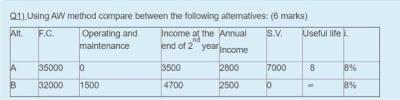 Q1) Using AW method compare between
the following alternatives: (6 marks) Alt. F.C. Operating and Income at
the Annual S.V. Useful life i. maintenance nd end of 2 year Income А
35000 0 3500 2800 7000 8 8% B 32000 1500 4700 2500 0 8%
Q1) Using AW method compare between
the following alternatives: (6 marks) Alt. F.C. Operating and Income at
the Annual S.V. Useful life i. maintenance nd end of 2 year Income А
35000 0 3500 2800 7000 8 8% B 32000 1500 4700 2500 0 8%
please help with question #12.24 without using excel. net present worth of this investment. Contributedby value,...
 please help with question #12.24 without using
excel.
net present worth of this investment. Contributedby value, and Assume unit 444 CHAPTER 12: INCOME TAXES FOR CORPORATIONS Mukasa Ssemakula, Wayne State University (b) Explain why the rate of return obtained in part (a) is different from the rate of return obtained in Problem 12-20. 12-25 A firm has invested $400.000 in car- ment. They will depreciate the r-washing equip equipment by 6% (a) Comput (b) Comput MACRS G MACRS, assuming a...
please help with question #12.24 without using
excel.
net present worth of this investment. Contributedby value, and Assume unit 444 CHAPTER 12: INCOME TAXES FOR CORPORATIONS Mukasa Ssemakula, Wayne State University (b) Explain why the rate of return obtained in part (a) is different from the rate of return obtained in Problem 12-20. 12-25 A firm has invested $400.000 in car- ment. They will depreciate the r-washing equip equipment by 6% (a) Comput (b) Comput MACRS G MACRS, assuming a...
 6. Compre the following alternatives using the Net Equivalent Uniform Annual Worth method. Alt. Construction cost $ Life (yrs) A $30million 40 B $35million Infinite
 The rate is 2.75%
5. Copmare the following 2 altrernatives using the Net Equivalent Uniform Annual method Alt. Construction cost $ Benefit ($/yr) Salvage $ Service Life (yrs) A 1,500,000 400,000 40,000 9 B 2,300,000 550,000 80,000 18
The rate is 2.75%
5. Copmare the following 2 altrernatives using the Net Equivalent Uniform Annual method Alt. Construction cost $ Benefit ($/yr) Salvage $ Service Life (yrs) A 1,500,000 400,000 40,000 9 B 2,300,000 550,000 80,000 18
 5. Compare the following two alternatives by the IRR method, given MARR of 8%/year. Is the incement in cost form A to B justified? Alt. Construction cost | Benefits Styr | Salvage Service Life (yrs 510,000 145,000 10,000 775,000 155,000 20,000
 3. Compare the two following two alternatives using an equivalent worth method and a MARR of 12%. The repeatability assumption is acceptable. Aternative I: Initial investment of $45,000, net revenue the first year of $8,000, increasing $4,000 per year for the six year useful life. Salvage value is estimated to be $6500. Alternative II: Initial investment of $60,000, uniform annual revenue of $12,000 for the five year useful life. Slavage value is estimated to be $9,000.
 Compare the two following alternatives in terms of present worth using MARRz 6% for a study period of 2 years Assume that the salvage value does not change depending on year sold. Alternative 1: First cost: 30,000 Yearly cost 6,000 Salvage value: 9,000 Lifetime: 4 Alternative 2 First cost: 75,000 Yearly cost 5,000 Salvage value: 13,000 Lifetime: 6 Alt 1: $-80,826, Alt 2: S-105,266 Alt 1: S-74,228, Alt 2: S-112,525 Alt 1 S-32,990, Alt 2: S-72,597 Alt 1: S-102,270, Alt...
 please help with question #12.24 without using
excel.
net present worth of this investment. Contributedby value, and Assume unit 444 CHAPTER 12: INCOME TAXES FOR CORPORATIONS Mukasa Ssemakula, Wayne State University (b) Explain why the rate of return obtained in part (a) is different from the rate of return obtained in Problem 12-20. 12-25 A firm has invested $400.000 in car- ment. They will depreciate the r-washing equip equipment by 6% (a) Comput (b) Comput MACRS G MACRS, assuming a...
please help with question #12.24 without using
excel.
net present worth of this investment. Contributedby value, and Assume unit 444 CHAPTER 12: INCOME TAXES FOR CORPORATIONS Mukasa Ssemakula, Wayne State University (b) Explain why the rate of return obtained in part (a) is different from the rate of return obtained in Problem 12-20. 12-25 A firm has invested $400.000 in car- ment. They will depreciate the r-washing equip equipment by 6% (a) Comput (b) Comput MACRS G MACRS, assuming a...
Most questions answered within 3 hours.
-
Where is the error in this code sequence?
String s1 = "Hello";
String s2 = "ello";...
asked 10 months ago -
Financial data for Joel de Paris, Inc., for last year
follow:
Joel de Paris, Inc.
Balance...
asked 10 months ago -
Consider this reaction:
Al2(SO4)3 (aq)+ BaCl3
(aq) Al2Cl6 (aq)- +
3BaSO4(s) . What is the...
asked 10 months ago -
Suppose that Savneet is considering increasing her
recent random sample from 20 car rentals to 40...
asked 10 months ago -
Trucks arrive at an unloading terminal at an average rate of 120
per hour.
Trucks arrive...
asked 10 months ago -
Why are methanol and ethanol completely soluble in water while
octanol is not very little soluble....
asked 10 months ago -
A facilities manager at a university reads in a research report
that the mean amount of...
asked 10 months ago -
When the CuSO4 is rehydrated by adding water to the anhydrous
compound, is this an endothermic...
asked 10 months ago -
A ray of sunlight is passing from diamond into crown glass; the
angle of incidence is...
asked 10 months ago -
A block of mass 0.249 kg is placed on top of a light, vertical
spring of...
asked 10 months ago -
how do the kidneys compensate in the presences of acidosis
a) trigger hyperventilate
b) reserve acid...
asked 10 months ago -
Question 501 pts
The rental rate of capital to the firm increases. Which of the
following...
asked 10 months ago