Treatment of cyclopentane-1,3-dione with a base followed by addition of methyl iodide affords a mixtures of...
Treatment of cyclopentane-1,3-dione with a base followed by addition of methyl iodide affords a mixtures of 2-methylcyclopentane-1,3-dione, 2,2-dimethylcyclopentane-1,3-dione and 3-methoxy-2-cyclopenten-1-one. Explain with the aid of a mechanism how each product is formed.
Homework Answers

Add Answer to:
Treatment of cyclopentane-1,3-dione with a base
followed by addition of methyl iodide affords a mixtures of...
3. Attempt to directly alkylate the following compound by treatment with one equivalent of LDA and...
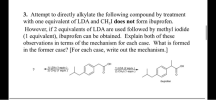 3. Attempt to directly alkylate the following compound by treatment with one equivalent of LDA and CH I does not form ibuprofen. However, if 2 equivalents of LDA are used followed by methyl iodide (1 equivalent), ibuprofen can be obtained. Explain both of these observations in terms of the mechanism for each case. What is formed in the former case? [For each case, write out the mechanism.] ? 2 CH 1 egun.) DLDA 2 equiv.) 2) CH1 (1 equiv.) ibuprofen
QUESTION 4 [1,2- versus 1,4-Addition Reactions] 4.1 Propose a detailed mechanism for the reaction of 2-butenal...
 QUESTION 4 [1,2- versus 1,4-Addition Reactions] 4.1 Propose a detailed mechanism for the reaction of 2-butenal with ethynylmagnesium bromide in dry THF followed by quenching with dilute aqueous acid. (5) 4.2 Propose a plausible mechanism for the reaction of 1,3-diphenyl-2-propen-1- one with potassium cyanide in ethanol followed by aqueous work-up. 1 (5) 4.3 Predict and draw the structure of the product of the reaction of 2-methyl-1,3- cyclohexanedione with methyl vinyl ketone (3-buten-2-one) in methanol in the presence of potassium hydroxide....
Treatment of phenyl 3-oxo-3-phenyl propanoate with sodium ethoxide (in ethanol) followed by the addition of a...
Treatment of phenyl 3-oxo-3-phenyl propanoate with sodium ethoxide (in ethanol) followed by the addition of a molar equivalent of allyl bromide should yield which organic compound as the major product? a. phenyl 2-allyl-3-oxo-3-phenylpropanoate b. benzyl 2-allyl-3-oxo-3-phenylpropanoate c. phenyl 2-methyl-3-oxo-3-phenylpropanoate d. phenyl 2-allyl-3-oxo-3-phenylpropanone e. phenyl 2-allyl-3-oxo-3-phenylpentanoate
Predict the structure of the major product formed by 1, 2-addition of HCI to 2-methyl-1, 3-butadiene...
 Predict the structure of the major product formed by 1, 2-addition of HCI to 2-methyl-1, 3-butadiene (isoprene). Predict the major product formed by 1, 4-addition of HCI to isoprene. Predict the structure of the major 1, 2-addition product formed by reaction of one mole of Br_2 with isoprene. Also predict the structure of the major 1, 4-addition product formed under these conditions. Which of the two molecules shown do you expect to be the major product formed by 1, 2-addition...
(C) Protonation of alkene to form a carbocation followed by addition of bromide ion (D) Addition...
 (C) Protonation of alkene to form a carbocation followed by addition of bromide ion (D) Addition of the proton to one face of the alkene with simultaneous delivery of a bromide ion from a different molecule of H-Br. 11. Which compound is the strongest nmucleophile for reaction of methane methanesulfonate (CHOS0.CH) in methanol at room temperature? (You may assume that everything is soluble in methanol) (A) potassium bromide (B) cesium iodide (C) sodiam chloride (D) lithium flaoride 12. Which proton...
need help with part c and d L euly butane 2-chloro-2-methylbutane 2-chloro-3-methylbutane 2-chlorobutane c) Draw a...
 need help with part c and d
L euly butane 2-chloro-2-methylbutane 2-chloro-3-methylbutane 2-chlorobutane c) Draw a curved-arrow mechanism for the following reaction: - H2O Hạº, d) Label the following reactions as S1, S2, E1, E2, addition, or acid/base (2 pts, cach). i. Bromoethane becomes ethanol upon treatment with hydroxide ion. ii. 1-Methyl-1-cyclohexanol reacts with acid in water to form l-methylcyclohexene. iii. Propyne becomes propane in the presence of hydrogen and metal catalyst. iv. I-iodopropane reacts with potassium tert-butoxide. SN e)...
need help with part c and d
L euly butane 2-chloro-2-methylbutane 2-chloro-3-methylbutane 2-chlorobutane c) Draw a curved-arrow mechanism for the following reaction: - H2O Hạº, d) Label the following reactions as S1, S2, E1, E2, addition, or acid/base (2 pts, cach). i. Bromoethane becomes ethanol upon treatment with hydroxide ion. ii. 1-Methyl-1-cyclohexanol reacts with acid in water to form l-methylcyclohexene. iii. Propyne becomes propane in the presence of hydrogen and metal catalyst. iv. I-iodopropane reacts with potassium tert-butoxide. SN e)...
B3: The following optically active oone optically active, one with no optical ac alkene, upon hydrogeraito explain this observation. n, yields two 4 pts H2 2 different products Pd/C CH3 B4: 1,3-...
 B3: The following optically active oone optically active, one with no optical ac alkene, upon hydrogeraito explain this observation. n, yields two 4 pts H2 2 different products Pd/C CH3 B4: 1,3-butadiene, when treated with HBr, gives a mix of two product neither of which is 4-bromobut-1-ene. Predict both these products using mechanism that involves a single carbocation intermediate: 4 4-bromobut-1-ene Anot formed! HBr C5: Terminal alkynes are moderately acidic synthetically. When pent-1-yne is treated with a strong base [sodium...
Alkyl Bromide Alkyl Bromide Classification Base Base Classification | % Reaction | % 1-Substituted | %...
 Alkyl Bromide Alkyl Bromide Classification Base Base Classification | % Reaction | % 1-Substituted | % 2-Substituted Yield Alkene Alkene Alkene 90 1.0 M The data above is from a paper published in 1956 in a chemistry journal. Answer the following questions based on the data: 1. Draw the mechanism to show how each alkene product is formed from the alkyl bromide and the base. 2. What does Zaitsev's rule say about double-bonds that are formed in an elimination reaction?...
Question 3. Predict the major products of the reactions below. Draw the full mechanism for the...
 Question 3. Predict the major products of the reactions below. Draw the full mechanism for the reactions, using appropriate arrows to indicate electron movement and the full structures of any intermediate(s). Use the mechanism of the reaction to provide a rationale for why the major product formed. OM (1 equivalent) ansole Bry Febr (1 culle brambenzone Fer (1 equivalent Priloromethylbenzene (9 marks) Question 4. Predict the major product from the treatment of 2,5-dibromopyridine with ammonia. Draw the full mechanism for...
Acid Catalyzed Hydration-treatment of alkenes with water in the presence of acid catalyst leads to the...
 Acid Catalyzed Hydration-treatment of alkenes with water in the presence of acid catalyst leads to the formation of alcohols. H2SO4/H2O > 150°C Mechanism Major Product Acid catalyzed dehydration goes through a carbocation intermediate. This means that the Markovnikov product is obtained when carbocation rearrangements do not occur. The need for excessively high temperatures makes this reaction of limited use in laboratory synthesis. Oxymercuration - Oxymercuration involves the addition of Hg to the alkene using mercury (II) acetate Hg(OAc) followed by...
 3. Attempt to directly alkylate the following compound by treatment with one equivalent of LDA and CH I does not form ibuprofen. However, if 2 equivalents of LDA are used followed by methyl iodide (1 equivalent), ibuprofen can be obtained. Explain both of these observations in terms of the mechanism for each case. What is formed in the former case? [For each case, write out the mechanism.] ? 2 CH 1 egun.) DLDA 2 equiv.) 2) CH1 (1 equiv.) ibuprofen
 QUESTION 4 [1,2- versus 1,4-Addition Reactions] 4.1 Propose a detailed mechanism for the reaction of 2-butenal with ethynylmagnesium bromide in dry THF followed by quenching with dilute aqueous acid. (5) 4.2 Propose a plausible mechanism for the reaction of 1,3-diphenyl-2-propen-1- one with potassium cyanide in ethanol followed by aqueous work-up. 1 (5) 4.3 Predict and draw the structure of the product of the reaction of 2-methyl-1,3- cyclohexanedione with methyl vinyl ketone (3-buten-2-one) in methanol in the presence of potassium hydroxide....
 Predict the structure of the major product formed by 1, 2-addition of HCI to 2-methyl-1, 3-butadiene (isoprene). Predict the major product formed by 1, 4-addition of HCI to isoprene. Predict the structure of the major 1, 2-addition product formed by reaction of one mole of Br_2 with isoprene. Also predict the structure of the major 1, 4-addition product formed under these conditions. Which of the two molecules shown do you expect to be the major product formed by 1, 2-addition...
 (C) Protonation of alkene to form a carbocation followed by addition of bromide ion (D) Addition of the proton to one face of the alkene with simultaneous delivery of a bromide ion from a different molecule of H-Br. 11. Which compound is the strongest nmucleophile for reaction of methane methanesulfonate (CHOS0.CH) in methanol at room temperature? (You may assume that everything is soluble in methanol) (A) potassium bromide (B) cesium iodide (C) sodiam chloride (D) lithium flaoride 12. Which proton...
 need help with part c and d
L euly butane 2-chloro-2-methylbutane 2-chloro-3-methylbutane 2-chlorobutane c) Draw a curved-arrow mechanism for the following reaction: - H2O Hạº, d) Label the following reactions as S1, S2, E1, E2, addition, or acid/base (2 pts, cach). i. Bromoethane becomes ethanol upon treatment with hydroxide ion. ii. 1-Methyl-1-cyclohexanol reacts with acid in water to form l-methylcyclohexene. iii. Propyne becomes propane in the presence of hydrogen and metal catalyst. iv. I-iodopropane reacts with potassium tert-butoxide. SN e)...
need help with part c and d
L euly butane 2-chloro-2-methylbutane 2-chloro-3-methylbutane 2-chlorobutane c) Draw a curved-arrow mechanism for the following reaction: - H2O Hạº, d) Label the following reactions as S1, S2, E1, E2, addition, or acid/base (2 pts, cach). i. Bromoethane becomes ethanol upon treatment with hydroxide ion. ii. 1-Methyl-1-cyclohexanol reacts with acid in water to form l-methylcyclohexene. iii. Propyne becomes propane in the presence of hydrogen and metal catalyst. iv. I-iodopropane reacts with potassium tert-butoxide. SN e)...
 B3: The following optically active oone optically active, one with no optical ac alkene, upon hydrogeraito explain this observation. n, yields two 4 pts H2 2 different products Pd/C CH3 B4: 1,3-butadiene, when treated with HBr, gives a mix of two product neither of which is 4-bromobut-1-ene. Predict both these products using mechanism that involves a single carbocation intermediate: 4 4-bromobut-1-ene Anot formed! HBr C5: Terminal alkynes are moderately acidic synthetically. When pent-1-yne is treated with a strong base [sodium...
 Alkyl Bromide Alkyl Bromide Classification Base Base Classification | % Reaction | % 1-Substituted | % 2-Substituted Yield Alkene Alkene Alkene 90 1.0 M The data above is from a paper published in 1956 in a chemistry journal. Answer the following questions based on the data: 1. Draw the mechanism to show how each alkene product is formed from the alkyl bromide and the base. 2. What does Zaitsev's rule say about double-bonds that are formed in an elimination reaction?...
 Question 3. Predict the major products of the reactions below. Draw the full mechanism for the reactions, using appropriate arrows to indicate electron movement and the full structures of any intermediate(s). Use the mechanism of the reaction to provide a rationale for why the major product formed. OM (1 equivalent) ansole Bry Febr (1 culle brambenzone Fer (1 equivalent Priloromethylbenzene (9 marks) Question 4. Predict the major product from the treatment of 2,5-dibromopyridine with ammonia. Draw the full mechanism for...
 Acid Catalyzed Hydration-treatment of alkenes with water in the presence of acid catalyst leads to the formation of alcohols. H2SO4/H2O > 150°C Mechanism Major Product Acid catalyzed dehydration goes through a carbocation intermediate. This means that the Markovnikov product is obtained when carbocation rearrangements do not occur. The need for excessively high temperatures makes this reaction of limited use in laboratory synthesis. Oxymercuration - Oxymercuration involves the addition of Hg to the alkene using mercury (II) acetate Hg(OAc) followed by...
Most questions answered within 3 hours.
-
Where is the error in this code sequence?
String s1 = "Hello";
String s2 = "ello";...
asked 10 months ago -
Financial data for Joel de Paris, Inc., for last year
follow:
Joel de Paris, Inc.
Balance...
asked 10 months ago -
Consider this reaction:
Al2(SO4)3 (aq)+ BaCl3
(aq) Al2Cl6 (aq)- +
3BaSO4(s) . What is the...
asked 10 months ago -
Suppose that Savneet is considering increasing her
recent random sample from 20 car rentals to 40...
asked 10 months ago -
Trucks arrive at an unloading terminal at an average rate of 120
per hour.
Trucks arrive...
asked 10 months ago -
Why are methanol and ethanol completely soluble in water while
octanol is not very little soluble....
asked 10 months ago -
A facilities manager at a university reads in a research report
that the mean amount of...
asked 10 months ago -
When the CuSO4 is rehydrated by adding water to the anhydrous
compound, is this an endothermic...
asked 10 months ago -
A ray of sunlight is passing from diamond into crown glass; the
angle of incidence is...
asked 10 months ago -
A block of mass 0.249 kg is placed on top of a light, vertical
spring of...
asked 10 months ago -
how do the kidneys compensate in the presences of acidosis
a) trigger hyperventilate
b) reserve acid...
asked 10 months ago -
Question 501 pts
The rental rate of capital to the firm increases. Which of the
following...
asked 10 months ago