What kind of process does the air in the piston-cylinder apparatus undergo during the process? Irreversible...
What kind of process does the air in the piston-cylinder apparatus undergo during the process?
|
Irreversible adiabatic |
||
|
Reversible isochoric |
||
|
Reversible adiabatic |
||
|
Reversible isothermal |
||
|
Irreversible isobaric |
||
|
Reversible isobaric |
Homework Answers
Air in the piston cylinder apparatus undergo a reversible isothermal process. Which means that the temperature is constant during the process
Add Answer to:
What kind of process does the air in the piston-cylinder
apparatus undergo during the process?
Irreversible...
Air in a piston-cylinder undergoes a cycle with the following processes: Process 1-2: Isobaric process from...
 Air in a piston-cylinder undergoes a cycle with the following processes: Process 1-2: Isobaric process from P = 0.1 MPa, T1 = 600K to T2 = 1200K Process 2-3: Isothermal process to state 3 where P3 = 0.05 MPa Process 3-4: Isochoric process to state 4 where P4 = 0.031 MPa Process 4-1: Polytropic process back to state 1 (a) Show the processes in a P-V plot showing the values. Also calculate or state the values of P. V. T...
Air is being compressed in a piston-cylinder device in a reversible and adiabatic manner. During the...
Air is being compressed in a piston-cylinder device in a reversible and adiabatic manner. During the process both the temperature and pressure of the gas increase, while the volume is decreasing. If the initial volume and temperature of the air are 3 m3 and 13 °C, respectively, and the final volume is measured to be 0.3 m3, the final temperature of the air is
An internally reversible, externally irreversible process Ammonia in a piston-cylinder that maintains constant P is at...
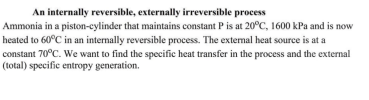 An internally reversible, externally irreversible process Ammonia in a piston-cylinder that maintains constant P is at 20°C, 1600 kPa and is now heated to 60°C in an internally reversible process. The external heat source is at a constant 70°C. We want to find the specific heat transfer in the process and the external (total) specific entropy generation.
Answer Description The Carnot cycle attempts to model the most efficient possible process by avoiding what?...
 Answer Description The Carnot cycle attempts to model the most efficient possible process by avoiding what? 1. Adiabatic processes 2. Isothermal processes 3. Irreversible processes 4. Reversible processes For the Carnot cycle, in what type of process is heat added or removed? 1. Adiabatic 2. Isobaric 3. Isochoric 4. Isothermal Which statement is true? 1. n carnot < nactual 2. n Carnot = nactual 3. n carnot > nactual D. A heat engine takes from heat from a reservoir at...
NGINEERI 13. A centrifugal compressor (not a piston type) compresses the air from the ambient condition at T, 300K and Pi 1 bar to P 10 bar following three different, standalone paths: isentropic,...
 NGINEERI 13. A centrifugal compressor (not a piston type) compresses the air from the ambient condition at T, 300K and Pi 1 bar to P 10 bar following three different, standalone paths: isentropic, reversible isothermal, and an irreversible adiabatic process, respectively. (Note: These processes are not sequential processes; rather each of them is an independent, standalone p They all start at the same initial condition at state 1, but they end at different state 2.) The mass flow rate is...
Please help 6. How does the First Law apply to weight gain? . What is an...
 Please help
6. How does the First Law apply to weight gain? . What is an irreversible process? 8. Define heat engine 9. Sketch Fig. 15.7 10. Given a plot of pressure vs. volume for a thermodynamic process, how do you find the work done? 11. (T/F) For a thermodynamic process, work and heat are independent of path 12. Define isobaric, isochoric, isothermal, and adiabatic
Please help
6. How does the First Law apply to weight gain? . What is an irreversible process? 8. Define heat engine 9. Sketch Fig. 15.7 10. Given a plot of pressure vs. volume for a thermodynamic process, how do you find the work done? 11. (T/F) For a thermodynamic process, work and heat are independent of path 12. Define isobaric, isochoric, isothermal, and adiabatic
Ulston cylinder device contains a liquid-vapor xture at 300K. During a constant pressure added to water....
 Ulston cylinder device contains a liquid-vapor xture at 300K. During a constant pressure added to water. As a result some of the liquid vaporizes. the entropy change? ure process. 750 kJ of heat is What is b.4 kJ/K c. 2.5 kJ/k d. 0.4 kJ/K 14. In which of the following processes does entropy change? a. Reversible adiabatic b. Isentropic Process procesS c. Internally reversible d. Constant-pressure expansion process process through a real turbine 15. A piston cylinder device contains superheated...
three kg of gas in a piston-cylinder assembly undergo a process during the relationship between pressure...
three kg of gas in a piston-cylinder assembly undergo a process during the relationship between pressure and specific volume is pv^0.5=constant. the process begins with p1=250kPa and V1=1.5m^3 and ends with p2=100kPa. determine the final specific volume,in m^3/kg. Plot the process on a graph of pressure versus specific volume.
Consider a cylinder with a piston, the region below the piston is filled with a gas....
 Consider a cylinder with a piston, the region below the piston is filled with a gas. The piston has area of .012m^2, the gas has volume 0015 m. and pressure of 1.02 x10 Pa, cylinder is in contact with water bath at 0 degree C (Step 1) Step 2: Next the piston is compressed by a metal block of 2.5 kg and gas is maintained at o degree C. In step 3 cylinder is placed in contact with boiling water...
Two mole of ideal gas, is compressed adiabatically in a piston/cylinder device from 2 bar and...
Two mole of ideal gas, is compressed adiabatically in a piston/cylinder device from 2 bar and 25oC to 7 bar. The process is irreversible and requires 25% more work than a reversible, adiabatic compression from the same initial state to the same final pressure. What is the entropy change of the gas? Assume Cv=(5/2)R in this calculation.
 Air in a piston-cylinder undergoes a cycle with the following processes: Process 1-2: Isobaric process from P = 0.1 MPa, T1 = 600K to T2 = 1200K Process 2-3: Isothermal process to state 3 where P3 = 0.05 MPa Process 3-4: Isochoric process to state 4 where P4 = 0.031 MPa Process 4-1: Polytropic process back to state 1 (a) Show the processes in a P-V plot showing the values. Also calculate or state the values of P. V. T...
 An internally reversible, externally irreversible process Ammonia in a piston-cylinder that maintains constant P is at 20°C, 1600 kPa and is now heated to 60°C in an internally reversible process. The external heat source is at a constant 70°C. We want to find the specific heat transfer in the process and the external (total) specific entropy generation.
 Answer Description The Carnot cycle attempts to model the most efficient possible process by avoiding what? 1. Adiabatic processes 2. Isothermal processes 3. Irreversible processes 4. Reversible processes For the Carnot cycle, in what type of process is heat added or removed? 1. Adiabatic 2. Isobaric 3. Isochoric 4. Isothermal Which statement is true? 1. n carnot < nactual 2. n Carnot = nactual 3. n carnot > nactual D. A heat engine takes from heat from a reservoir at...
 NGINEERI 13. A centrifugal compressor (not a piston type) compresses the air from the ambient condition at T, 300K and Pi 1 bar to P 10 bar following three different, standalone paths: isentropic, reversible isothermal, and an irreversible adiabatic process, respectively. (Note: These processes are not sequential processes; rather each of them is an independent, standalone p They all start at the same initial condition at state 1, but they end at different state 2.) The mass flow rate is...
 Please help
6. How does the First Law apply to weight gain? . What is an irreversible process? 8. Define heat engine 9. Sketch Fig. 15.7 10. Given a plot of pressure vs. volume for a thermodynamic process, how do you find the work done? 11. (T/F) For a thermodynamic process, work and heat are independent of path 12. Define isobaric, isochoric, isothermal, and adiabatic
Please help
6. How does the First Law apply to weight gain? . What is an irreversible process? 8. Define heat engine 9. Sketch Fig. 15.7 10. Given a plot of pressure vs. volume for a thermodynamic process, how do you find the work done? 11. (T/F) For a thermodynamic process, work and heat are independent of path 12. Define isobaric, isochoric, isothermal, and adiabatic
 Ulston cylinder device contains a liquid-vapor xture at 300K. During a constant pressure added to water. As a result some of the liquid vaporizes. the entropy change? ure process. 750 kJ of heat is What is b.4 kJ/K c. 2.5 kJ/k d. 0.4 kJ/K 14. In which of the following processes does entropy change? a. Reversible adiabatic b. Isentropic Process procesS c. Internally reversible d. Constant-pressure expansion process process through a real turbine 15. A piston cylinder device contains superheated...
 Consider a cylinder with a piston, the region below the piston is filled with a gas. The piston has area of .012m^2, the gas has volume 0015 m. and pressure of 1.02 x10 Pa, cylinder is in contact with water bath at 0 degree C (Step 1) Step 2: Next the piston is compressed by a metal block of 2.5 kg and gas is maintained at o degree C. In step 3 cylinder is placed in contact with boiling water...
Most questions answered within 3 hours.
-
Where is the error in this code sequence?
String s1 = "Hello";
String s2 = "ello";...
asked 10 months ago -
Financial data for Joel de Paris, Inc., for last year
follow:
Joel de Paris, Inc.
Balance...
asked 10 months ago -
Consider this reaction:
Al2(SO4)3 (aq)+ BaCl3
(aq) Al2Cl6 (aq)- +
3BaSO4(s) . What is the...
asked 10 months ago -
Suppose that Savneet is considering increasing her
recent random sample from 20 car rentals to 40...
asked 10 months ago -
Trucks arrive at an unloading terminal at an average rate of 120
per hour.
Trucks arrive...
asked 10 months ago -
Why are methanol and ethanol completely soluble in water while
octanol is not very little soluble....
asked 10 months ago -
A facilities manager at a university reads in a research report
that the mean amount of...
asked 10 months ago -
When the CuSO4 is rehydrated by adding water to the anhydrous
compound, is this an endothermic...
asked 10 months ago -
A ray of sunlight is passing from diamond into crown glass; the
angle of incidence is...
asked 10 months ago -
A block of mass 0.249 kg is placed on top of a light, vertical
spring of...
asked 10 months ago -
how do the kidneys compensate in the presences of acidosis
a) trigger hyperventilate
b) reserve acid...
asked 10 months ago -
Question 501 pts
The rental rate of capital to the firm increases. Which of the
following...
asked 10 months ago