Explain, using the AD-AS diagram, how wage rigidity may prevent real output to return its natural...
Explain, using the AD-AS diagram, how wage rigidity may prevent real output to return its natural level in the event of an aggregate demand shock in the short-run but real output will eventually reach its natural level as long as the price level is perfectly flexible.
Homework Answers
Ans
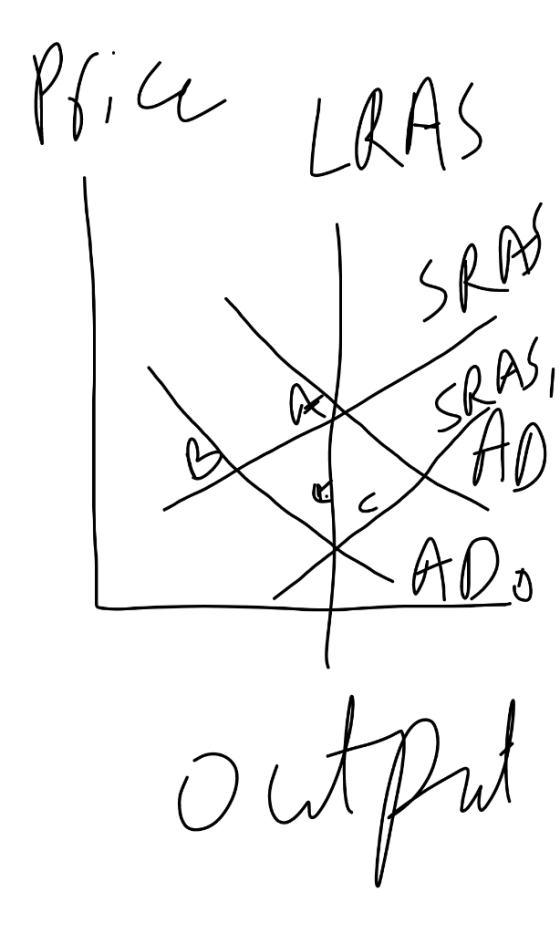
Initially the economy is in equilbrium at A where LRAS=SRAS=AD. However Aggregate demand shock shifts AD to ADo. Short run equilbrium is at B. Here actual output is less than potential output. Here we have unemployment of resources and labour. This should have decreased wages so that Aggregate supply shifts rightwards and full employment output is restored. But this doesn't happen die to wage rigidity
However in longrun wages will fall since in longrun wage contracts are revised. Note Keynesians streesed shortrun phenomena but this happens in longrun. Even otherwise since other resources are underemployed here there prices will fall which will shift AD rightwards. As a result of price flexibility short run Aggregate supply shifts to SRAS1. New equilbrium is at C where full employment output is restored
Add Answer to:
Explain, using the AD-AS diagram, how wage rigidity may prevent
real output to return its natural...
Suppose real output is initially at its full employment level. Using Aggregate Demand (AD)—Aggregate Supply (AS) framework, discuss the short-run and long-run effects of a decrease in government expe...
Suppose real output is initially at its full employment level. Using Aggregate Demand (AD)—Aggregate Supply (AS) framework, discuss the short-run and long-run effects of a decrease in government expenditure on the price level, real output, nominal wage rate and real wage rate under the following three alternative assumptions: nominal wages are fully flexible nominal wages are relatively slow to adjust nominal wages are completely rigid.
1. The diagram below shows an AD/AS model for a hypothetical economy. The economy begins in...
 1. The diagram below shows an AD/AS model for a hypothetical economy. The economy begins in long-run equilibrium at point A. Price Level - AD, -t-AD₂ 1250 700 800 900 1000 Real GDP C. Describe a plausible economic event (ie. Shock) that could have shifted the AD curve from AD1 to AD2? D. Please describe the adjustment process that would return the economy to its long-run equilibrium following the negative aggregate demand shock shown in the diagram.
Which of the following statements best describes how economic growth is represented i n the AD/AS...
Which of the following statements best describes how economic growth is represented i n the AD/AS diagram? In the AD/AS diagram, long-run economic growth due to productivity increases over time will be represented by a gradual shift to the right of aggregate supply. In the AD/AS diagram, short-run economic growth due to productivity increases over time will be represented by a dramatic shift to the right of aggregate supply. In the AD/AS diagram, short-run economic growth due to productivity increases...
1. Aggregate demand curve of an economy is given by AD = 51 - 0.2P, the...
1. Aggregate demand curve of an economy is given by AD = 51 - 0.2P, the long-run aggregate supply, LRAS, is 30 and the short-run aggregate supply is given by SRAS = 0.3 P (all output measures are in US$ billions and the price level is given as an index number). What could be the unemployment rate if the natural rate of unemployment is 4%? 2. Aggregate demand curve of an economy is given by AD = 51 - 0.2P,...
Suppose that workers and firms perfectly forecast inflation, so that the real wage remains unchanged as...
 Suppose that workers and firms perfectly forecast inflation, so that the real wage remains unchanged as the price level rises over time. Prices and wages rise at the same rate, which implies that the real wage stays constant. The following graph shows the aggregate demand curve (AD) in an economy in long-run equilibrium. Assume the natural rate of unemployment is 6%, and potential output is $50 trillion. Use the orange points (square symbol) to draw the aggregate supply curve in...
Assume that the real long-run output of RenduJ Island is 3,000, while current price level is...
Assume that the real long-run output of RenduJ Island is 3,000, while current price level is at P = 1.0. Suppose that the aggregate demand curve is given by Y = 3(M/P) and M = 1,000. Show that the RenduJ economy is (or is not) at its long-run equilibrium. Now suppose a supply shock moves the short-run aggregate price level to P = 1.5. What are the new short-run P and Y? If the aggregate demand curve and long-run aggregate...
Assume that the real long-run output of RenduJ Island is 3,000, while current price level is...
Assume that the real long-run output of RenduJ Island is 3,000, while current price level is at P = 1.0. Suppose that the aggregate demand curve is given by Y = 3(M/P) and M = 1,000. Show that the RenduJ economy is (or is not) at its long-run equilibrium. Now suppose a supply shock moves the short-run aggregate price level to P = 1.5. What are the new short-run P and Y? If the aggregate demand curve and long-run aggregate...
Long run aggregate supply is the relationship between the quantity of real GDP supplied and the...
 Long run aggregate supply is the relationship between the quantity of real GDP supplied and the price level when the maintain full employment changes in step with the price level to O A. money wage rate OB. quantity of money OC. real wage rate OD. interest rate supplied and the when the money wage rate, the prices of other resources and Short run aggregate supply is the relationship between the quantity of potential GDP remain constant O A real GDP...
Consider the aggregate demand – aggregate supply (AD-AS) model. Assume the economy is initially at its...
Consider the aggregate demand – aggregate supply (AD-AS) model. Assume the economy is initially at its long-run equilibrium. Produce a new graph, draw the aggregated demand curve, short-run aggregate supply curve, and the long-run aggregate supply curve and label the curves. Label both the horizonal and vertical axes clearly. Label the long-run equilibrium as A and its corresponding output level as Y1 Now assume a positive supply shock hits the economy. In the graph, show the short-run effects of this...
Using the aggregate demand (AD), the short-run aggregate supply (SRAS), and the long-run aggregate supply (LRAS)...
Using the aggregate demand (AD), the short-run aggregate supply (SRAS), and the long-run aggregate supply (LRAS) curves, briefly explain how an open market purchase will affect the equilibrium price level (P) and real output (Y) in the short run. Assume the economy is initially in a recession?
 1. The diagram below shows an AD/AS model for a hypothetical economy. The economy begins in long-run equilibrium at point A. Price Level - AD, -t-AD₂ 1250 700 800 900 1000 Real GDP C. Describe a plausible economic event (ie. Shock) that could have shifted the AD curve from AD1 to AD2? D. Please describe the adjustment process that would return the economy to its long-run equilibrium following the negative aggregate demand shock shown in the diagram.
 Suppose that workers and firms perfectly forecast inflation, so that the real wage remains unchanged as the price level rises over time. Prices and wages rise at the same rate, which implies that the real wage stays constant. The following graph shows the aggregate demand curve (AD) in an economy in long-run equilibrium. Assume the natural rate of unemployment is 6%, and potential output is $50 trillion. Use the orange points (square symbol) to draw the aggregate supply curve in...
 Long run aggregate supply is the relationship between the quantity of real GDP supplied and the price level when the maintain full employment changes in step with the price level to O A. money wage rate OB. quantity of money OC. real wage rate OD. interest rate supplied and the when the money wage rate, the prices of other resources and Short run aggregate supply is the relationship between the quantity of potential GDP remain constant O A real GDP...
Most questions answered within 3 hours.
-
Where is the error in this code sequence?
String s1 = "Hello";
String s2 = "ello";...
asked 10 months ago -
Financial data for Joel de Paris, Inc., for last year
follow:
Joel de Paris, Inc.
Balance...
asked 10 months ago -
Consider this reaction:
Al2(SO4)3 (aq)+ BaCl3
(aq) Al2Cl6 (aq)- +
3BaSO4(s) . What is the...
asked 10 months ago -
Suppose that Savneet is considering increasing her
recent random sample from 20 car rentals to 40...
asked 10 months ago -
Trucks arrive at an unloading terminal at an average rate of 120
per hour.
Trucks arrive...
asked 10 months ago -
Why are methanol and ethanol completely soluble in water while
octanol is not very little soluble....
asked 10 months ago -
A facilities manager at a university reads in a research report
that the mean amount of...
asked 10 months ago -
When the CuSO4 is rehydrated by adding water to the anhydrous
compound, is this an endothermic...
asked 10 months ago -
A ray of sunlight is passing from diamond into crown glass; the
angle of incidence is...
asked 10 months ago -
A block of mass 0.249 kg is placed on top of a light, vertical
spring of...
asked 10 months ago -
how do the kidneys compensate in the presences of acidosis
a) trigger hyperventilate
b) reserve acid...
asked 10 months ago -
Question 501 pts
The rental rate of capital to the firm increases. Which of the
following...
asked 10 months ago